President Thomas S. Monson, “Charity Never Faileth” (2010)
Charity as the opposite of criticism and judging, with stories of looking past appearances.3
Read the talk →Scripture Story Sketch Notes · 1 Corinthians 13
“Charity suffereth long, and is kind.” 1 Corinthians 13:4
Tongues, prophecy, faith to move mountains: Paul says none of it matters without charity. Then he shows what charity looks like, and whose love it is.
Before you begin
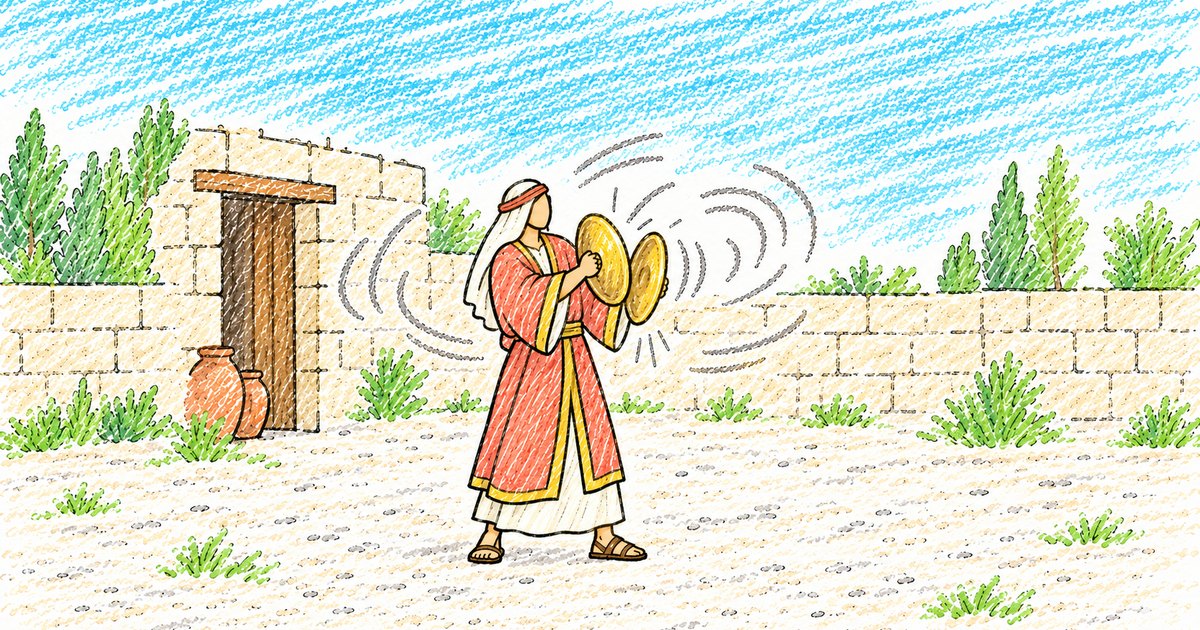
The Saints in Corinth were proud of their spiritual gifts and were comparing them. Paul answered with one of the most famous chapters in the Bible. Speaking with the tongues of angels, prophesying, knowing all mysteries, having faith to move mountains, even giving everything away: without charity, he said, “I am nothing.”
Then he described what charity is: it “suffereth long, and is kind,” it “envieth not,” it “is not easily provoked,” and it “beareth all things, believeth all things, hopeth all things, endureth all things.” Prophecy, tongues and knowledge will end, and now “we see through a glass, darkly.” But “charity never faileth.” Faith, hope and charity remain, “but the greatest of these is charity.” The Book of Mormon names it plainly: “charity is the pure love of Christ.”
Corinth, a Greek city famous for its bronze work, including mirrors.
Watch how every line about charity also describes the Savior.
Read it yourself: 1 Corinthians 13
Part 1 of 7
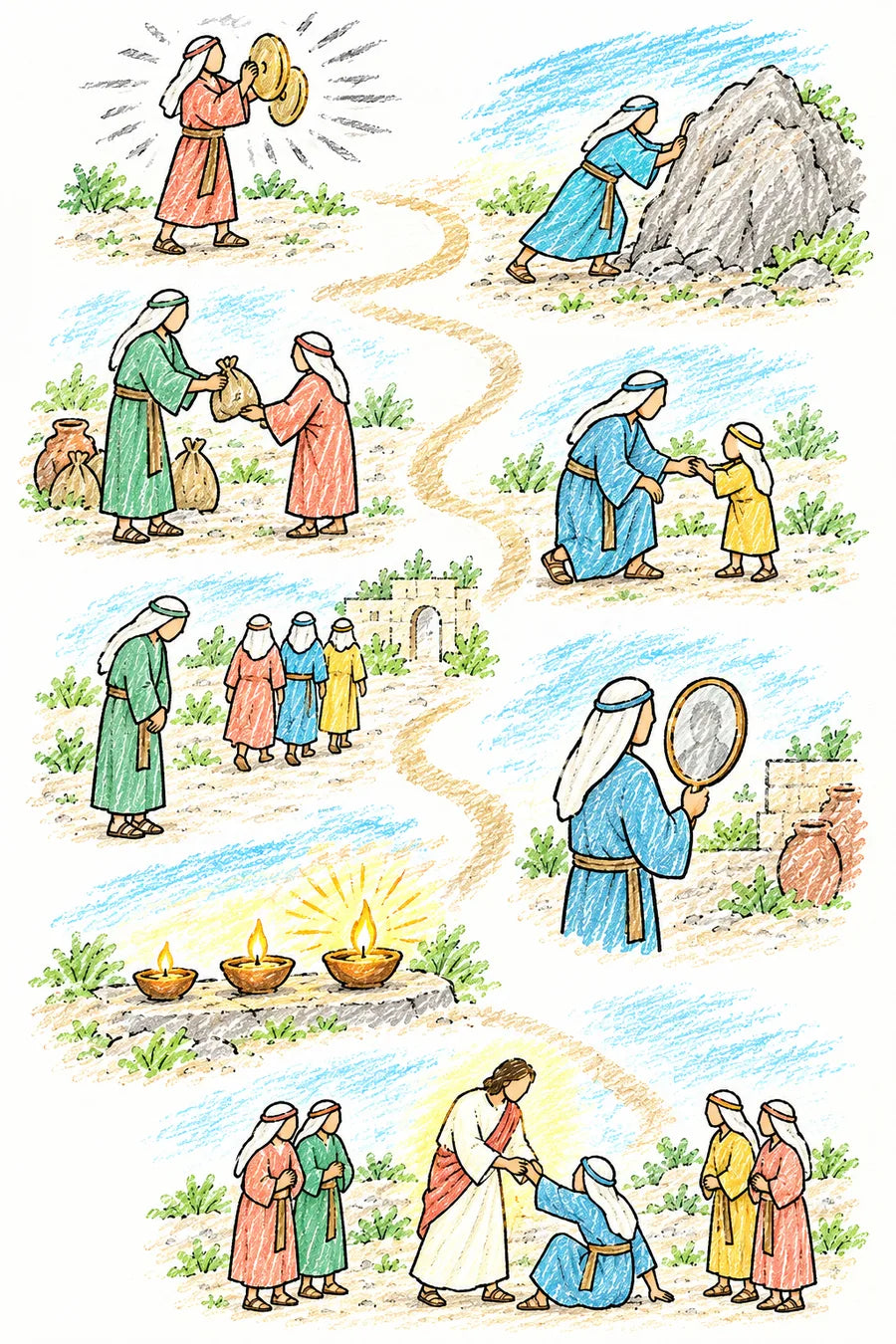
Eight stops from a lonely cymbal to the pure love of Christ. Scroll, or tap a number on the map.
Part 2 of 7
Four scenes: the cymbal, the kindness, the mirror and the love that never fails. Look for the Savior in each one.
Read it plainly
Tap any dotted word for its meaning. The scripture stays exactly as written.1
Part 3 of 7
Small details tell the story. Some cards are details in the text; others share insights from prophets or Church resources. Each card says which.
All nine. The cymbal, the mountain, the basket, the hourglass, the heart, the mirror, the child, the three lamps and the flame. 1 Corinthians 13
Part 4 of 7
Running out of patience, comparing, keeping score, or praying for more love. Which feels most like you right now?
A next step for you
Your choice is saved only on this device.
Try it
Paul described charity by what it does and what it never does. Read each word and decide: is it charity, or not?
“Charity suffereth long, and is kind.” 1 Corinthians 13:4
Part 5 of 7
A little background helps us hear Paul’s words the way the Corinthians did. Outside sources are labeled.
Elder Joseph B. Wirthlin: Paul’s message “was simple and direct: Nothing you do makes much of a difference if you do not have charity.”4
The Saints were proud of their gifts.
“Polished metal mirrors were used in the ancient world.”5
Corinth was famous for its bronze.
“Charity never ends; thus, it stands in contrast to even the wonderful gifts of prophecy, tongues, and knowledge, which Paul said would end.”5
Gifts are for now. Love is forever.
“Charity is the pure love of Christ, and it endureth forever.”2
The same truth, on another continent.
Word study · Greek
agapē ἀγάπη · “charity” (1 Corinthians 13:1)
Word study · Greek
makrothumeō μακροθυμέω · “suffereth long” (1 Corinthians 13:4)
Word study · Greek
esoptron ἔσοπτρον · “glass” (1 Corinthians 13:12)
What the text does not say
The story does not say we must already have perfect charity. Mormon tells us to “pray unto the Father with all the energy of heart, that ye may be filled with this love.” It is a gift we ask for.2
Part 6 of 7
True charity is His love. Every line of 1 Corinthians 13 describes Jesus Christ.
Paul’s answer: “The greatest of these is charity.”
1 Corinthians 13:131“True charity has been known only once. It is shown perfectly and purely in Christ’s unfailing, ultimate, and atoning love for us.”
“If we wish to learn truly how to love, all we need to do is reflect on the life of our Savior.”
“Charity is having patience with someone who has let us down.”
Mormon
“Pray unto the Father with all the energy of heart, that ye may be filled with this love, which he hath bestowed upon all who are true followers of his Son, Jesus Christ.” Moroni 7:48
Paul
“For now we see through a glass, darkly; but then face to face: now I know in part; but then shall I know even as also I am known.” 1 Corinthians 13:12
Part 7 of 7
A question to ask in prayer
Who do I see “through a glass, darkly”? 1 Corinthians 13:12
Ask Heavenly Father to help you see one person the way He sees them. Write down what you notice.
One step each day. It saves on this device, one day at a time.
0 of 7 today
Seven days of charity. Come again tomorrow.
A quiet moment
“Charity never faileth.”
Read 1 Corinthians 13:4–8 slowly, putting “Jesus” in place of “charity.” Then thank Him for loving you that way. 1 Corinthians 13:4–8
A verse to hold
Talk about it
For adults and deeper study
Longer readings, harder questions, and where to study next. Each one says what it is before you click.
Charity as the opposite of criticism and judging, with stories of looking past appearances.3
Read the talk →Loving God and neighbor as the measure of a disciple, with Paul’s cymbal as the warning.4
Read the talk →Charity compared to other gifts, bronze mirrors, and Elder Holland on Christ’s love as true charity.5
Read the chapter →Mormon’s parallel teaching on charity, and how to receive it.2
Read Moroni 7 →Every quotation, gloss, and piece of background on this page is listed here: scripture first, then Church sources, then outside scholarship (labeled).
Quotations checked against the linked pages on October 10, 2026. Scripture is quoted from the King James Version as published in the Gospel Library.

His love lifts us first, and it never ends. 1 Corinthians 13:8

Printable sketch notes
Everything on this page as a 11-page letter-size PDF: the map, scenes, cards, activity, word studies, tracker, Go deeper and sources. For home, class or a quiet Sunday.
More stories
Charity Never Faileth is part of the Scripture Story Sketch Notes for the New Testament, set alongside Come, Follow Me for August 23–29, 2027 (1 Corinthians 8–13).
See every story See all 2027 weeksIndependent study notes from Weak Things, not an official publication of The Church of Jesus Christ of Latter-day Saints. Scripture quotations are from the King James Version. The story is told in 1 Corinthians 13; the insights in “Look closer” are labeled by source.