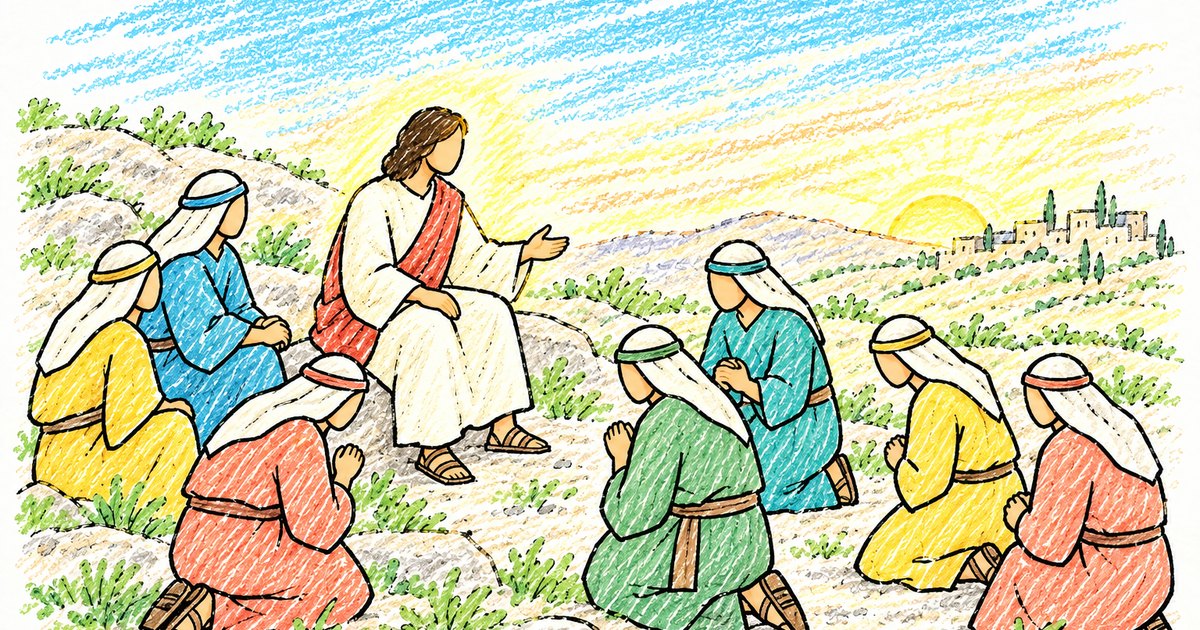
Elder Russell M. Nelson, “Lessons from the Lord’s Prayers” (2009)
What “Our Father,” “daily bread” and “amen” mean, and lessons from the Savior’s other prayers.4
Read the talk →Scripture Story Sketch Notes · Matthew 6:5–15; Luke 11:1–4
“After this manner therefore pray ye: Our Father which art in heaven, Hallowed be thy name.” Matthew 6:9
His disciples watched Him pray and asked, “Lord, teach us to pray.” Jesus taught them to pray in secret, without empty repetition, and gave them a pattern that begins, “Our Father.”
Before you begin
In the Sermon on the Mount, Jesus taught that prayer is not a performance. Some people prayed on street corners so others would notice them. Instead, He said, go into a private room, shut the door and pray to your Father, who sees in secret. And don’t pile up empty words, because “your Father knoweth what things ye have need of, before ye ask him.”
Then He gave a pattern: “Our Father which art in heaven, Hallowed be thy name.” We ask for His kingdom and His will, for daily bread, for forgiveness as we forgive others, and for protection from evil, and we end by giving Him the glory. Luke records that on another occasion a disciple watched Jesus pray and asked, “Lord, teach us to pray,” and He taught them the same pattern.
A mountainside in Galilee (Matthew 6), and “a certain place” where Jesus had been praying (Luke 11).
Watch how the prayer begins, and what Jesus says right after it about forgiving others.
Read it yourself: Matthew 6:5–15; Luke 11:1–4
Part 1 of 7
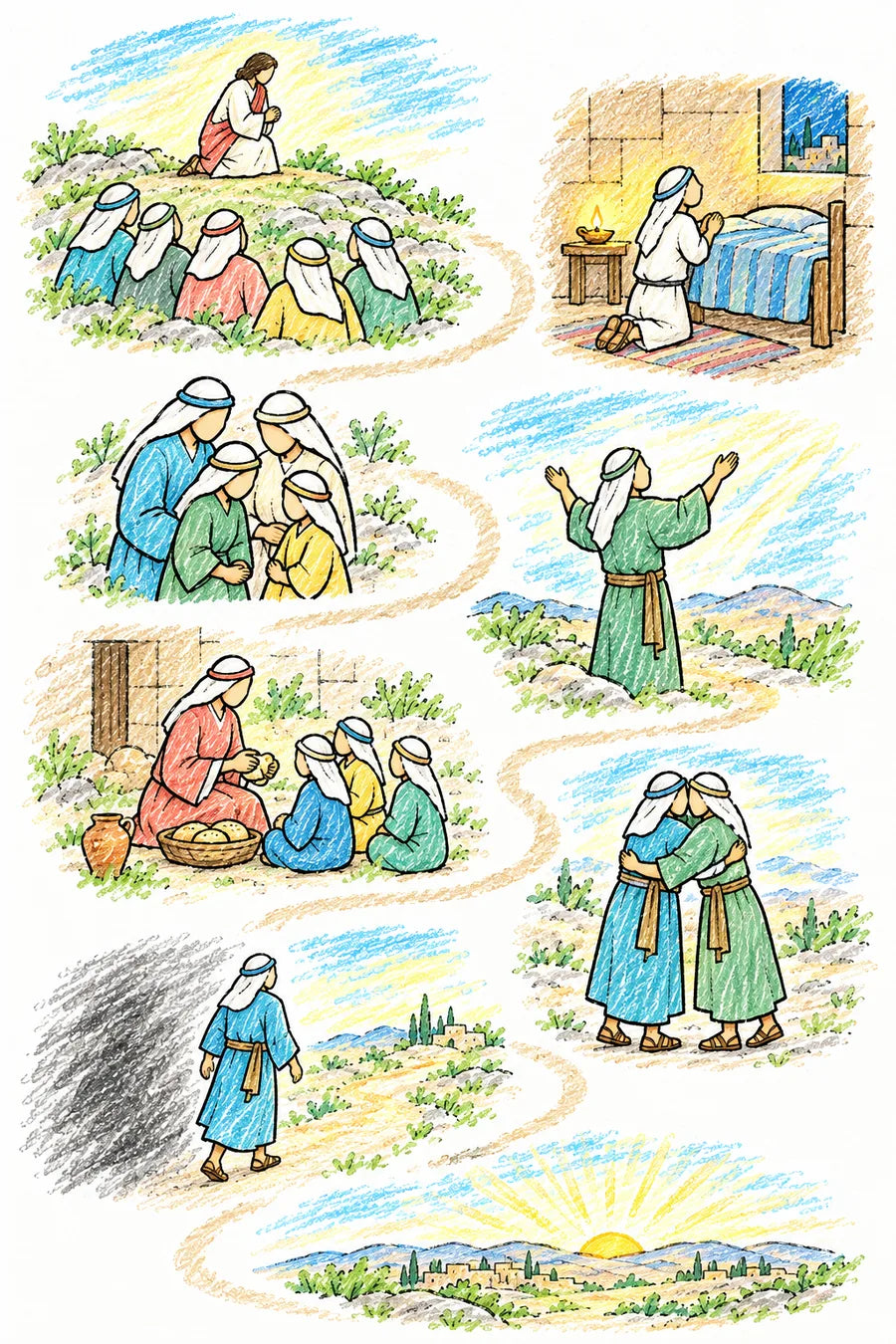
Eight stops from the disciples’ question to the amen. Scroll, or tap a number on the map.
Part 2 of 7
Four scenes: teach us, the pattern, daily bread, and forgiving. Look for the Savior in each one.
Read it plainly
Tap any dotted word for its meaning. The scripture stays exactly as written.1
Part 3 of 7
Small details tell the story. Some cards are details in the text; others share insights from Church leaders, Church resources or outside sources. Each card says which.
All nine. The sky, the bow, the crown, the earth, the bread, the ledger, the path, the shield and the sun. Matthew 6:9–13
Part 4 of 7
Not sure how, in need, hurt by someone, or tempted. Which feels most like you right now?
A next step for you
Your choice is saved only on this device.
Try it
Jesus gave His disciples a pattern for prayer. Tap each part in the order it comes, from the disciples’ question to the amen.
“After this manner therefore pray ye.” Matthew 6:9
Part 5 of 7
A little background on prayer in Jesus’s day helps the pattern come alive. Outside sources are labeled.
Elder Bruce R. McConkie: some devout Jews “ostentatiously went through the ritual of prayer.”6
Jesus taught a different way.
Elder Joseph B. Wirthlin: “Our prayers become hollow when we say similar words in similar ways over and over.”6
Real words, from the heart.
“The Lord’s Prayer is recorded twice in the New Testament and once in the Book of Mormon.”4
Plus the Joseph Smith Translation.
“The object of prayer is not to change the will of God but to secure for ourselves and for others blessings that God is already willing to grant.”7
He is willing.
Word study · Greek
epiousios ἐπιούσιος · “daily” (Matthew 6:11)
Word study · Greek
opheiléma ὀφείλημα · “debts” (Matthew 6:12)
What the text does not say
Jesus doesn’t tell us to repeat these exact words every time. He says, “After this manner,” a pattern to follow. And He doesn’t say prayer informs God of our needs: “Your Father knoweth what things ye have need of, before ye ask him.” Prayer draws us close to Him.1
Part 6 of 7
He prayed Himself, He taught us to pray to our Father, and He invites us to talk to God every day.
“Our prayers follow patterns and teachings of the Lord Jesus Christ. He taught us how to pray.”
Elder Russell M. Nelson4“Each of us has problems that we cannot solve and weaknesses that we cannot conquer without reaching out through prayer to a higher source of strength.”
“He is reachable at any time and any place.”
“As soon as we learn the true relationship in which we stand toward God (namely, God is our Father, and we are His children), then at once prayer becomes natural and instinctive on our part.”
Jesus (3 Nephi 13)
“After this manner therefore pray ye: Our Father who art in heaven, hallowed be thy name.” 3 Nephi 13:9
Jesus (Luke 11)
“When ye pray, say, Our Father which art in heaven … Give us day by day our daily bread.” Luke 11:2–3
Part 7 of 7
A question to ask in prayer
Heavenly Father, what do I need to understand about how to pray to Thee? Luke 11:1
Ask it as the disciples did. Then pray using His pattern, slowly and in your own words.
One part of the Lord’s pattern each day. It saves on this device, one day at a time.
0 of 7 today
Seven days of praying His way. Come again tomorrow.
A quiet moment
“Our Father which art in heaven.”
Read Matthew 6:9–13 slowly, stopping after each line to add your own words. How does it feel to call Him Father? Matthew 6:9–13
A verse to hold
Talk about it
For adults and deeper study
Longer readings, harder questions, and where to study next. Each one says what it is before you click.
What “Our Father,” “daily bread” and “amen” mean, and lessons from the Savior’s other prayers.4
Read the talk →Why prayer is a lifeline, and how to make it more meaningful.5
Read the talk →Prayer as the meeting of our will and the Father’s will.7
Read the entry →The Savior teaches the Nephites to pray, individually and as families.3
3 Nephi 13 → 3 Nephi 18 →Every quotation, gloss, and piece of background on this page is listed here: scripture first, then Church sources, then outside scholarship (labeled).
Quotations checked against the linked pages on October 11, 2026. Scripture is quoted from the King James Version as published in the Gospel Library.

He taught us to pray to a Father who already knows us. Follow His pattern, and talk to Him today. Matthew 6:9
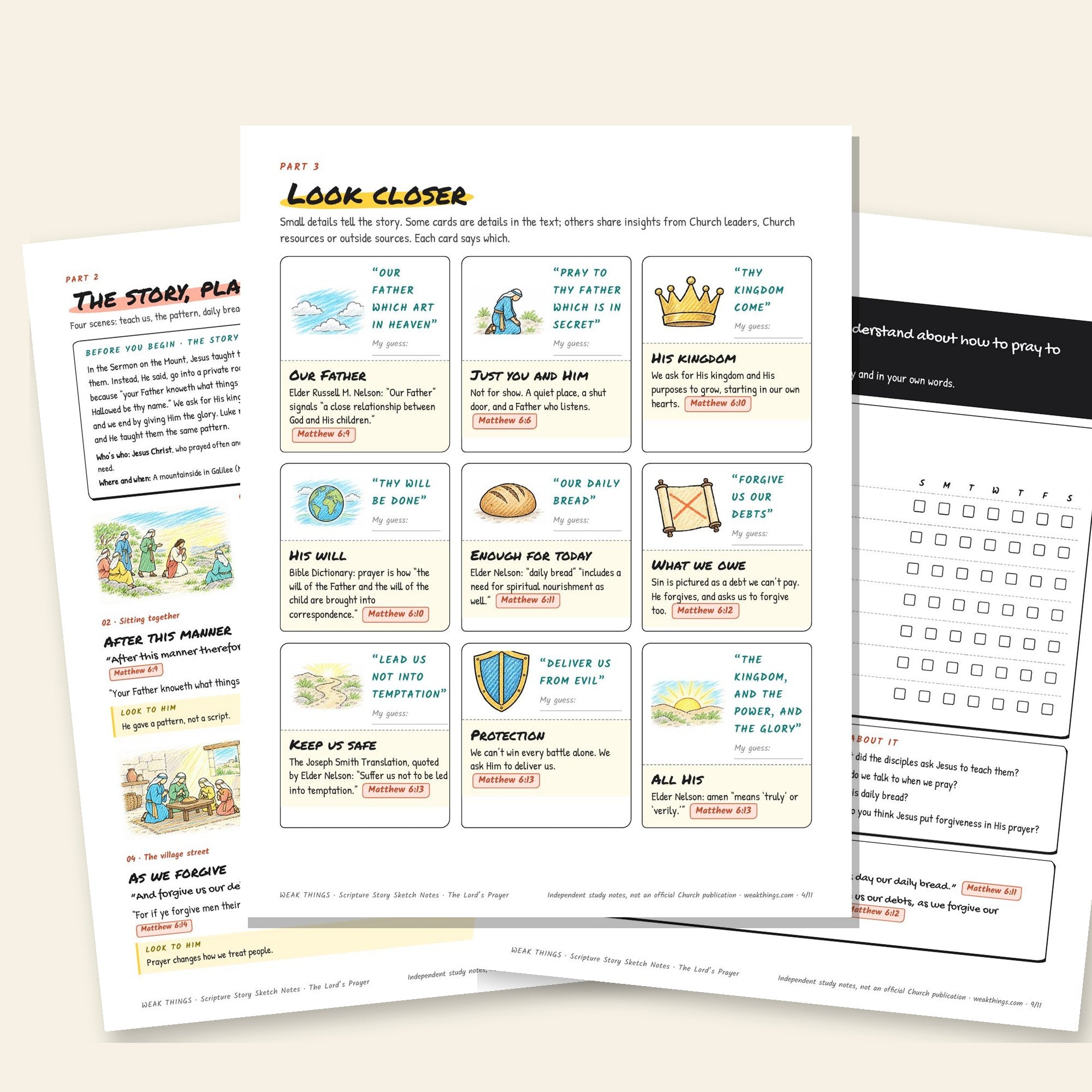
Printable sketch notes
Everything on this page as a 11-page letter-size PDF: the map, scenes, cards, activity, word studies, tracker, Go deeper and sources. For home, class or a quiet Sunday.
More stories
The Lord’s Prayer is part of the Scripture Story Sketch Notes for the New Testament, set alongside Come, Follow Me for February 15–21, 2027 (Matthew 6–7).
See every story See all 2027 weeksIndependent study notes from Weak Things, not an official publication of The Church of Jesus Christ of Latter-day Saints. Scripture quotations are from the King James Version. The words are in Matthew 6:5–15 and Luke 11:1–4; the insights in “Look closer” are labeled by source.