“For unto you is born this day in the city of David a Saviour, which is Christ the Lord.” Luke 2:11
One decree, one crowded town, one manger, one sky full of light. Walk the road to Bethlehem, look closer at what Luke noticed, and light the night sky with the angel’s words.
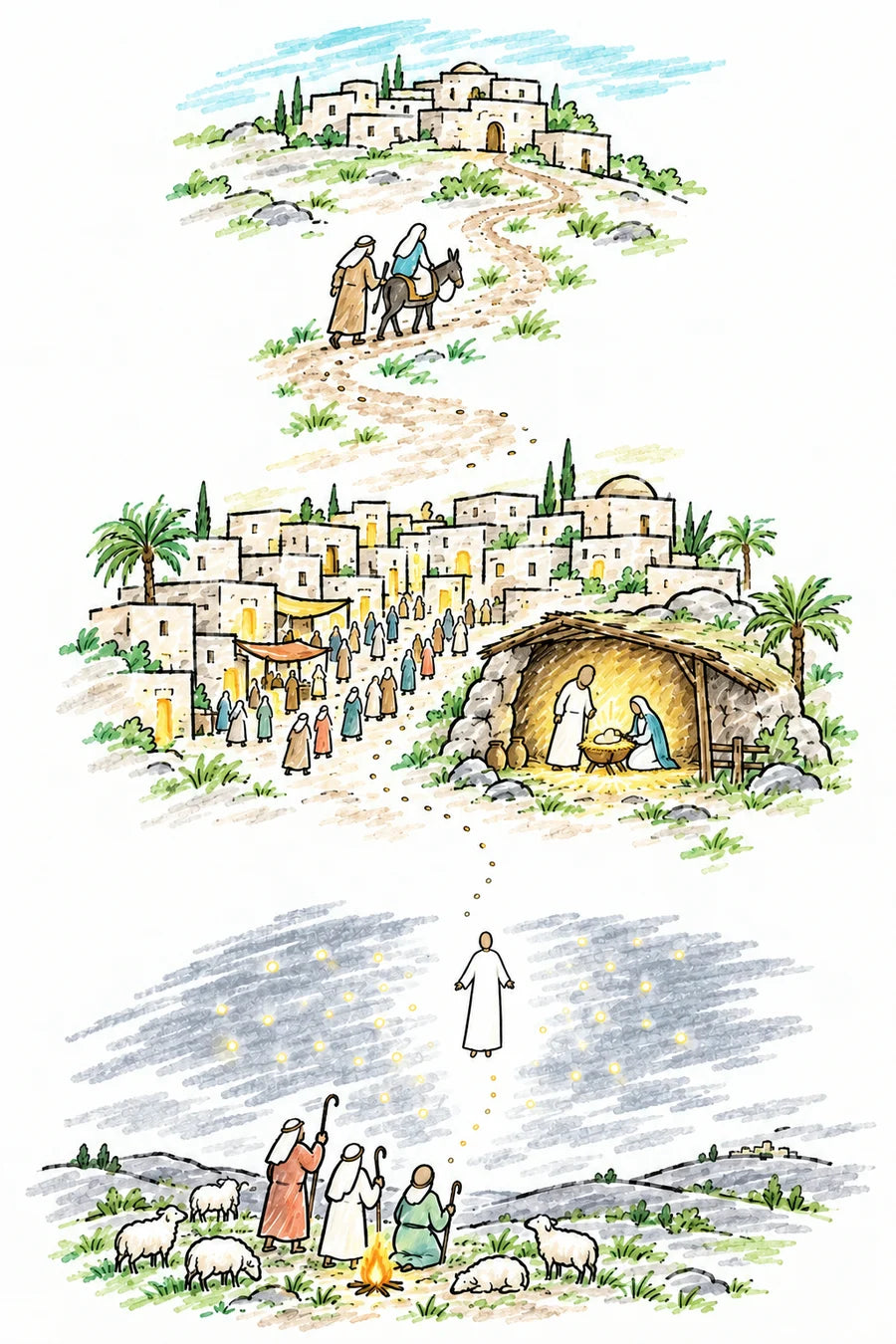
Caesar Augustus, the Roman emperor, ordered that everyone be taxed, “every one into his own city.” So Joseph traveled from Nazareth to Bethlehem, the city of his ancestor King David, with Mary, who was about to give birth. When they arrived there was no room for them in the inn, and Jesus was born and laid in a manger, a feeding trough for animals.
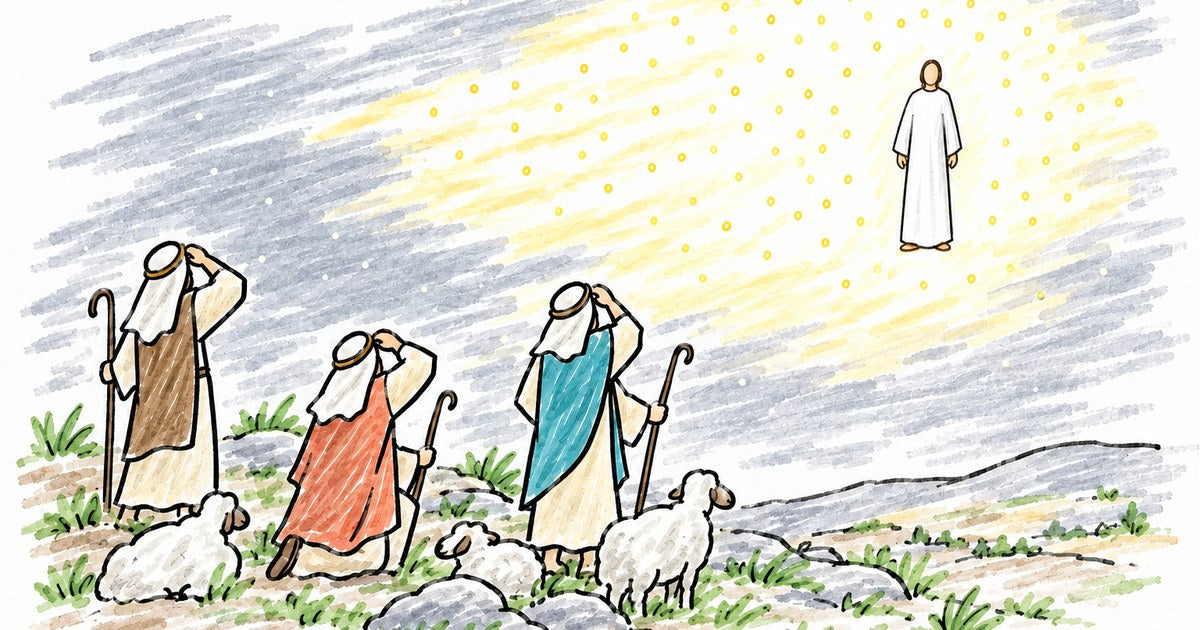
That night an angel appeared to shepherds watching their sheep in the fields nearby and announced the birth of “a Saviour, which is Christ the Lord.” The shepherds hurried to find the baby, and then they told everyone what they had seen.
Who’s who
Mary: the mother of Jesus
Joseph: her husband, of the family of King David
The shepherds: workers keeping watch over their flocks at night
The angels: one who announced the birth, then a multitude praising God
Where and when
Bethlehem in Judea, south of Jerusalem and far from Mary and Joseph’s home in Nazareth.
Watch for the Savior
Notice who heard the news first, and how the angel named the baby: “a Saviour, which is Christ the Lord.”
Eight stops, from Nazareth to the fields and back to the manger. Scroll, or tap a number on the map.
Part 2 of 7
The story, plainly
Four scenes, from a Roman decree to a quiet heart. Look for the Savior in each one.
Read it plainly
The words that trip people up
Tap any dotted word for its meaning. The scripture stays exactly as written.1
Luke 2:1 “there went out a Meaning: an official order. from Cæsar Augustus, that all the world should be Meaning: registered, enrolled in a count of the people..”
Luke 2:5 “To be taxed with Mary his Meaning: promised in marriage; legally pledged to him. wife, being Meaning: far along in her pregnancy..”
Luke 2:6 “the days were Meaning: completed; the time had come. that she should be Meaning: give birth..”
Luke 2:7 “wrapped him in Meaning: strips of cloth wrapped snugly around a newborn., and laid him in a Meaning: a feeding trough for animals. (See Part 5.)”
Luke 2:8 “shepherds Meaning: staying, living outdoors. in the field, keeping watch over their flock by night.”
Luke 2:9 “the glory of the Lord shone round about them: and they were Meaning: terribly afraid..”
Luke 2:10 “I bring you Meaning: good news. (See the Greek word in Part 5.) of great joy”
Luke 2:13 “a multitude of the Meaning: a great army of angels. praising God”
Luke 2:19 “Mary kept all these things, and Meaning: thought them over, putting them together. (See Part 5.) them in her heart.”
Part 3 of 7
Look closer
This is a true account, not a parable, so these are details in the text, not symbols with assigned meanings. Turn each card to see what it shows. Each back says where the insight comes from.
0 of 9 turned
All nine. A decree, a road, a full town, a feeding trough, and the Saviour of the world. Luke 2:1–19
Part 4 of 7
Where are you this Christmas?
Everyone in Luke 2 responds to the news in some way. Which one feels most like you right now?
A next step for you
Your choice is saved only on this device.
Try it
Light the sky
It was night in the fields. Tap each star to light it, and the angel’s words will fill in, in order. When every star is lit, the sky fills with the heavenly host.
“The glory of the Lord shone round about them.” Luke 2:9
Part 5 of 7
Their world, their words
A little background helps us see the night the way Luke’s first readers did. Outside sources are labeled.
Apostle · Jesus the Christ
Flocks in the field
Elder Talmage wrote that Bethlehem’s people were “engaged mostly in pastoral and agricultural pursuits,” and that at the season of the Savior’s birth, “which was in the springtime of the year,” it fits “to find … that flocks were in the field both night and day under the watchful care of their keepers.”12
The first announcement went to people at work in the dark.
Scripture · Bible Dictionary
Little Bethlehem
The Bible Dictionary gives Bethlehem’s meaning as “house of bread,” about five miles south of Jerusalem, where Samuel anointed David.13 Micah had said, “thou, Beth-lehem Ephratah, though thou be little among the thousands of Judah, yet out of thee shall he come forth.”2
A small town, a large promise.
Outside · BYU Studies
What was “the inn”?
The Greek word is katalyma, the same word translated “guest chamber” for the room of the Last Supper. It can mean a traveler’s lodging place or a guest room in a home.14,18 The Joseph Smith Translation reads “there was none to give room for them.”14
Either way, the King was laid where the animals ate.
Outside · BYU Studies
A manger and a prophecy
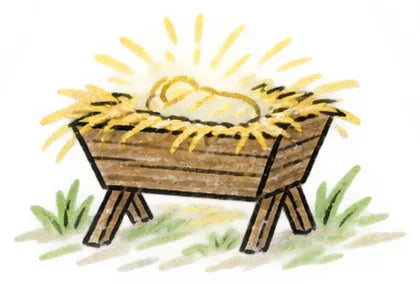
A manger (phatnē) is a feeding trough. Brown notes that the same Greek word appears in the Greek Old Testament of Isaiah 1:3: “The ox knoweth his owner, and the ass his master’s crib: but Israel doth not know.”14,4
That night, shepherds came to know their Master’s crib.
Word study · Greek
euangelizomai εὐαγγελίζομαι · “I bring you good tidings” (Luke 2:10)
The angel’s verb means “to announce good news.” It is built from eu, “well,” and angelos, “messenger,” and it is the word later used for preaching “the gospel.”16Outside · lexicon
The first time the gospel was preached in Luke’s account of the birth, it was preached by an angel, at night, to shepherds. And the good news was a Person: “unto you is born … a Saviour.”
Word study · Greek
symballō συμβάλλω · “pondered” (Luke 2:19)
Literally “to throw together,” and so “to combine” or, in the mind, “to consider.”17Outside · lexicon
Mary was putting the pieces side by side: Gabriel’s words, Elisabeth’s greeting, the long road, the manger, the shepherds’ story. Elder Talmage noted that the full truth “had not yet unfolded itself in its fulness to her mind.”12
What the text does not say
Luke never mentions an innkeeper, a donkey, or that Jesus was born the night they arrived. He says only that “while they were there, the days were accomplished.”1 The heavenly host is “praising God, and saying.”1 And the wise men are not in Luke at all; in Matthew they find “the young child” in “the house.” Mickelson notes how many familiar details come from tradition rather than the text.15 The true story is simpler, and the simplicity is the point.
Part 6 of 7
Look to Him
Shepherds came to see a baby. They went home praising God, because the baby is the Lord.
Saviour: the One who saves. Christ: the Anointed One, the Messiah. Lord: the God of Israel. The angel put all three titles on a baby in a feeding trough, and the shepherds believed it.
“No baby had ever been born about whom so much was already known, of whom so much had already been written, and regarding whom so much was already expected.”
Elder Jeffrey R. Holland, “The Dreams of Bethlehem,” December 20208
“Before we can successfully undertake a personal search for Jesus, we must first prepare time for Him in our lives and room for Him in our hearts.”
President Thomas S. Monson, “The Search for Jesus”9
“Like the shepherds, we must respond immediately, with haste, whenever the Spirit speaks to us.”
Elder Patrick Kearon, “Come, Let Us Adore Him,” December 201110
“The Lord would soon fill that hollowness with holiness.”
Sister Bonnie H. Cordon, “Let Earth Receive Her King,” December 202211
Another Testament
Nephi saw this night
Six hundred years before, an angel showed Nephi “the virgin again, bearing a child in her arms,” and said, “Behold the Lamb of God, yea, even the Son of the Eternal Father!” 1 Nephi 11:20–21
Another Testament
His own voice, the night before
To Nephi in the Americas, the day before the sign: “Lift up your head and be of good cheer; for behold, the time is at hand, and on this night shall the sign be given, and on the morrow come I into the world.” 3 Nephi 1:13 The baby in the manger chose to come.
Part 7 of 7
Room for Him today
The shepherds’ words
“Let us now go even unto Bethlehem, and see this thing which is come to pass.” Luke 2:15
They said it to each other, then they went. President Monson asked, “Did they procrastinate their search for Jesus?”9 Where is your Bethlehem this week: a place where you can go and see Him more clearly?
Try it today
Each thing you do is one more step toward Bethlehem. It saves on this device, one day at a time.
0 of 6 today
This week:0 of 7 days
Six steps to the manger. Come again tomorrow.
A quiet moment
“Fear not: for, behold, I bring you good tidings of great joy, which shall be to all people.”
Picture the dark field and the sudden light. Read Luke 2:10–11 slowly, and hear “unto you” as if it were spoken to you by name. Then sit still for one minute. Luke 2:10–11
A verse to hold
Talk about it
Why do you think the first announcement went to shepherds in a field?
What crowds out room for the Savior in our home right now?
The shepherds went “with haste.” What prompting could our family act on quickly?
Mary “kept all these things.” What do you want to remember about Him from this story?
Open
For adults and deeper study
Go deeper
Longer readings, harder questions, and where to study next. Each one says what it is before you click.
Apostle
Elder Jeffrey R. Holland, “The Dreams of Bethlehem” (2020)
Walks through the night of the birth and who this baby already was: the Firstborn, Jehovah, the One who would “tread the wine press of redemption utterly and entirely alone.” Then: “But not tonight. Not this night. Here He was just a baby in the arms of a mother who adored Him.”8
President Monson’s “The Search for Jesus” asks how we find Him: “the earnest and sincere prayer of a humble and pure heart.” Elder Kearon draws one lesson each from the shepherds, Simeon, Anna and the wise men.9,10
Sister Bonnie H. Cordon, “Let Earth Receive Her King” (2022)
Reads the Christmas story as lessons in receiving: Mary and Joseph receive His holiness, the shepherds receive His invitation to act, and the wise men receive Him with enduring faith.11
A verse-by-verse commentary by a Latter-day Saint scholar, with notes on swaddling, the manger, the meaning of “inn,” the Joseph Smith Translation, and “this day.”14 Also see Mickelson’s short study of what Luke 2:7 does and does not say about an inn.15
Quotations checked against the linked pages on October 7, 2026. Scripture is quoted from the King James Version as published in the Gospel Library.
“…a Saviour, which is Christ the Lord”
Born in a borrowed place, announced to shepherds, kept in His mother’s heart. The good tidings are “to all people,” and that includes you. Luke 2:10–11
Everything on this page as a 11-page letter-size PDF: the map, scenes, cards, activity, word studies, tracker, Go deeper and sources. For home, class or a quiet Sunday.
The Nativity is part of the Scripture Story Sketch Notes for the New Testament, set alongside Come, Follow Me for January 4–10, 2027 (Matthew 2; Luke 2).
Independent study notes from Weak Things, not an official publication of The Church of Jesus Christ of Latter-day Saints. Scripture quotations are from the King James Version. This is a true account, not a parable; the insights in “Look closer” are labeled by source.