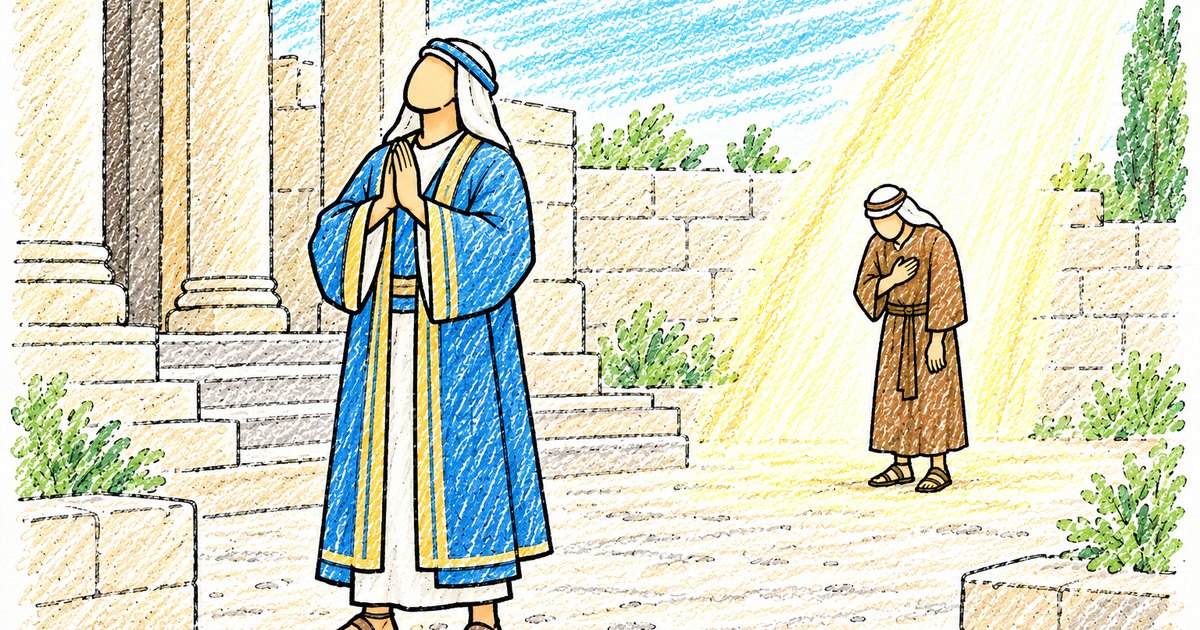
Elder Howard W. Hunter, “The Pharisee and the Publican” (1984)
Who the Pharisees and publicans were, and why humility matters more than outward show.3
Read the talk →Scripture Story Sketch Notes · Luke 18:1–14
“God be merciful to me a sinner.” Luke 18:13
Jesus told two parables about prayer. A widow kept asking an unjust judge until he answered. Then two men went up to the temple to pray: a proud Pharisee who listed his good works, and a humble publican who asked only for mercy. The publican went home justified.
Before you begin
Jesus told a parable “that men ought always to pray, and not to faint.” A widow kept coming to a judge who “feared not God, neither regarded man,” asking for justice. At last he gave in so she would stop troubling him. Jesus asked, “And shall not God avenge his own elect, which cry day and night unto him, though he bear long with them?”
Then, to people who “trusted in themselves that they were righteous, and despised others,” He told of two men who went up to the temple to pray. The Pharisee thanked God that he was “not as other men are” and listed his fasting and tithes. The publican stood far off, would not lift his eyes, beat his breast and said, “God be merciful to me a sinner.” Jesus said the publican “went down to his house justified rather than the other.”
The second parable takes place at the temple in Jerusalem.
Watch who each person in these parables trusts.
Read it yourself: Luke 18:1–14
Part 1 of 7
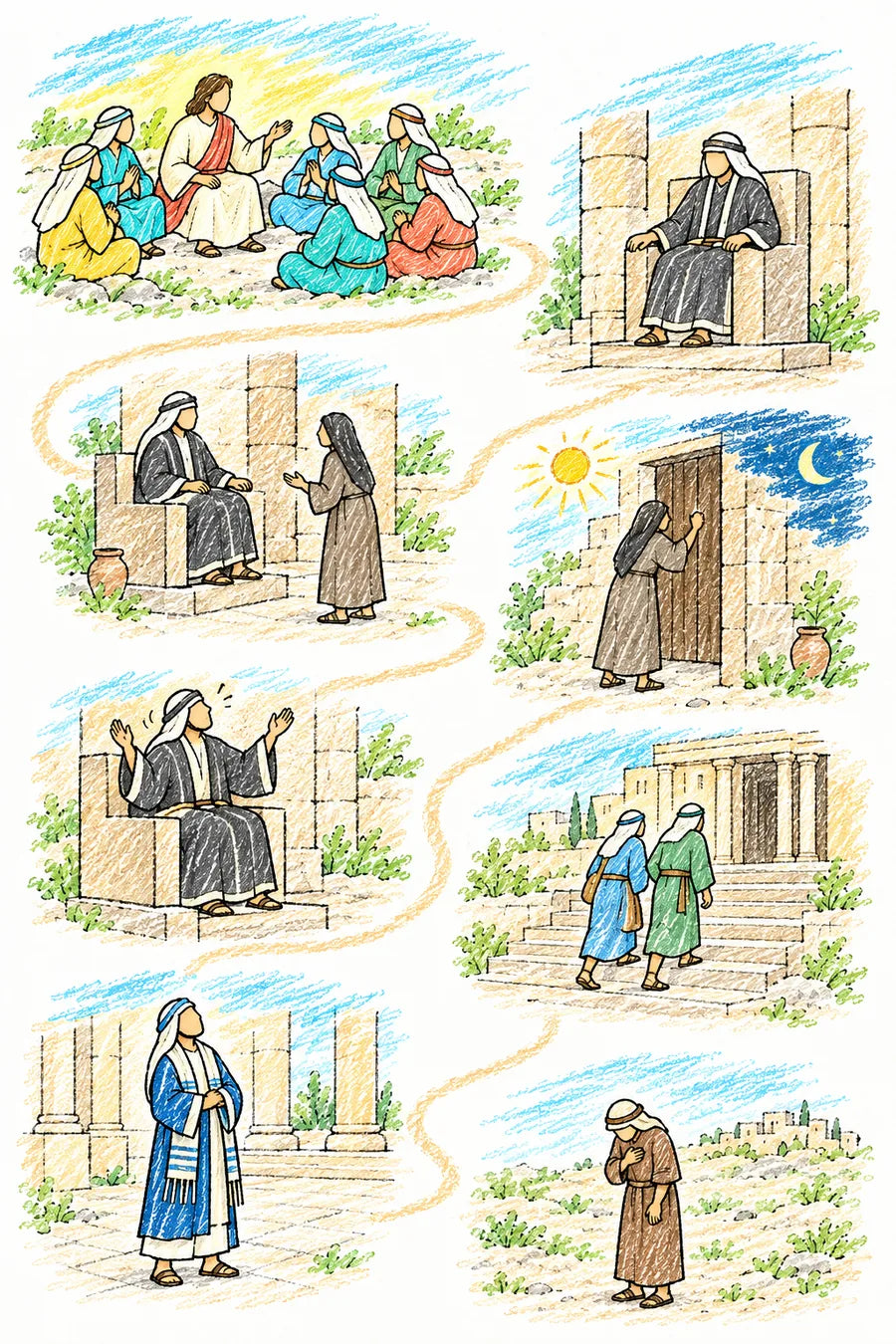
Eight stops from the judge’s door to the temple courtyard. Scroll, or tap a number on the map.
Part 2 of 7
Four scenes: the widow, the temple steps, the proud prayer and the humble one. Look for the Savior’s teaching in each.
Read it plainly
Tap any dotted word for its meaning. The scripture stays exactly as written.1
Part 3 of 7
Small details tell the story. Some cards are details in the text; others share insights from Church leaders, Church resources or outside sources. Each card says which.
All nine. The judge, the knocking, day and night, the temple steps, the tithes, the proud prayer, the breast, the lifting and the plea for mercy. Luke 18:1–14
Part 4 of 7
Tired of asking, comparing, needing mercy, or praying always. Which feels most like you right now?
A next step for you
Your choice is saved only on this device.
Try it
Jesus told two parables about prayer. Tap the things you will do this week and watch each part grow.
“Men ought always to pray, and not to faint.” Luke 18:1
Part 5 of 7
A little background on widows, Pharisees, publicans and two Greek words helps the story come alive. Outside sources are labeled.
“A widow, one of the most vulnerable members of society, and a publican, one of the despised, serve as positive examples” in these parables.2
He lifts the overlooked.
Jesus told this parable to people who “trusted in themselves that they were righteous, and despised others.” Pharisees “were generally admired and regarded as very obedient to the law.”2
A surprise ending.
Tax collectors under Rome were “detested by the Jews, and any Jew who undertook the work was excommunicated.”4
The outsider was heard.
“In this parable the Savior spoke few words, yet the lesson taught is clear.”3
Read it slowly.
Word study · Greek
hilaskomai ἱλάσκομαι · “be merciful” (Luke 18:13)
Word study · Greek
dikaioó δικαιόω · “justified” (Luke 18:14)
Part 6 of 7
He teaches us to keep praying, and He lifts up everyone who comes to Him humbly asking for mercy.
“In this parable the Savior spoke few words, yet the lesson taught is clear.”
Elder Howard W. Hunter3“The Greek word translated as ‘to faint’ means to become discouraged or weary or to tire of something.”
“In the parable, praying without giving up is represented by a widow who repeatedly appeals to a judge to remedy an injustice.”
“It was not intended for Pharisees or publicans expressly, but for the benefit of the self-righteous who lack the virtues of humility.”
Part 7 of 7
A question to ask in prayer
Father, what is in my heart that I need to bring humbly to Thee? Luke 18:13
Ask, then be honest with Him about what comes to mind.
One way to pray like the widow and the publican each day. It saves on this device, one day at a time.
0 of 7 today
Seven days of humble prayer. Come again tomorrow.
A quiet moment
“Be merciful to me.”
Read Luke 18:9–14 slowly. Picture both men praying in the same courtyard. Then quietly offer the publican’s prayer as your own. Luke 18:9–14
A verse to hold
Talk about it
For adults and deeper study
Longer readings, harder questions, and where to study next. Each one says what it is before you click.
Who the Pharisees and publicans were, and why humility matters more than outward show.3
Read the talk →The importuning widow, the meaning of “faint,” and the two men at the temple.2
Read the chapter →Who the tax collectors were and why they were despised.4
Read the entry →Read both parables together and look for what each teaches about prayer.1
Luke 18 →Every quotation, gloss, and piece of background on this page is listed here: scripture first, then Church sources, then outside scholarship (labeled).
Quotations checked against the linked pages on October 11, 2026. Scripture is quoted from the King James Version as published in the Gospel Library.

He hears the widow who keeps asking and the sinner who asks for mercy. Everyone who comes humbly is lifted up. Luke 18:14

Printable sketch notes
Everything on this page as a 11-page letter-size PDF: the map, scenes, cards, activity, word studies, tracker, Go deeper and sources. For home, class or a quiet Sunday.
More stories
The Pharisee and the Publican is part of the Scripture Story Sketch Notes for the New Testament, set alongside Come, Follow Me for May 3–9, 2027 (Matthew 19–20; Mark 10; Luke 18).
See every story See all 2027 weeksIndependent study notes from Weak Things, not an official publication of The Church of Jesus Christ of Latter-day Saints. Scripture quotations are from the King James Version. The words are in Luke 18:1–14; the insights in “Look closer” are labeled by source.