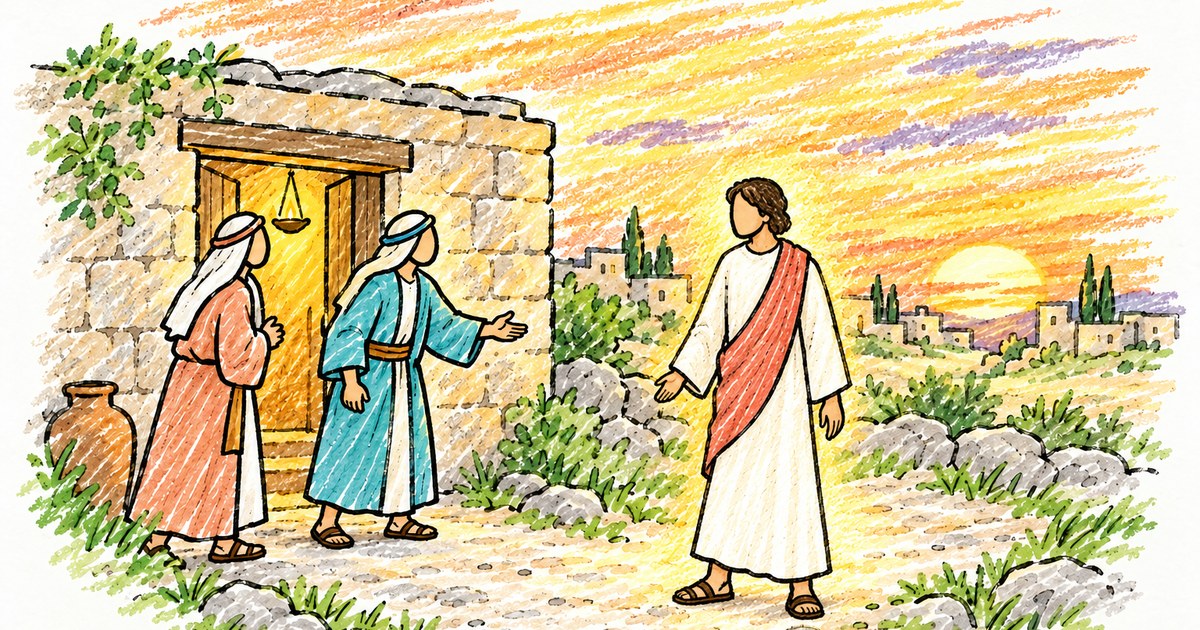
Elder Gerrit W. Gong, “’Tis Eastertide: No One Walks Alone” (2026)
The road to Emmaus as a covenant pattern: His words, His sacrament, and His promise to abide with us.4
Read the talk →Scripture Story Sketch Notes · Luke 24:13–35; Mark 16:12–13
“Did not our heart burn within us, while he talked with us by the way, and while he opened to us the scriptures?” Luke 24:32
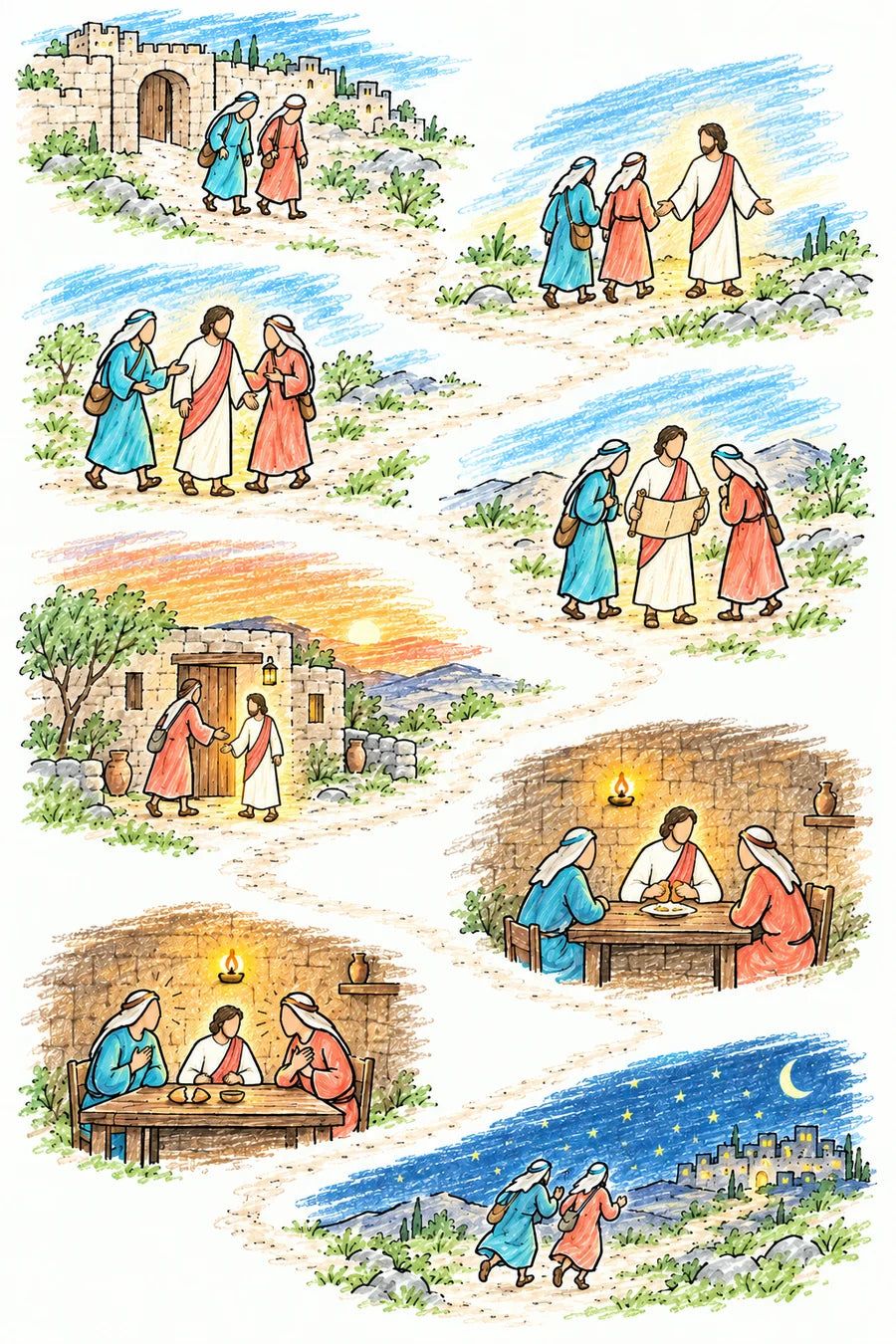
Two sad disciples, a Stranger on the road, the scriptures opened, an invitation at sunset, and bread broken at a small table. Walk with them, and watch your own heart.
Before you begin
On the same day Jesus rose, two disciples walked from Jerusalem to a village called Emmaus, about seven miles away. As they walked and talked sadly about all that had happened, Jesus Himself drew near and went with them, but their eyes were holden that they should not know him. He asked why they were sad. One of them, Cleopas, told Him about Jesus of Nazareth, “a prophet mighty in deed and word,” who had been crucified, and about the women who said angels told them He was alive. Then, beginning at Moses and all the prophets, He expounded unto them in all the scriptures the things concerning Himself.
When they reached the village, He made as though He would go further. But they constrained Him, saying, “Abide with us: for it is toward evening, and the day is far spent.” As He sat at meat with them, He took bread, blessed it, broke it and gave it to them. Their eyes were opened, they knew Him, and He vanished out of their sight. They said to each other, “Did not our heart burn within us, while he talked with us by the way, and while he opened to us the scriptures?” That same hour they returned to Jerusalem and found the Apostles saying, “The Lord is risen indeed.” Then they told how He was known of them in breaking of bread.
The road from Jerusalem to the village of Emmaus, about seven miles, on the afternoon and evening of the day of the Resurrection.
Watch how He walks beside people who are sad, opens the scriptures, and waits to be invited in.
Read it yourself: Luke 24:13–35
Part 1 of 7
Eight stops, from the sad walk out of Jerusalem to the run back at night. Scroll, or tap a number on the map.
Part 2 of 7
Four scenes: the Stranger, the scriptures, the invitation and the bread. Look for the Savior beside them in each one.
Read it plainly
Tap any dotted word for its meaning. The scripture stays exactly as written.1
Part 3 of 7
Small details tell the story. Some cards are details in the text; others share insights from prophets. Each card says which.
All nine. The sad walk, the Stranger, the holden eyes, the open scroll, the burning heart, the sunset, the invitation, the broken bread and the run back. Luke 24:13–35
Part 4 of 7
Some of us are walking with a sad heart, some do not notice Him nearby, some find the scriptures hard to understand, and some are ready to invite Him in. Which feels most like you right now?
A next step for you
Your choice is saved only on this device.
Try it
Walk the road with them, stop by stop. Watch the heart warm as He opens the scriptures, then decide what to say at the door.
“Abide with us: for it is toward evening, and the day is far spent.” Luke 24:29
Part 5 of 7
A little background helps us walk the road with them. Outside sources are labeled.
Elder Gong: “Emmaus means “hot springs,” a place of healing.”4
Two hurting disciples found healing on the way there.
Elder Talmage: “There could be but one topic of conversation between them”.5
When our hearts are full, we talk about what matters most.
Elder Talmage: “There may have been something in the fervency of the blessing, or in the manner of the breaking and distributing the bread, that revived memories of former days”.5
They knew Him when He broke the bread.
A 2026 Liahona article: “Each of us walks our own road to Emmaus.”6
He walks our roads with us too.
Word study · Greek
kaiō καίω · “burn” (Luke 24:32)
Word study · Greek
diermēneuō διερμηνεύω · “expounded” (Luke 24:27)
What the text does not say
The text does not tell us the name of the second disciple. Only Cleopas is named. Perhaps that leaves room for each of us to walk beside him. And the text does not say they stopped being sad all at once. Their hearts warmed step by step, while He talked with them by the way.1
Part 6 of 7
He is the risen Lord who walks beside sad people, opens the scriptures, and makes Himself known in the breaking of bread.
Elder Gerrit W. Gong: “Though we did not recognize Him before, He has been walking with us all along.”
Elder Gerrit W. Gong, “’Tis Eastertide: No One Walks Alone,” April 20264“As He breaks and blesses the sacramental bread, His ordinances and covenants can help us know Him.”
“In a fulness of joyful wonderment they rose from the table”
“We can ask the Savior to be with us.”
Part 7 of 7
A question to ask yourself
“Abide with us: for it is toward evening, and the day is far spent.” Luke 24:29
Where in your day this week will you invite Him to stay?
One small way to walk with Him each day. It saves on this device, one day at a time.
0 of 7 today
Seven days on the road with Him. Come again tomorrow.
A quiet moment
“Did not our heart burn within us, while he talked with us by the way, and while he opened to us the scriptures?”
Read Luke 24:13–32 slowly. Then think of a time your heart felt warm while you read or heard His words. Write down what was happening. Luke 24:13–32
A verse to hold
Talk about it
For adults and deeper study
Longer readings, harder questions, and where to study next. Each one says what it is before you click.
The road to Emmaus as a covenant pattern: His words, His sacrament, and His promise to abide with us.4
Read the talk →The two disciples on the road, the Stranger who opened the scriptures, and the meal at Emmaus.5
Read chapter 37 →An Easter article on what the two disciples teach us about recognizing the Savior on our own roads.6
Read the article →The risen Lord with the Eleven that same night, and His promise to come to us and make His abode with us.3
Read Luke 24 → Read John 14 →Every quotation, gloss, and piece of background on this page is listed here: scripture first, then Church sources, then outside scholarship (labeled).
Quotations checked against the linked pages on October 7, 2026. Scripture is quoted from the King James Version as published in the Gospel Library.

He walked beside them before they knew Him, opened the scriptures, and waited to be invited in. He walks your road too. Ask Him to stay. Luke 24:29
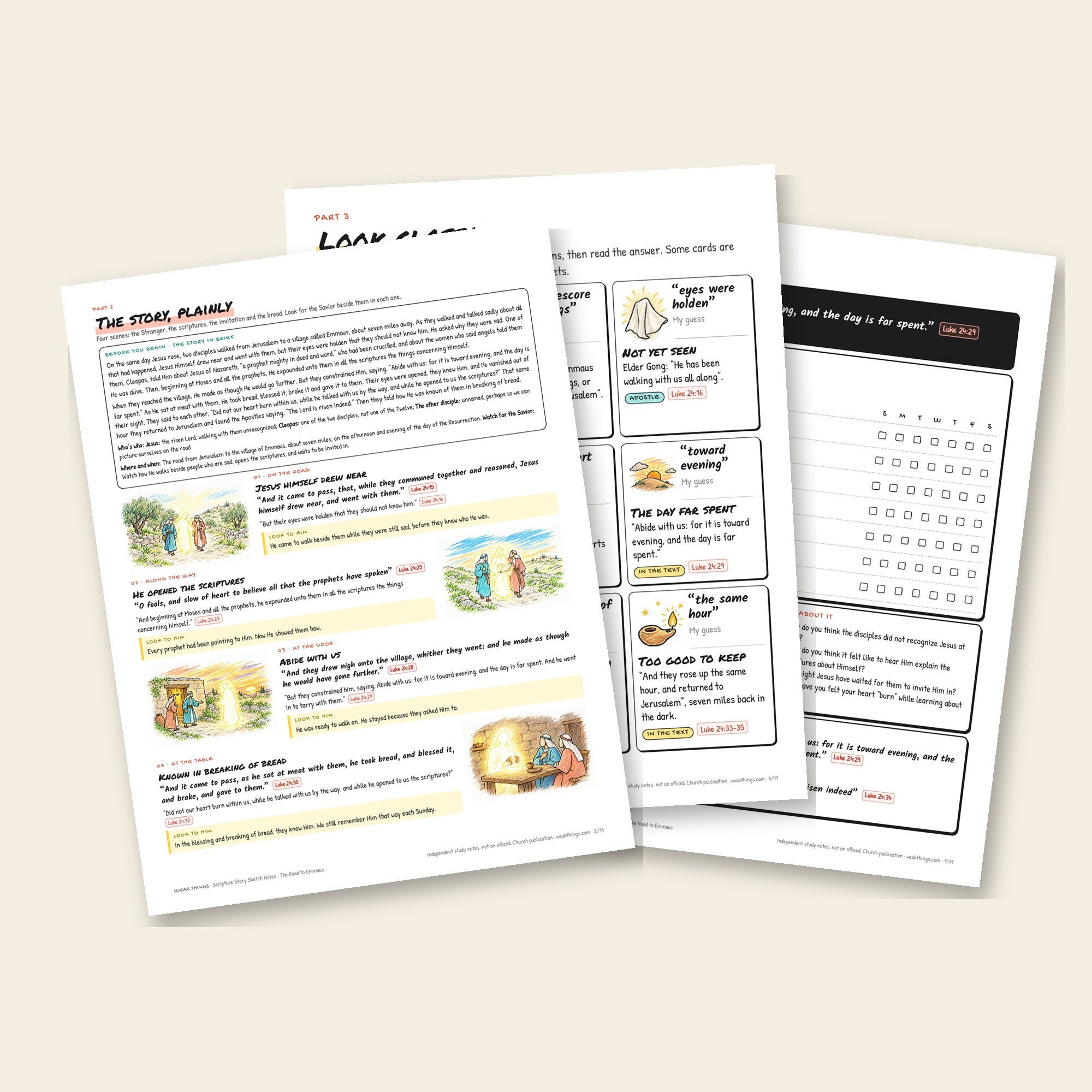
Printable sketch notes
Everything on this page as an 11-page letter-size PDF: the map, scenes, cards, activity, word studies, tracker, Go deeper and sources. For home, class or a quiet Sunday.
More stories
The Road to Emmaus is part of the Scripture Story Sketch Notes for the New Testament, set alongside Come, Follow Me for June 21–27, 2027 (Matthew 28; Mark 16; Luke 24; John 20–21).
See every story See all 2027 weeksIndependent study notes from Weak Things, not an official publication of The Church of Jesus Christ of Latter-day Saints. Scripture quotations are from the King James Version. This story is told in the words of Luke and Mark; the insights in “Look closer” are labeled by source.