Elder Jeffrey R. Holland, “Are We Not All Beggars?” (2014)
Why the Savior’s call to care for the poor is so persistent, how to “do what we can,” and the blessings of the fast.4
Read the talk →Scripture Story Sketch Notes · Matthew 25:31–46; Mosiah 2:17
“Inasmuch as ye have done it unto one of the least of these my brethren, ye have done it unto me.” Matthew 25:40
A throne of glory, all nations gathered, and a surprise. Walk the scene, find where the King says He was all along, and look for Him in the people around you.
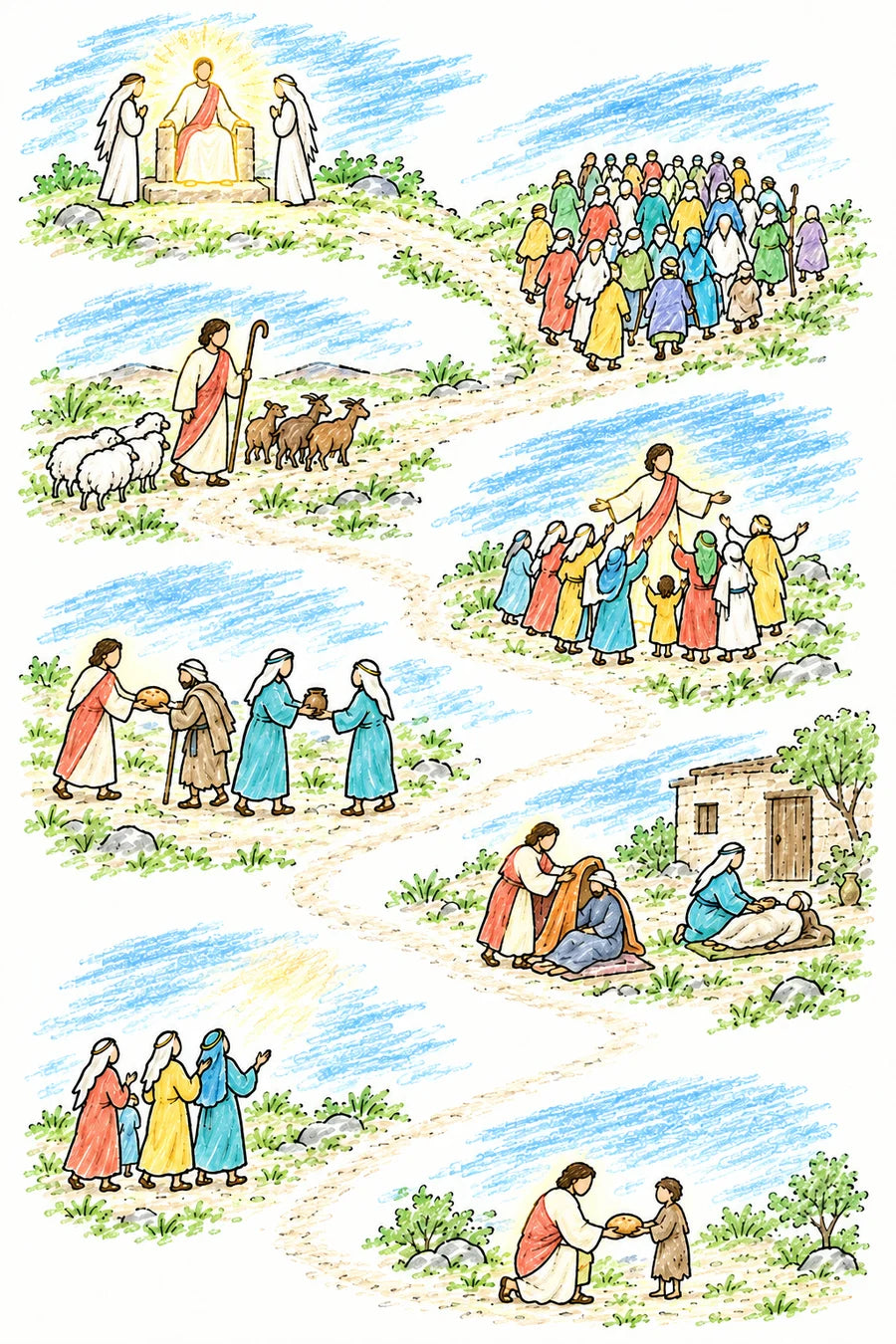
Before you begin
Jesus taught that when He comes in His glory, He will sit on the throne of His glory, and all nations will be gathered before Him. He will separate them “as a shepherd divideth his sheep from the goats,” the sheep on His right hand and the goats on the left. To those on His right He will say, “Come, ye blessed of my Father,” because when He was hungry they fed Him, when He was thirsty they gave Him drink, when He was a stranger they took Him in, and when He was naked, sick or in prison, they came to Him.
The righteous are surprised. “Lord, when saw we thee an hungred, and fed thee?” The King answers, “Inasmuch as ye have done it unto one of the least of these my brethren, ye have done it unto me.” Those on the left had not cared for people in need, and so, He says, they had not cared for Him. Every kindness to anyone, it turns out, reaches the Savior Himself.
The Mount of Olives, in the last days before the Crucifixion, right after the parables of the ten virgins and the talents. It looks ahead to His Second Coming.
Watch where the King says He was all along: hungry, thirsty, a stranger, sick and in prison.
Read it yourself: Matthew 25:31–46
Part 1 of 7
Eight stops from the throne of glory to the King’s answer. Scroll, or tap a number on the map.
Part 2 of 7
Four scenes: the gathering, the welcome, the surprise, and the answer. Look for the Savior in each one.
Read it plainly
Tap any dotted word for its meaning. The scripture stays exactly as written.1
Part 3 of 7
Small details tell the story. Some cards are details in the text; others share insights from prophets. Each card says which.
All nine. The throne, the shepherd, the right hand, the bread, the cup, the open door, the cloak, the visit and the surprise. Matthew 25:31–46
Part 4 of 7
Some of us feel too small to help, some are the ones in need, some are too busy to notice, and some wonder if a small kindness matters. Which feels most like you right now?
A next step for you
Your choice is saved only on this device.
Try it
The King names six needs and six kindnesses. Tap a need on the left, then the kindness that answers it on the right.
“Inasmuch as ye have done it unto one of the least of these my brethren, ye have done it unto me.” Matthew 25:40
Part 5 of 7
A little background helps us see what the listeners pictured. Outside sources are labeled.
The sheep are set “on his right hand”, and the King calls them “ye blessed of my Father”. The kingdom was “prepared for you from the foundation of the world”.1
It was ready for them long before they arrived.
Elder Talmage lists the hungry fed, the strangers lodged and the prisoners visited, “all of which mercies are accredited to them as having been rendered to their Lord in person”.6
Every kindness lands on Him.
President Monson: “I believe the Savior is telling us that unless we lose ourselves in service to others, there is little purpose to our own lives.”5
They served without counting.
Elder Holland: “the great Redeemer has issued no more persistent call than for us to join Him in lifting this burden from the people”, speaking of poverty and need.4
Caring for the needy is His own work.
Word study · Greek
probaton πρόβατον · “sheep” (Matthew 25:32)
Bible Hub: “something that walks forward (a quadruped), i.e. (specially), a sheep (literally or figuratively).”7 Outside · lexicon
Sheep follow their shepherd. At the waters of Mormon, coming “into the fold of God” meant being “willing to bear one another’s burdens, that they may be light”.
Word study · Greek
elachistos ἐλάχιστος · “least” (Matthew 25:40)
What the text does not say
The text does not say the righteous earned their place by keeping a list of good deeds. They did not even remember doing them: “Lord, when saw we thee an hungred, and fed thee?” Nor does it limit kindness to people we already know. Elder Holland spoke of needs “that go well beyond members of the Church”.4
Part 6 of 7
He is the King on the throne of glory, and He is also the hungry child, the stranger and the prisoner. Every kindness reaches Him.
President Thomas S. Monson: “That service to which all of us have been called is the service of the Lord Jesus Christ.”
President Thomas S. Monson, “What Have I Done for Someone Today?” October 20095“The needs of others are ever present, and each of us can do something to help someone.”
“God knows, and He will help you and guide you in compassionate acts of discipleship”
“As He enlists us to His cause, He invites us to draw close to Him.”
Another testament
“When ye are in the service of your fellow beings ye are only in the service of your God.” Mosiah 2:17
Earlier, Jesus said
“Whosoever shall give to drink unto one of these little ones a cup of cold water only in the name of a disciple, verily I say unto you, he shall in no wise lose his reward.” Matthew 10:42
Part 7 of 7
A question to ask yourself
“Lord, when saw we thee an hungred, and fed thee?” Matthew 25:37
Who near you is hungry, lonely, sick, new or stuck this week? What is one way to reach them as if you were reaching Him?
One kindness each day. It saves on this device, one day at a time.
0 of 7 today
Seven kindnesses, each one done unto Him. Come again tomorrow.
A quiet moment
“Ye have done it unto me.”
Read Matthew 25:31–46 slowly. Then ask Heavenly Father who needs you this week. Listen, and write down the first name that comes. Matthew 25:31–46
A verse to hold
Talk about it
For adults and deeper study
Longer readings, harder questions, and where to study next. Each one says what it is before you click.
Why the Savior’s call to care for the poor is so persistent, how to “do what we can,” and the blessings of the fast.4
Read the talk →Losing ourselves in service, children’s acts of kindness, and Matthew 25 as the service of the Lord Jesus Christ.5
Read the talk →The ten virgins, the talents and the judgment of the nations read as one discourse: waiting, working and caring for the least.6
Read chapter 32 →King Benjamin asks, “Are we not all beggars?” and Alma invites the people to bear one another’s burdens at the waters of Mormon.2
Read Mosiah 4 → Read Mosiah 18 →Every quotation, gloss, and piece of background on this page is listed here: scripture first, then Church sources, then outside scholarship (labeled).
Quotations checked against the linked pages on October 7, 2026. Scripture is quoted from the King James Version as published in the Gospel Library.

Every kindness to anyone in need reaches Him. Look for Him this week in the people around you. Matthew 25:40
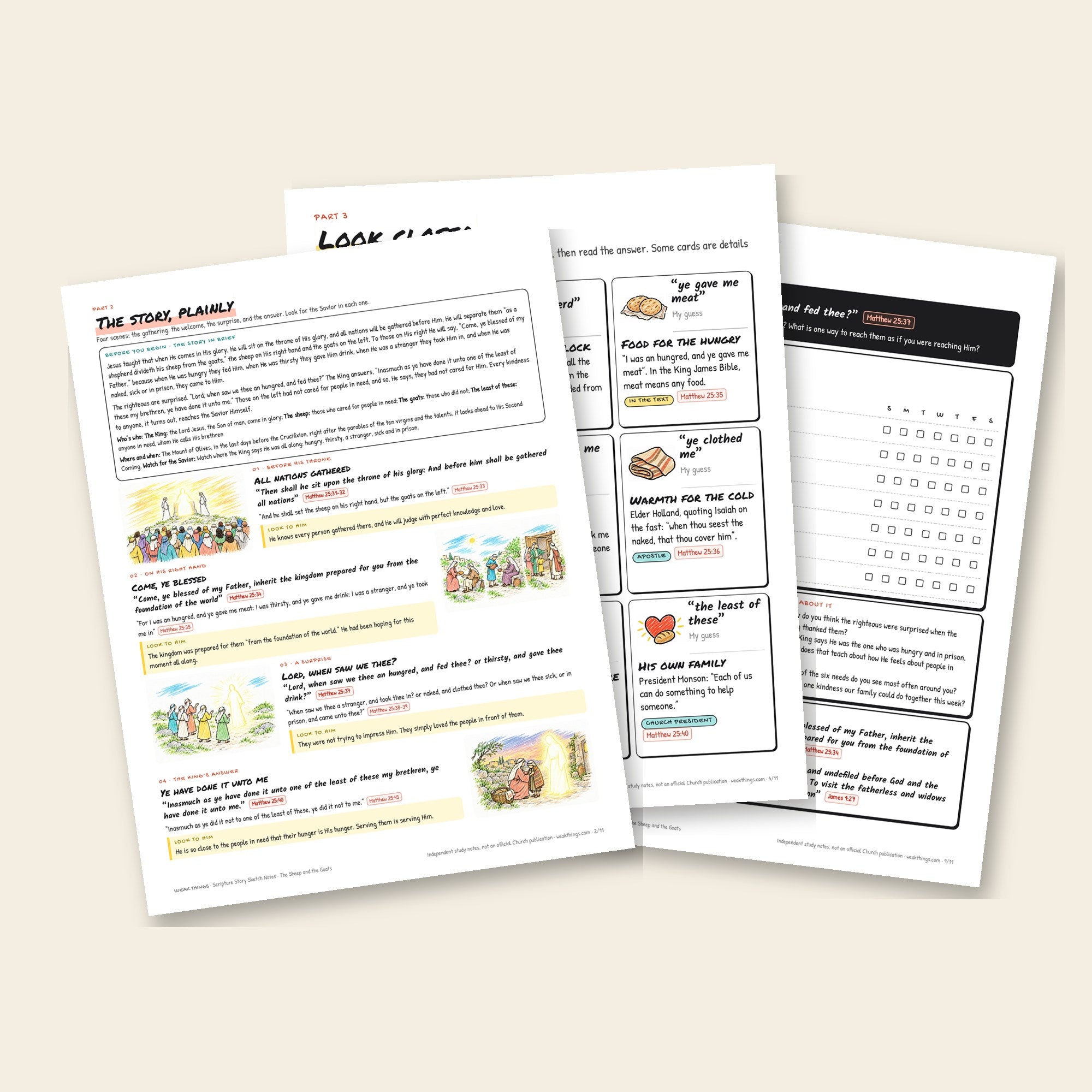
Printable sketch notes
Everything on this page as an 11-page letter-size PDF: the map, scenes, cards, activity, word studies, tracker, Go deeper and sources. For home, class or a quiet Sunday.
More stories
The Sheep and the Goats is part of the Scripture Story Sketch Notes for the New Testament, set alongside Come, Follow Me for May 17–23, 2027 (Joseph Smith—Matthew 1; Matthew 24–25; Mark 12–13; Luke 21).
See every story See all 2027 weeksIndependent study notes from Weak Things, not an official publication of The Church of Jesus Christ of Latter-day Saints. Scripture quotations are from the King James Version. This teaching is told in the Savior’s own words; the insights in “Look closer” are labeled by source.