President Thomas S. Monson, “The Search for Jesus” (2003)
Follows the shepherds and the wise men, then asks where our own search begins: prayer, “room for Him in our hearts,” and gifts of ourselves rather than treasure.8
Read the article →Scripture Story Sketch Notes · Matthew 2
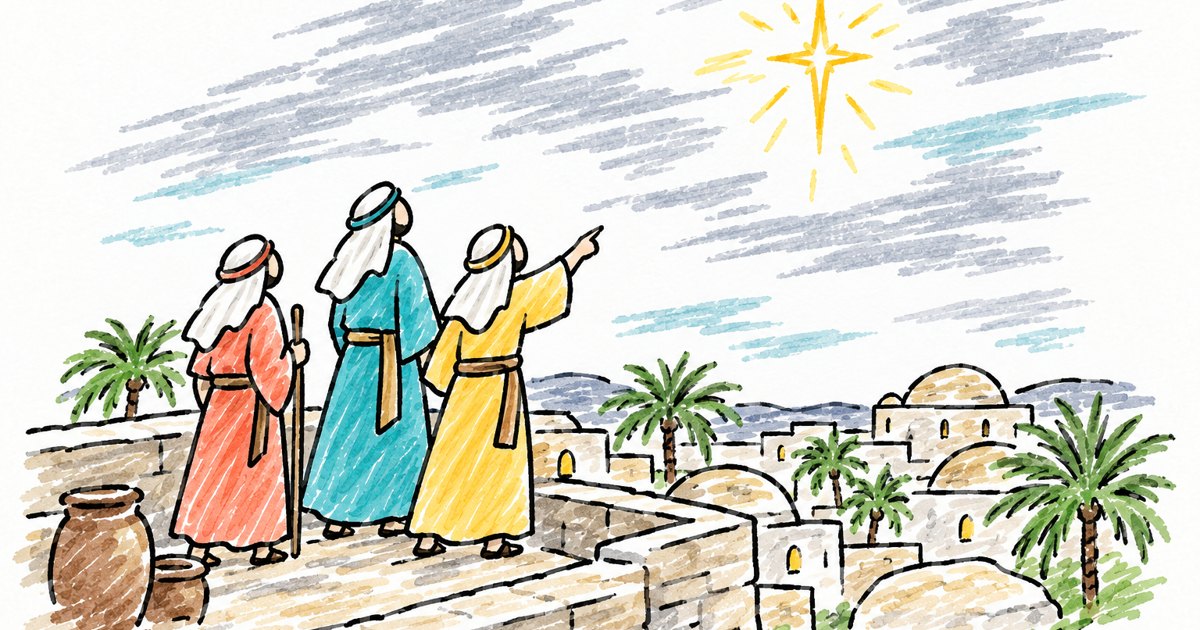
“Where is he that is born King of the Jews? for we have seen his star in the east, and are come to worship him.” Matthew 2:2
A star, a long road, a troubled king, a house in Bethlehem, and another way home. Follow the star on the map, look closer at the gifts, and find yourself among the seekers.
Before you begin
Some time after Jesus was born, wise men from a land to the east saw a new star and understood that a king had been born. They traveled to Jerusalem to find Him and worship Him. King Herod was troubled to hear of a new king. He asked the religious leaders where the Messiah would be born, and they answered from scripture: Bethlehem.
Herod sent the wise men there, pretending he wanted to worship the child too. The star led them to the house where they found the young child with Mary. They knelt, worshipped Him and gave Him gifts of gold, frankincense and myrrh. Then, warned by God in a dream, they went home another way.
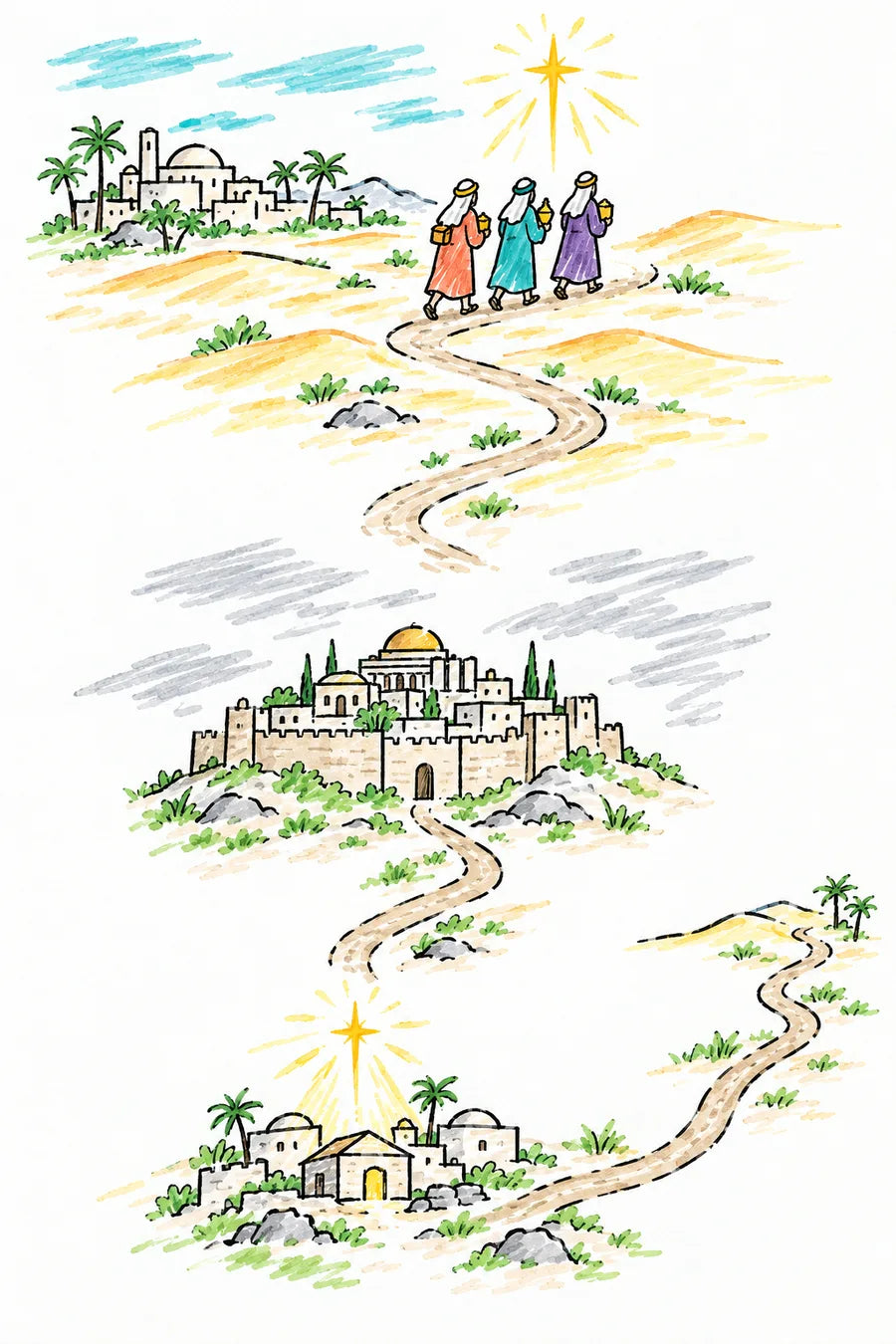
From somewhere in the east to Jerusalem, then on to Bethlehem, a few miles south.
They traveled far for one reason: “to worship him.” Watch what they do when they finally see Him.
Read it yourself: Matthew 2:1–12
Part 1 of 7
Eight stops, from the star in the east to the road home. Scroll, or tap a number on the map.
Part 2 of 7
Four scenes, from a sign in the sky to a different road home. Look for the Savior in each one.
Read it plainly
Tap any dotted word for its meaning. The scripture stays exactly as written.1
Part 3 of 7
This is a true account, not a parable. Some cards are details in the text; others share meanings Church writers have suggested, and each card says which.
All nine. A star, a king, a scroll, a house, three gifts and a new road home, all pointing to one young child. Matthew 2:1–12
Part 4 of 7
The same news reached everyone in Matthew 2. Which response feels most like you right now?
A next step for you
Your choice is saved only on this device.
Try it
Walk the wise men’s road one stop at a time. The star moves ahead of you, and the trail you’ve walked stays on the map. At the last stop, you choose the way home.
“And, lo, the star, which they saw in the east, went before them.” Matthew 2:9
Part 5 of 7
A little background helps us see who came and why it mattered. Outside sources are labeled.
The Bible Dictionary: “it is certain that they were righteous men sent on an errand to witness the presence of the Son of God on the earth.” It suggests they may have been “representatives of a branch of the Lord’s people from somewhere east of Palestine.”12
They came to witness, and they went home to testify.
Skinner: the Greek term “points to a Persian origin,” and perhaps they descended from Jewish priests taken to Babylon. “We do not know how many wise men visited the holy family, nor do we know how long after Jesus’s birth they arrived.”15
Matthew tells us less about who they were and more about what they did.
Herod was “a successful ruler,” friendly with Augustus, who “rebuilt the temple at an immense cost.” But “his reign was disgraced by many acts of cruelty.”12
A king with a throne was afraid of a young child.
“The Bible doesn’t say why the Wise Men brought these particular gifts, but all three gifts had practical value and perhaps symbolic meaning.” The New Era links gold to kingship, frankincense to priesthood offerings, and myrrh to burial.13 The gold may also have helped a young family soon headed to Egypt.13
However they were meant, every gift ended up pointing to who He is.
Word study · Greek
magoi μάγοι · “wise men” (Matthew 2:1)
From a word “of foreign origin” meaning a Magian, “Oriental scientist,” and by extension a magician.16 Skinner notes it “points to a Persian origin.”15 Outside · lexicon
The same word could describe a court astrologer. Matthew uses it for seekers who came to worship, and the Bible Dictionary calls them “righteous men.”12 Whatever they had been, the star brought them to Him.
Word study · Greek
proskyneō προσκυνέω · “worship” (Matthew 2:2, 8, 11)
“To fall face down (prostrate) in adoration.”17 Outside · lexicon
Matthew uses the word three times. The wise men come “to worship him” (Matthew 2:2). Herod says, “that I may come and worship him also” (Matthew 2:8). Only the wise men actually do it: they “fell down, and worshipped him” (Matthew 2:11).1 Same word, very different hearts.
What the text does not say
Matthew never says how many wise men there were. The Bible Dictionary: “We are not told how many wise men there were, but tradition usually speaks of three, because of the three gifts.”12 (Our drawings follow that custom; the text does not.) Matthew doesn’t call them kings or mention camels. They find “the young child” in “the house,” not a baby in a stable.1,19 Elder Talmage warned that “much has been written, beyond all possible warrant of scriptural authority, concerning the visit of the magi.”11
Part 6 of 7
Wise men came a long way to worship a young child. Prophets teach us to seek Him the same way.
“Where is he that is born King of the Jews?” is still the question that matters most. They came a long way, and when they found Him they did one thing first: they “fell down, and worshipped him.”
Matthew 2:2, 111“The formula for finding Jesus has always been and ever will be the same—the earnest and sincere prayer of a humble and pure heart.”
“These are not the gifts Jesus asks of us. From the treasure of our hearts Jesus asks that we give of ourselves.”
“They had to seek, ask, wait, and go, and then do so again, until finally they saw the young child with Mary, His mother.”
“Like them, we should study the scriptures and know the signs to watch for.”
Another Testament
Samuel the Lamanite promised, “there shall a new star arise, such an one as ye never have beheld.” Helaman 14:5 Five years later: “a new star did appear, according to the word.” 3 Nephi 1:21 Heaven announced His birth to seekers on both sides of the earth.
Latter-day scripture
“Behold, the Lord requireth the heart and a willing mind.” Doctrine and Covenants 64:34 President Monson used this verse to teach what our gifts to Him can be.8
Part 7 of 7
The wise men’s question
“Where is he that is born King of the Jews?” Matthew 2:2
They asked it out loud, in a city that didn’t want to hear it. President Monson asked, “how shall we find Him if we don’t seek Him?”8 Ask it in your own words this week: where is He in my life right now?
Each thing you do is one more step on the road. It saves on this device, one day at a time.
0 of 6 today
Six steps behind the star. Come again tomorrow.
A quiet moment
“When they saw the star, they rejoiced with exceeding great joy.”
Think back to a time you felt led toward the Savior: a person, a verse, a quiet prompting. That was your star. Read Matthew 2:9–10 slowly and thank Heavenly Father for it. Matthew 2:9–10
A verse to hold
Talk about it
For adults and deeper study
Longer readings, harder questions, and where to study next. Each one says what it is before you click.
Follows the shepherds and the wise men, then asks where our own search begins: prayer, “room for Him in our hearts,” and gifts of ourselves rather than treasure.8
Read the article →Sister Cordon calls the wise men “great seekers of Jesus Christ” who “diligently spent their lives watching.” Elder Kearon draws lessons from the shepherds, Simeon, Anna and the wise men.9,10
Cordon → Kearon →The Bible Dictionary entry “Magi” and the New Era article “We Three Kings” separate what Matthew says from what later tradition added; “Thoughtful Gifts” explains the gifts’ uses and suggested meanings.12,14,13
Magi → We Three Kings → Thoughtful Gifts →An overview by a Latter-day Saint scholar of the Savior’s birth and early life, including the magi, Herod and the family’s move to Nazareth.15
Read the chapter →Elder Talmage connects these prophecies with the star the magi saw.11
Jesus the Christ, chapter 8 →Every quotation, gloss, and piece of background on this page is listed here: scripture first, then Church sources, then outside scholarship (labeled).
Quotations checked against the linked pages on October 7, 2026. Scripture is quoted from the King James Version as published in the Gospel Library.

They saw, they sought, they asked, they followed, they knelt, they gave, and they went home another way. The star still leads to the same place. Matthew 2:2
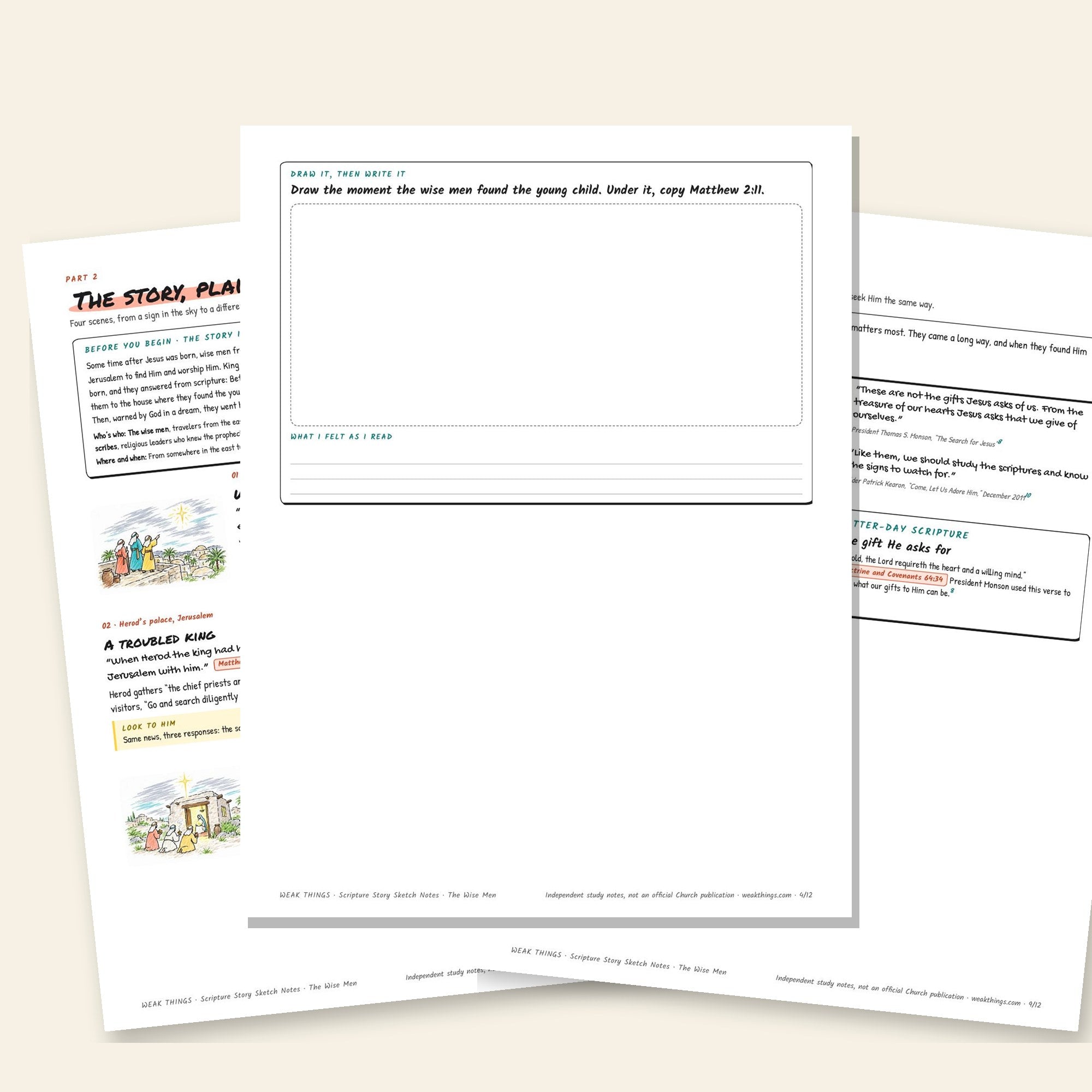
Printable sketch notes
Everything on this page as a 11-page letter-size PDF: the map, scenes, cards, activity, word studies, tracker, Go deeper and sources. For home, class or a quiet Sunday.
More stories
The Wise Men is part of the Scripture Story Sketch Notes for the New Testament, set alongside Come, Follow Me for January 4–10, 2027 (Matthew 2; Luke 2).
See every story See all 2027 weeksIndependent study notes from Weak Things, not an official publication of The Church of Jesus Christ of Latter-day Saints. Scripture quotations are from the King James Version. This is a true account, not a parable; the insights in “Look closer” are labeled by source.