Elder Howard W. Hunter, “Master, the Tempest Is Raging” (1984)
The geography of sudden storms on Galilee, the story behind Mary Ann Baker’s hymn, and peace in the Savior’s heart “no matter how fiercely the tempest was raging.”6
Read the talk →Scripture Story Sketch Notes · Mark 4:35–41; Matthew 8:23–27; Luke 8:22–25
“Peace, be still. And the wind ceased, and there was a great calm.” Mark 4:39
An evening crossing, a sudden storm, a tired Savior asleep in the stern, and three words that calmed the sea. Ride the map, look closer, and bring Him your storm.
Before you begin
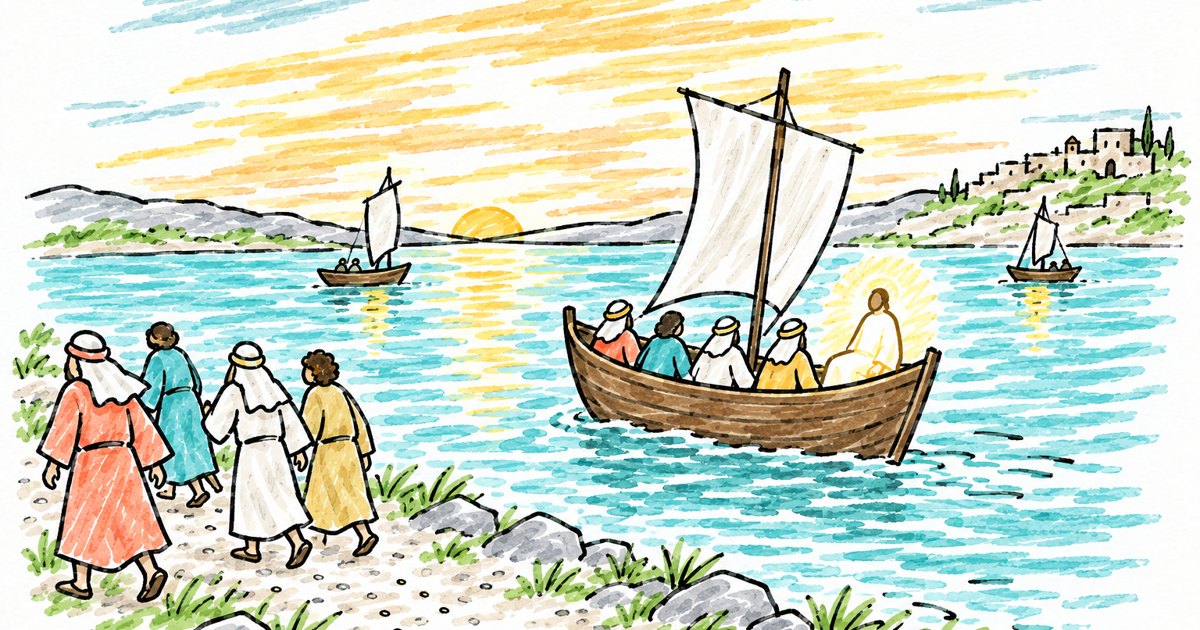
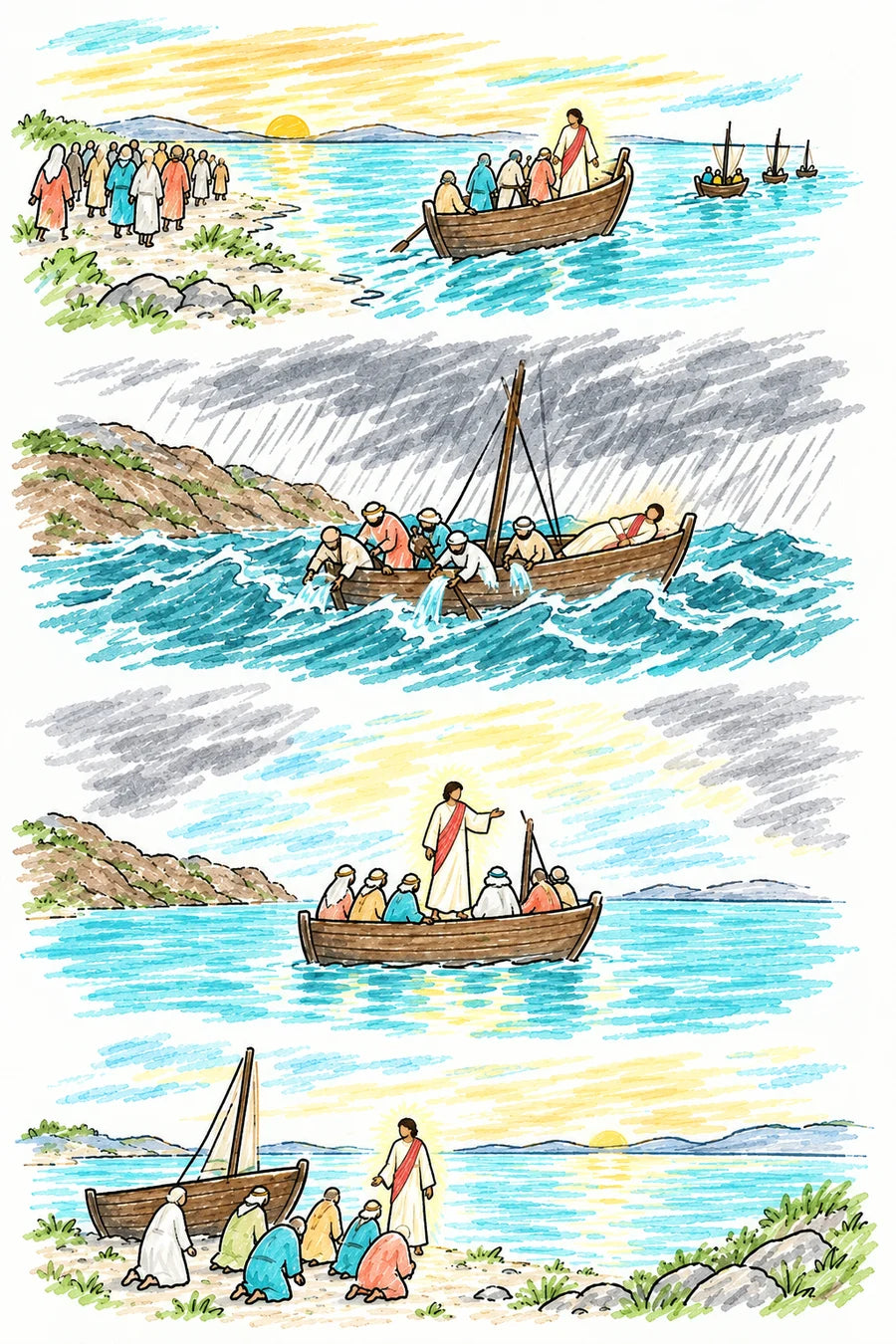
After a long day teaching by the Sea of Galilee, Jesus told His disciples, “Let us pass over unto the other side.” They set out in a fishing boat that evening, and Jesus, worn out, fell asleep on a cushion in the back of the boat.
A violent windstorm hit the lake. Waves crashed into the boat until it was filling with water. The terrified disciples woke Him: “Master, carest thou not that we perish?” Jesus stood, commanded the wind and said to the sea, “Peace, be still,” and everything went completely calm. He asked why they were so afraid, and they wondered to each other what kind of man even the wind and sea obey.
A fishing boat crossing the Sea of Galilee at night.
He was tired enough to sleep and powerful enough to command the sea: fully human and the Creator at once.
Read it yourself: Mark 4:35–41
Part 1 of 7
Eight stops across the lake, from the shore to the great calm. Scroll, or tap a number on the map.
Part 2 of 7
Four scenes: pushing off, the storm, the cry for help and the great calm. Look for the Savior in each one.
Read it plainly
Tap any dotted word for its meaning. The scripture stays exactly as written.1
Part 3 of 7
This is a true account, not a parable. Some cards are details in the text; others share insights from prophets and Church resources, and each card says which.
All nine. A boat, little ships, the hills, the waves, a pillow, reaching hands, the wind, a great calm and the light. Mark 4:35–41
Part 4 of 7
People in the boat were caught in a sudden storm, wondering if He cared, afraid, or amazed after the calm. Which feels most like you right now?
A next step for you
Your choice is saved only on this device.
Try it
The storm is loud. Press and hold the button, and keep holding. As you hold, the waves settle and His words appear, line by line. Let go and the wind picks up again.
“He can calm the troubled waters of our lives.” Elder Howard W. Hunter
Part 5 of 7
A little background helps us feel the storm the way the disciples did. Outside sources are labeled.
Elder Hunter: “The Sea of Galilee is quite low, about 680 feet below sea level,” and “the hills surrounding the water rise up very sharply.”6
Cold air from the hills meets warm air over the water.
Scripture Helps: the lake “is relatively shallow, with a maximum depth of 141 feet (43 m), which tends to produce larger waves when wind speeds are high.”5
Even fishermen could be frightened.
Elder Talmage: “Sleep after toil is natural and necessary. The day’s work done, Jesus slept.”4
He knows what it is to be worn out.
Matthew, Mark and Luke all tell it, each with a different cry: “Lord, save us: we perish”; “Master, carest thou not that we perish?”; “Master, master, we perish.”2
Each cry was heard.
Word study · Greek
siōpaō σιωπάω · “Peace” (Mark 4:39)
Word study · Greek
phimoō φιμόω · “be still” (Mark 4:39)
What the text does not say
The account doesn’t promise that every storm will stop the moment we pray. Elder Hunter: “We should not expect to get through life individually or collectively without some opposition.”6 It does show who is in the boat with us.
Part 6 of 7
He was tired enough to sleep and powerful enough to command the sea. Both were true at once.
Elder Howard W. Hunter: “No waters can swallow the ship where lies the Master of ocean and earth and skies.”
Elder Howard W. Hunter, quoting the hymn “Master, the Tempest Is Raging,” October 19846“All of us have seen some sudden storms in our lives.”
“On the Sea of Galilee, the stirring of the disciples’ faith was ultimately more important than the stilling of the sea.”
“Peace was on the lips and in the heart of the Savior no matter how fiercely the tempest was raging.”
“They were abjectly frightened, and at least partly forgetful that there was with them One whose voice even death had to obey.”
Gospel of Matthew
“And his disciples came to him, and awoke him, saying, Lord, save us: we perish.” Matthew 8:25
Gospel of Luke
“And he said unto them, Where is your faith? … What manner of man is this! for he commandeth even the winds and water, and they obey him.” Luke 8:25
Part 7 of 7
The Savior’s words
“Peace, be still.” Mark 4:39
Elder Hunter: “our faith should remind us that he can calm the troubled waters of our lives.”6 What storm will you bring to Him this week?
One step toward peace a day. It saves on this device, one day at a time.
0 of 7 today
Seven days of turning to Him. Come again tomorrow.
A quiet moment
“Peace, be still. And the wind ceased, and there was a great calm.”
Read Mark 4:35–41 slowly. Picture yourself in the boat. Then ask Heavenly Father what storm He wants to help you with, and listen. Mark 4:35–41
A verse to hold
Talk about it
For adults and deeper study
Longer readings, harder questions, and where to study next. Each one says what it is before you click.
The geography of sudden storms on Galilee, the story behind Mary Ann Baker’s hymn, and peace in the Savior’s heart “no matter how fiercely the tempest was raging.”6
Read the talk →The crossing, why Jesus slept, the disciples’ three cries, and the Creator’s dominion over the elements.4
Read chapter 20 →The geography and depth of the Sea of Galilee and why it is prone to windstorms.5
Read Scripture Helps →The same crossing in two more Gospels, with “Lord, save us” and “Where is your faith?”3
Read Matthew 8 → Read Luke 8 →Every quotation, gloss, and piece of background on this page is listed here: scripture first, then Church sources, then outside scholarship (labeled).
Quotations checked against the linked pages on October 7, 2026. Scripture is quoted from the King James Version as published in the Gospel Library.
He was tired enough to sleep and powerful enough to command the sea. He is in the boat with you. Peace, be still. Mark 4:39
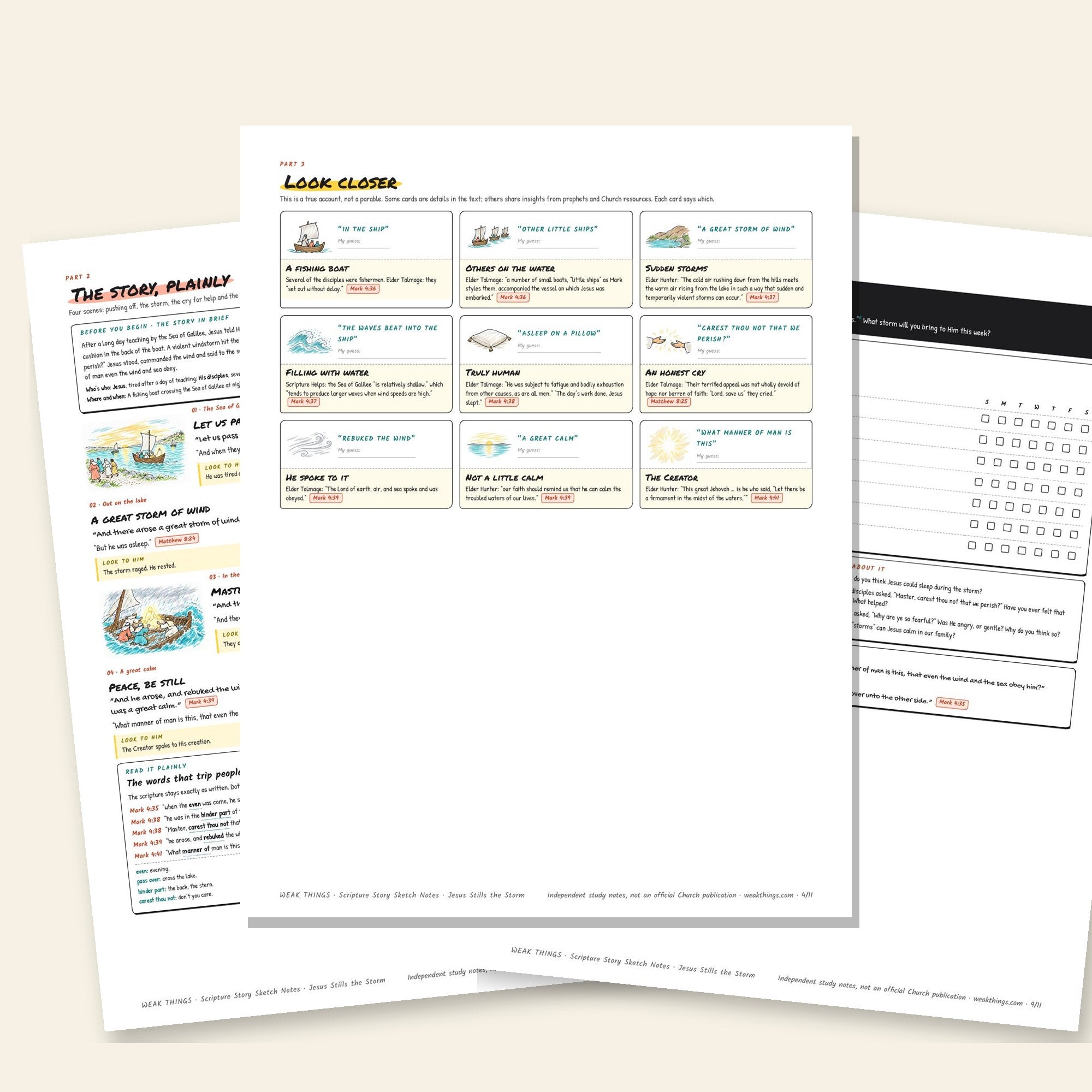
Printable sketch notes
Everything on this page as a 11-page letter-size PDF: the map, scenes, cards, activity, word studies, tracker, Go deeper and sources. For home, class or a quiet Sunday.
More stories
Jesus Stills the Storm is part of the Scripture Story Sketch Notes for the New Testament, set alongside Come, Follow Me for February 22–28, 2027 (Matthew 8; Mark 2–4; Luke 7).
See every story See all 2027 weeksIndependent study notes from Weak Things, not an official publication of The Church of Jesus Christ of Latter-day Saints. Scripture quotations are from the King James Version. This is a true account, not a parable; the insights in “Look closer” are labeled by source.