Elder Chi Hong (Sam) Wong, “Rescue in Unity” (2014)
The four friends imagined as a modern ward council, and the “hidden treasure” of “their faith.”6
Read the talk →Scripture Story Sketch Notes · Mark 2:1–12; Luke 5:17–26
“When Jesus saw their faith, he said unto the sick of the palsy, Son, thy sins be forgiven thee.” Mark 2:5
A packed house in Capernaum, a man who couldn’t walk, four friends who wouldn’t give up, and a Savior with power to forgive. Walk the map, look closer, and think of who you could carry.

Before you begin
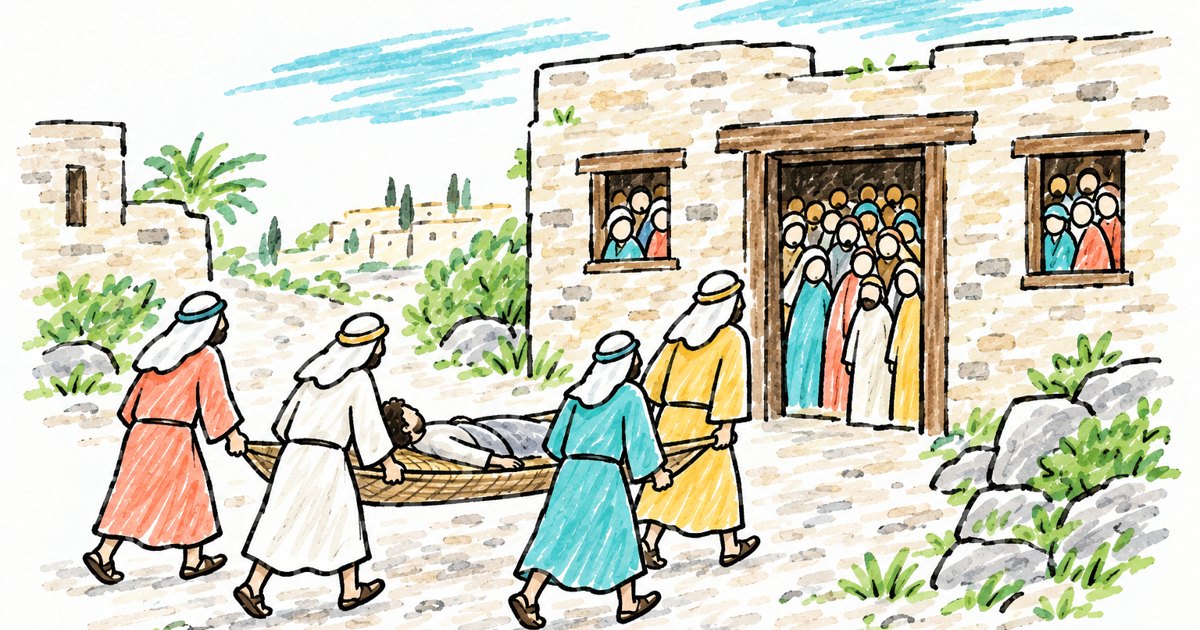
Jesus came back to Capernaum, and word spread that He was in a house there. So many people crowded in that no one else could get near the door. Four men arrived carrying a friend who had palsy, a paralysis that kept him from moving on his own.
They could not get through the crowd, so they climbed onto the flat roof, opened a hole and lowered their friend on his mat right in front of Jesus. When Jesus saw their faith, He told the man his sins were forgiven. Some religious teachers silently objected that only God can forgive sins. To show He had that power, Jesus told the man to get up, take his mat and go home, and the man walked out in front of everyone.
A crowded house in Capernaum, by the Sea of Galilee.
Jesus forgave first and healed second; the healing everyone could see proved the forgiveness they couldn’t.
Read it yourself: Mark 2:1–12
Part 1 of 7
Eight stops, from the crowded door to a man walking home. Scroll, or tap a number on the map.
Part 2 of 7
Four scenes: the street, the roof, inside the house and out the door. Look for the Savior in each one.
Read it plainly
Tap any dotted word for its meaning. The scripture stays exactly as written.1
Part 3 of 7
This is a true account, not a parable. Some cards are details in the text; others share insights from prophets and Church resources, and each card says which.
All nine. A house, a blocked door, a mat, four friends, a ladder, a hole in the roof, ropes, their faith and a man walking home. Mark 2:1–12
Part 4 of 7
People in this story needed carrying, did the carrying, were blocked at the door, or carried a hidden burden. Which feels most like you right now?
A next step for you
Your choice is saved only on this device.
Try it
Nothing about this rescue was easy. Tap the friends’ steps in the order they happened. When a step is right, it moves into place with its verse.
“When Jesus saw their faith.” Mark 2:5
Part 5 of 7
A little background helps us see the house, the roof and the question the scribes asked. Outside sources are labeled.
Scripture Helps: houses in Capernaum had “a flat roof made of wooden beams, thatch, and packed earth.”5
Opening it was hard work, but it could be done.
Elder Talmage: palsy was “a species of paralysis which deprived the subject of the power of voluntary motion and usually of speech; the man was helpless.”4
He could not have reached Jesus alone.
The scribes reasoned, “who can forgive sins but God only?”1 They were right that only God can forgive.
So by forgiving, Jesus was showing who He is.
Elder Talmage quotes Alfred Edersheim (an outside scholar): “In this forgiveness of sins He presented His person and authority as divine, and He proved it such by the miracle of healing which immediately followed.”4
The healing you could see proved the forgiveness you couldn’t.
Word study · Greek
aphiēmi ἀφίημι · “forgive” (Mark 2:5)
Word study · Greek
krabattos κράβαττος · “bed” (Mark 2:4, 11–12)
What the text does not say
Mark doesn’t name the four friends or the man, and he doesn’t say the man’s sickness was caused by sin. Elder Talmage notes only that “in many instances” sickness and sin are linked, and that Christ “recognized his repentance together with the faith that accompanied it.”4
Part 6 of 7
He saw their faith, read the hearts in the room and showed He has power to forgive sins.
Elder Chi Hong (Sam) Wong noticed a “hidden treasure” in Mark 2:5: “When Jesus saw their faith.” “Our combined faith will also affect the well-being of others.”
Elder Chi Hong (Sam) Wong, October 20146“In order to assist the Savior, we have to work together in unity and in harmony. Everyone, every position, and every calling is important.”
“They did not leave the man with palsy by the door.”
“Jesus was deeply impressed by the faith and works of those who had thus labored to place a helpless paralytic before Him.”
“Jesus showed mercy on him and healed him—not only physically but also spiritually.”
Gospel of Matthew
Matthew records the first thing Jesus said to him: “Son, be of good cheer; thy sins be forgiven thee.” Matthew 9:2
Gospel of Luke
Luke adds that the healed man went home “glorifying God,” and the crowd said, “We have seen strange things to day.” Luke 5:25–26
Part 7 of 7
The Savior’s words
“Son, thy sins be forgiven thee.” Mark 2:5
He saw their faith and answered the man’s deepest need first.1 Who could you help bring to Him this week, and how?
One step for a friend a day. It saves on this device, one day at a time.
0 of 7 today
Seven days of carrying. Come again tomorrow.
A quiet moment
“Son, be of good cheer; thy sins be forgiven thee.”
Read Mark 2:1–12 slowly. Picture yourself as the man on the mat, then as one of the four. Ask Heavenly Father which one you are this week. Mark 2:1–12
A verse to hold
Talk about it
For adults and deeper study
Longer readings, harder questions, and where to study next. Each one says what it is before you click.
The four friends imagined as a modern ward council, and the “hidden treasure” of “their faith.”6
Read the talk →The crowded house, how the friends reached the roof, why Jesus forgave first, and the scribes’ silent question.4
Read chapter 14 →Capernaum houses and roofs, what palsy meant, and the faith of all five men.5
Read Scripture Helps →The same miracle in two more Gospels: the tiling, “be of good cheer,” and the crowd glorifying God.2
Read Luke 5 → Read Matthew 9 →Every quotation, gloss, and piece of background on this page is listed here: scripture first, then Church sources, then outside scholarship (labeled).
Quotations checked against the linked pages on October 7, 2026. Scripture is quoted from the King James Version as published in the Gospel Library.

Four friends wouldn’t give up. The Savior saw their faith, forgave the man’s sins and sent him home walking. Bring your friends to Him. Mark 2:5

Printable sketch notes
Everything on this page as a 11-page letter-size PDF: the map, scenes, cards, activity, word studies, tracker, Go deeper and sources. For home, class or a quiet Sunday.
More stories
Through the Roof is part of the Scripture Story Sketch Notes for the New Testament, set alongside Come, Follow Me for February 22–28, 2027 (Matthew 8; Mark 2–4; Luke 7).
See every story See all 2027 weeksIndependent study notes from Weak Things, not an official publication of The Church of Jesus Christ of Latter-day Saints. Scripture quotations are from the King James Version. This is a true account, not a parable; the insights in “Look closer” are labeled by source.