1 · The scriptures
“the scriptures, or the words of ancient prophets.” Elder David A. Bednar asked, “Are you and I daily reading, studying, and searching the scriptures in a way that enables us to hold fast to the rod of iron?”
Scripture Story Sketch Notes · 1 Nephi 8–15
“I have dreamed a dream; or, in other words, I have seen a vision.” 1 Nephi 8:2
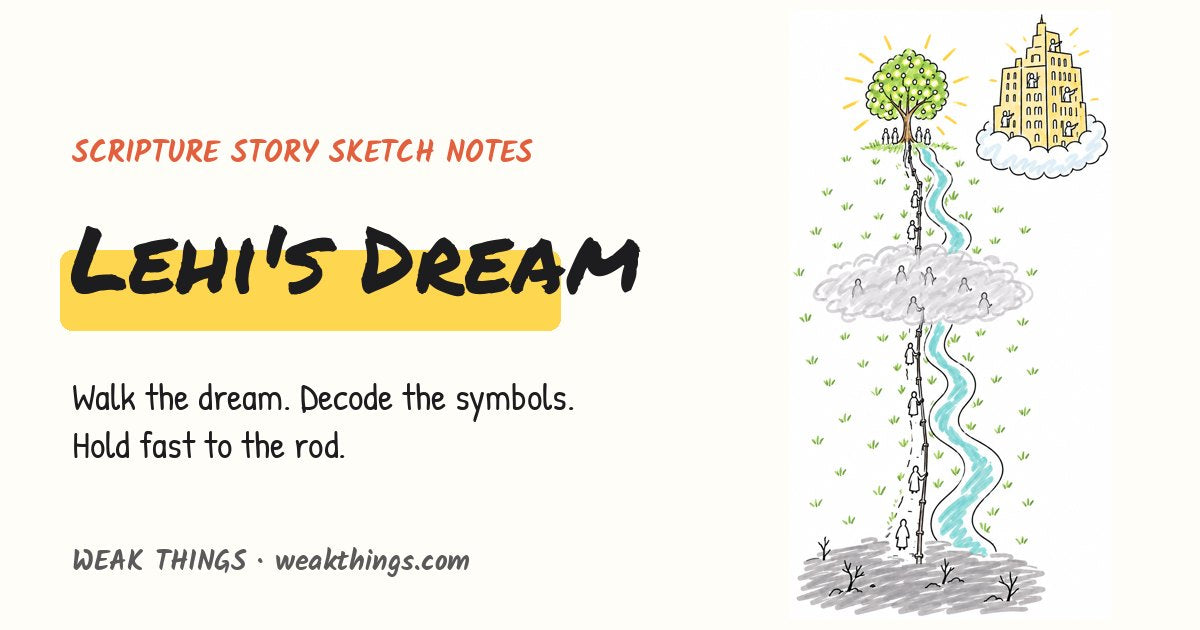
A whole plan of salvation, drawn as one landscape. Walk it one landmark at a time, decode what each symbol means, and find yourself on the path.
Before you begin
Not long after leaving Jerusalem, Lehi’s family was camped in the wilderness when Lehi told them, “I have dreamed a dream; or, in other words, I have seen a vision.” In the dream a man in a white robe asked Lehi to follow him, and Lehi found himself in a dark and dreary waste. After many hours he prayed for mercy. Then he saw a large field and a tree whose white fruit was “most sweet, above all that I ever before tasted.”
The fruit filled him with joy, and his first thought was his family. Sariah, Sam and Nephi came and ate; Laman and Lemuel would not. Lehi saw a rod of iron along a river, a strait and narrow path, crowds pressing toward the tree, a mist of darkness, and a great and spacious building full of people mocking those who ate. Some travelers were lost in the mist, some tasted the fruit and then fell away in shame, and some kept holding to the rod until they reached the tree.
Nephi wanted to see what his father saw. In his own vision an angel showed him that the tree is the love of God, and showed him the Son of God.
A tent camp in the Arabian wilderness, about 600 B.C., soon after the family left Jerusalem.
When Nephi asked what the tree meant, the angel showed him a mother holding her child and said, “Behold the Lamb of God.” The love of God is made known in Jesus Christ.
Read it yourself: 1 Nephi 8 · 1 Nephi 11:1–25 · 1 Nephi 15:21–36
Part 1 of 8
Nine landmarks, from where Lehi started to where the path leads. Scroll, or tap a number on the map.
Part 2 of 8 · Lehi's journey
Notice
Darkness, then prayer, then light. And the moment Lehi tastes joy, he looks for his family.
“I knew that it was desirable above all other fruit.” 1 Nephi 8:12
Part 3 of 8 · What it means
Nephi asked to know “the interpretation thereof” 1 Nephi 11:11. Guess first, then tap a card to see what the angel and Nephi said it means.
All nine decoded. Every symbol came straight from the scriptures.
Part 4 of 8 · Where are you on the path?
“The key phrase in this verse is continually holding fast to the rod of iron.”
Try it
Press and hold the button to walk along the rod. Let go, and the mist rolls back in.

“…continually holding fast to the rod of iron, until they came forth and fell down and partook of the fruit of the tree.”
1 Nephi 8:30Part 5 of 8 · The word of God
Nephi's brothers asked the question you might ask: “What meaneth the rod of iron which our father saw, that led to the tree?” 1 Nephi 15:23
“It was the word of God; and whoso would hearken unto the word of God, and would hold fast unto it, they would never perish; neither could the temptations and the fiery darts of the adversary overpower them unto blindness, to lead them away to destruction.”
1 Nephi 15:24
Elder Neil L. Andersen described three talks, given to the same audience, that “identified three aspects of the iron rod, or the word of God.” “Fruit,” Oct. 2019 general conference
“the scriptures, or the words of ancient prophets.” Elder David A. Bednar asked, “Are you and I daily reading, studying, and searching the scriptures in a way that enables us to hold fast to the rod of iron?”
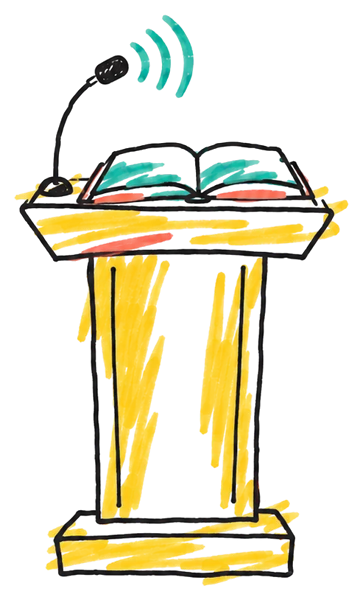
“the words of living prophets.” General conference talks are part of the rod you can hold today.

“the power of the Holy Ghost.” President Boyd K. Packer: “If you hold to the rod, you can feel your way forward with the gift of the Holy Ghost.”
Group 2 · 1 Nephi 8:24–28
“…clinging to the rod of iron, even until they did come forth and partake of the fruit of the tree.”
They made it through the mist. Then the mocking from the building made them ashamed, and “they fell away into forbidden paths and were lost.” 1 Nephi 8:24, 28
Group 3 · 1 Nephi 8:30
“…continually holding fast to the rod of iron, until they came forth and fell down and partook of the fruit of the tree.”
Same rod, same mist. The difference is a grip that is never let go. 1 Nephi 8:30
“Perhaps this third group of people consistently read and studied and searched the words of Christ. … This is the group you and I should strive to join.”
“The rod of iron represented for this group of people the only safety and security that they could find, and they held fast continually; they refused to let go.”
“Search the Book of Mormon and the words of the living prophets every day, every day, every day! It's the key to spiritual survival and avoiding deception. Without it, we are spiritually lost.”
“I promise that as you prayerfully study the Book of Mormon every day, you will make better decisions—every day. … I promise that as you daily immerse yourself in the Book of Mormon, you can be immunized against the evils of the day.”
“Strong faith requires more than strong desire. It means daily trying, one step at a time, with prayer and scriptural learning.”
“Our need for constant recourse to the scriptures is greater than in any previous time.”

Try it today
Six small ways to hold the rod, each taken from a prophet's counsel. Tap each one as you do it, and watch the hand-holds fill in.
0 of 6 hand-holds today
“…feast upon the words of Christ; for behold, the words of Christ will tell you all things what ye should do.” 2 Nephi 32:3
That is today's grip. Holding fast continually means coming back tomorrow.
A verse to hold this week
Part 6 of 8
A little background helps us see the dream the way Lehi’s family did. Outside sources are labeled.
Dana M. Pike: “‘Behold, I have dreamed a dream,’ Lehi announced to his family one morning in the valley of Lemuel in northwestern Arabia.”20
They were far from home, living in the desert.
Pike: people of the ancient Near East “believed that many if not all dreams came as communications from external sources,” and “the Bible, not surprisingly, indicates dreams originated with Jehovah, the true God.”20
Lehi’s family would have taken this dream seriously.
Hugh Nibley: in the old Arab poems of desert travel, “the culminating horror is almost always a ‘mist of darkness,’ a depressing mixture of dust, and clammy fog, which, added to the night, completes the confusion of any who wander in the waste.”21
Being lost in the dark was a real fear for desert travelers.
Nibley: a desert river is either “a clear stream a few yards wide with its source but a hundred paces away” or “a raging muddy wash, a sayl of ‘filthy water’ that sweeps people away to their destruction.”21
Lehi’s dream has both: a fountain of living waters and a river of filthy water.
The tree of life was planted “in the midst of the garden” of Eden, and Proverbs says of wisdom, “She is a tree of life to them that lay hold upon her.”7
Lehi knew these scriptures. “Lay hold” sounds a lot like holding to the rod.
Come, Follow Me: “Lehi’s dream—with its iron rod, mists of darkness, spacious building, and tree with ‘most sweet’ fruit—is an inspiring invitation to receive the blessings of the Savior’s love and atoning sacrifice.”9
Every landmark points toward Christ.
Word study · Hebrew
ʿēṣ ḥayyîm עֵץ חַיִּים · “tree of life” (Genesis 2:9; Proverbs 3:18)
ʿēṣ is the everyday Hebrew word for a tree; ḥayyîm is the plural of ḥay, “living” or “life.”23 Outside · lexicon
Lehi wrote in “the learning of the Jews and the language of the Egyptians” (1 Nephi 1:2), so we don’t know the exact words he used. Nephi calls it “the tree of life” (1 Nephi 11:25).
Part 7 of 8
Nephi asked what the tree meant. The angel answered by showing him the Savior.
“Behold the Lamb of God, yea, even the Son of the Eternal Father! Knowest thou the meaning of the tree which thy father saw?”
The angel to Nephi, 1 Nephi 11:212Look closer
Right before the angel asks Nephi what the tree means, Nephi sees the virgin “bearing a child in her arms” and hears, “Behold the Lamb of God.” Then he answers: “it is the love of God.” 1 Nephi 11:20–22
“Yea, it is the love of God, which sheddeth itself abroad in the hearts of the children of men; wherefore, it is the most desirable above all things. … Yea, and the most joyous to the soul.”
“I beheld the Son of God going forth among the children of men; and I saw many fall down at his feet and worship him.”
“Holding fast to the word of God leads me to the Savior and helps me feel His love.”
Alma’s sermon
Alma compares the word to a seed that grows into “a tree springing up unto everlasting life,” with fruit “which is sweet above all that is sweet, and which is white above all that is white.” Alma 32:41–426
Nephi’s teaching
“Ye must press forward with a steadfastness in Christ … feasting upon the word of Christ, and endure to the end.” 2 Nephi 31:205
The Bible’s last book
“To him that overcometh will I give to eat of the tree of life, which is in the midst of the paradise of God.” Revelation 2:78
Part 8 of 8 · Living it today

Nephi did. He desired, believed the Lord could show him, and pondered. Then he was “caught away in the Spirit” to a high mountain. 1 Nephi 11:1–6
From modern prophets
“Grasp the iron rod, and do not let go.”
“An unseen power will hold your hand as you hold to the iron rod.”
President Boyd K. Packer, “Lehi's Dream and You,” BYU devotional, Jan. 16, 2007; New Era, Jan. 2015
“The rod of iron is the word of God.”
Elder David A. Bednar, Ensign, Oct. 2011
Lehi's answer to the mockers: “but we heeded them not.” 1 Nephi 8:33
Talk about it
For adults and deeper study
Longer readings, harder questions, and where to study next. Each one says what it is before you click.
Nephi sees the tree, the virgin and her child, the ministry and Crucifixion of the Lamb, and the future of his people. Then he explains the dream to his brothers in 1 Nephi 15.2
Read 1 Nephi 11 → Read 1 Nephi 15:21–36 →The four groups of travelers and what “continually holding fast” looks like in daily scripture study.11
Read the article →A devotional for young adults on the mist, the rod and feeling your way forward by the Holy Ghost.12
Read the devotional →A table of each symbol, its meaning and questions to ponder, with family and individual study ideas.9
Read the lesson →How dreams were understood in Lehi’s world and why the dream and Nephi’s vision together form “a powerful Christ-centered foundation for the whole Book of Mormon.”20
Read the chapter →The desert images in the dream: the dark and dreary waste, the mist of darkness, the springhead and the flash-flood river, and paths that stray.21
Read the chapter →Why Nephi could recognize the meaning of the tree in a mother and her child. Peterson argues Nephi’s vision “reflects a meaning of the ‘sacred tree’ that is unique to the ancient Near East.”22
Read the article →Ancient Jewish and early Christian descriptions of a tree of life with white fruit, and a biblical scholar’s reaction to finding it in the Book of Mormon.24
Read the summary →Lehi saw the tree; Nephi saw the Savior. Why might the Lord answer a question about a tree with a mother and her baby? What does the “condescension of God” (1 Nephi 11:26) teach about how the love of God reaches us?
Every quotation, gloss and piece of background on this page is listed here: scripture first, then Church sources, then outside scholarship (labeled).
Quotations checked against the linked pages on October 12, 2026. Book of Mormon and Bible text is quoted from the editions published in the Gospel Library.
Lehi's first thought was his family. Who will you bring with you? 1 Nephi 8:15
This is a pilot
Lehi's Dream is the first of the Book of Mormon story lessons we are building to go alongside the January 17–23, 2028 lesson in Come, Follow Me. We are planning three versions of each story: brick figures for younger children, sketch notes like this for older children and youth, and a deeper adult study.
See what is coming & get updatesIndependent study notes from Weak Things, not an official publication of The Church of Jesus Christ of Latter-day Saints. Scripture quotations are from the Book of Mormon; symbol meanings are taken from 1 Nephi 11, 12 and 15. Outside scholarship is labeled and listed in the sources.