President Dieter F. Uchtdorf, “The Merciful Obtain Mercy” (2012)
Judging, grudges and the two-word sermon, with Paul’s counsel to feed our enemies.5
Read the talk →Scripture Story Sketch Notes · Romans 12; Romans 16:1–22
“Be not overcome of evil, but overcome evil with good.” Romans 12:21
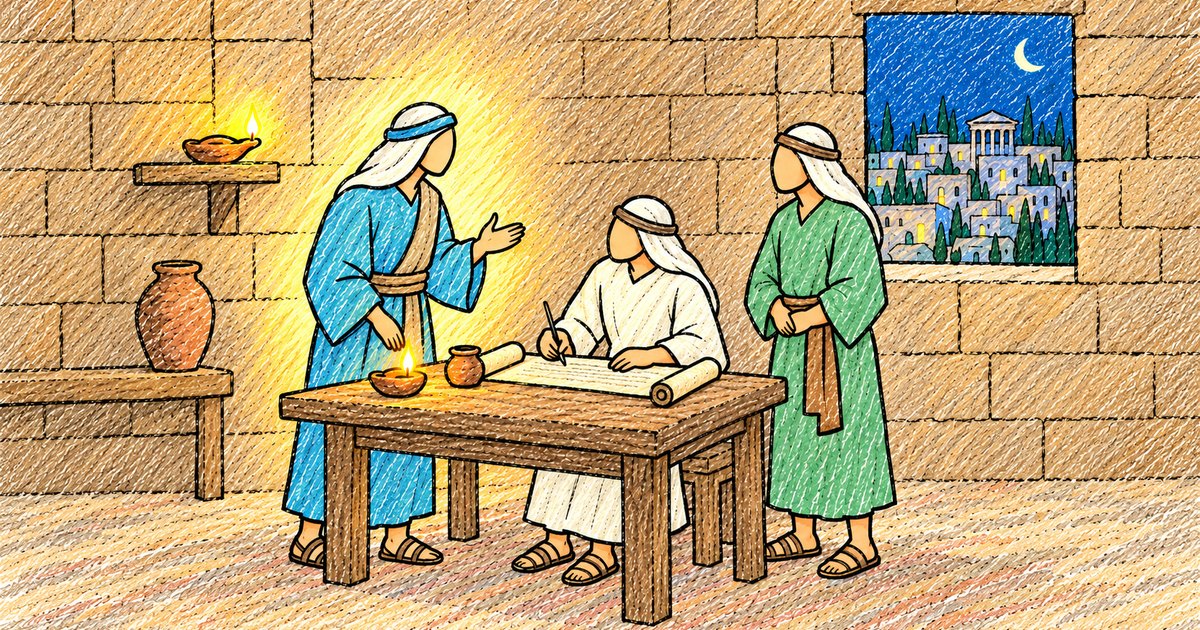
A letter written in Corinth, carried by Phebe, read aloud in a house in Rome. Inside: how to love without pretending, weep with those who weep, and feed an enemy, the way Jesus did.
Before you begin
While staying in Corinth, Paul dictated a letter to the Saints in Rome, a city he had not yet visited. A scribe named Tertius wrote it down, and a trusted sister named Phebe likely carried it across the sea, where it was read aloud to small congregations meeting in homes.
In chapter 12, Paul pleads “by the mercies of God” that the Saints offer themselves as a living sacrifice and be transformed. He reminds them that they are one body with differing gifts, and then gives counsel that echoes the Savior’s Sermon on the Mount: love without pretending, bless those who persecute you, rejoice with those who rejoice and weep with those who weep, never repay evil for evil, leave vengeance to the Lord, and feed a hungry enemy. “Be not overcome of evil,” he ends, “but overcome evil with good.”
Written in Corinth, Greece, and read in house churches in Rome.
Watch how every piece of Paul’s counsel matches the way Jesus treated people.
Read it yourself: Romans 12
Part 1 of 7
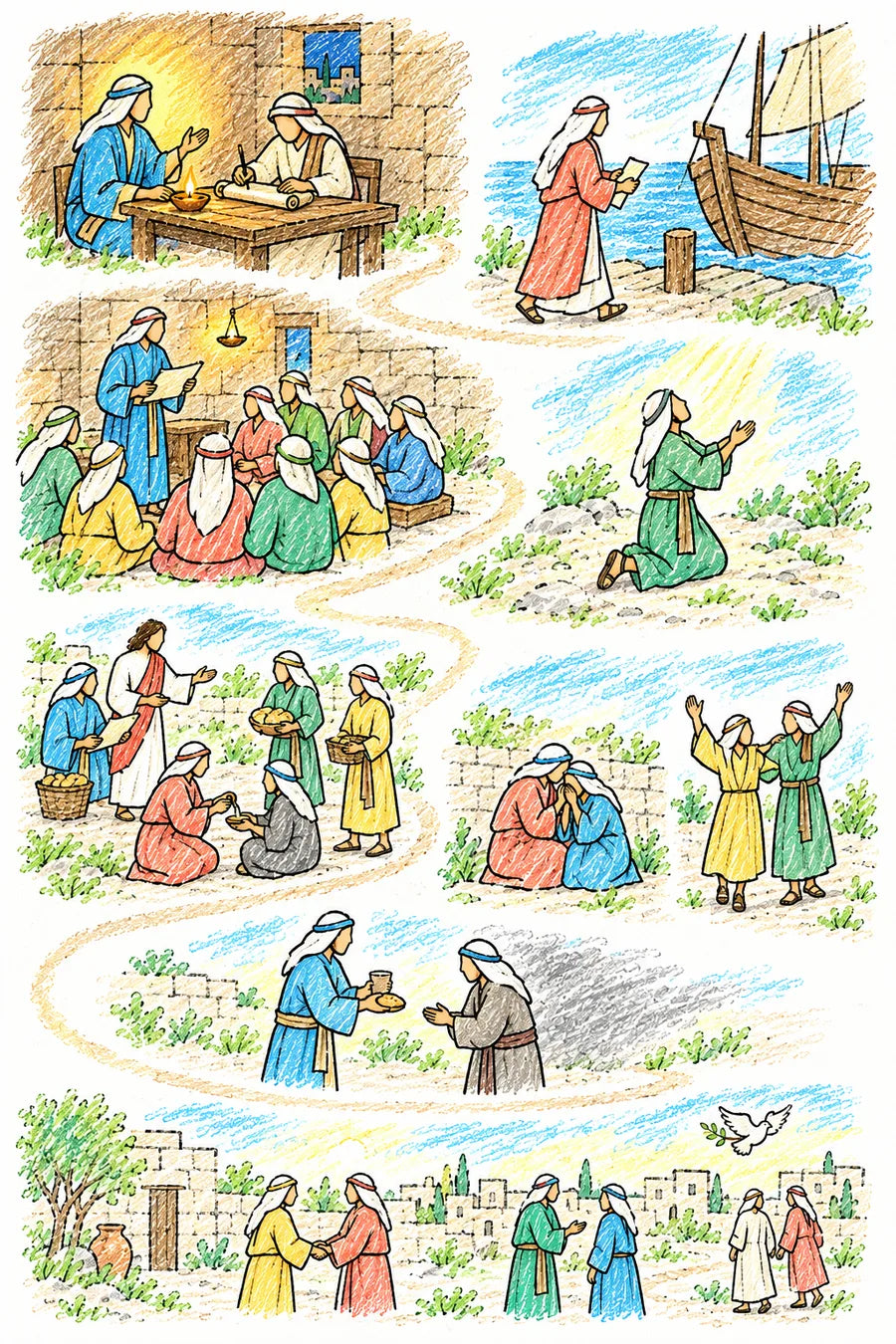
Eight stops from Corinth to a peaceful street in Rome. Scroll, or tap a number on the map.
Part 2 of 7
Four scenes: the letter, the house church, the enemy and the neighbors. Look for the Savior in each one.
Read it plainly
Tap any dotted word for its meaning. The scripture stays exactly as written.1
Part 3 of 7
Small details tell the story. Some cards are details in the text; others share insights from prophets or Church resources. Each card says which.
All nine. The offering, the butterfly, the gifts, the heart, the hug, the bread, the cup, the coals and the dove. Romans 12
Part 4 of 7
Hurt, holding a grudge, going against the crowd, or ready to do good. Which feels most like you right now?
A next step for you
Your choice is saved only on this device.
Try it
Each card shows something unkind that could happen. Tap it to see how Paul, and the Savior, say to answer it.
“Be not overcome of evil, but overcome evil with good.” Romans 12:21
Part 5 of 7
A little background helps us see how this letter reached Rome. Outside sources are labeled.
The student manual: “the scribe who had written the epistle under Paul’s direction inserted his own greeting.”7
Paul dictated; Tertius wrote.
The student manual: Phebe “was evidently the messenger who carried Paul’s epistle to the Saints in Rome.”7
A trusted sister of the Church.
“Much as the Savior did in the Sermon on the Mount … Paul provided counsel to Church members.”7
Paul echoes Jesus.
Elder D. Todd Christofferson, quoted in the student manual: “We should consecrate its powers to serve and further the work of Christ.”7
A living sacrifice serves.
Word study · Greek
nikaō νικάω · “overcome” (Romans 12:21)
Word study · Greek
anthrax ἄνθραξ · “coals” (Romans 12:20)
What the text does not say
The story does not say we must stay in harmful situations. Paul wrote, “If it be possible, as much as lieth in you.” We do our part and leave the rest to the Lord.1
Part 6 of 7
Paul’s counsel sounds like the Sermon on the Mount, because it is the Savior’s way.
Paul’s plea: “I beseech you therefore, brethren, by the mercies of God.”
Romans 12:11“Because we all depend on the mercy of God, how can we deny to others any measure of the grace we so desperately desire for ourselves?”
“Remember, heaven is filled with those who have this in common: They are forgiven. And they forgive.”
“As you continue to center your mind and heart in Him, He will help you have a rich and full life no matter what happens in the world around you.”
Jesus
“Love your enemies, bless them that curse you, do good to them that hate you, and pray for them which despitefully use you.” Matthew 5:44
Part 7 of 7
A question to ask in prayer
Who is my “enemy” this week? Romans 12:20
Think of someone who is hard to love right now. Ask Heavenly Father for one way to offer them “bread” or “drink,” a small kindness, and do it.
One step each day. It saves on this device, one day at a time.
0 of 7 today
Seven days of good. Come again tomorrow.
A quiet moment
“Overcome evil with good.”
Read Romans 12:14–21 slowly. Then think of the Savior on the cross saying, “Father, forgive them,” and ask Him to help you forgive. Romans 12:14–21
A verse to hold
Talk about it
For adults and deeper study
Longer readings, harder questions, and where to study next. Each one says what it is before you click.
Judging, grudges and the two-word sermon, with Paul’s counsel to feed our enemies.5
Read the talk →Centering our hearts in Christ so evil does not overcome us.6
Read the talk →A living sacrifice, love without hypocrisy, Phebe, Tertius and the Saints in Rome.7
Read the chapter →The Savior’s own teaching on loving enemies, which Paul echoes.4
Read Matthew 5 →Every quotation, gloss, and piece of background on this page is listed here: scripture first, then Church sources, then outside scholarship (labeled).
Quotations checked against the linked pages on October 10, 2026. Scripture is quoted from the King James Version as published in the Gospel Library.
The Savior answered every wrong with love. He will help you do the same. Romans 12:21

Printable sketch notes
Everything on this page as a 11-page letter-size PDF: the map, scenes, cards, activity, word studies, tracker, Go deeper and sources. For home, class or a quiet Sunday.
More stories
Overcome Evil with Good is part of the Scripture Story Sketch Notes for the New Testament, set alongside Come, Follow Me for August 9–15, 2027 (Romans 7–16).
See every story See all 2027 weeksIndependent study notes from Weak Things, not an official publication of The Church of Jesus Christ of Latter-day Saints. Scripture quotations are from the King James Version. The story is told in Romans 12 and 16; the insights in “Look closer” are labeled by source.