Elder Jeffrey R. Holland, “The Grandeur of God” (2003)
How a weeping God, and the weeping Lord of the vineyard, reveal the true nature of the Father and the Son.4
Read the talk →Scripture Story Sketch Notes · Romans 11:16–24; Jacob 5
“For God is able to graft them in again.” Romans 11:23
A tame tree, broken branches, a wild branch grafted in, and a Lord of the vineyard who will not give up. Paul’s olive tree, with Zenos’s allegory beside it.
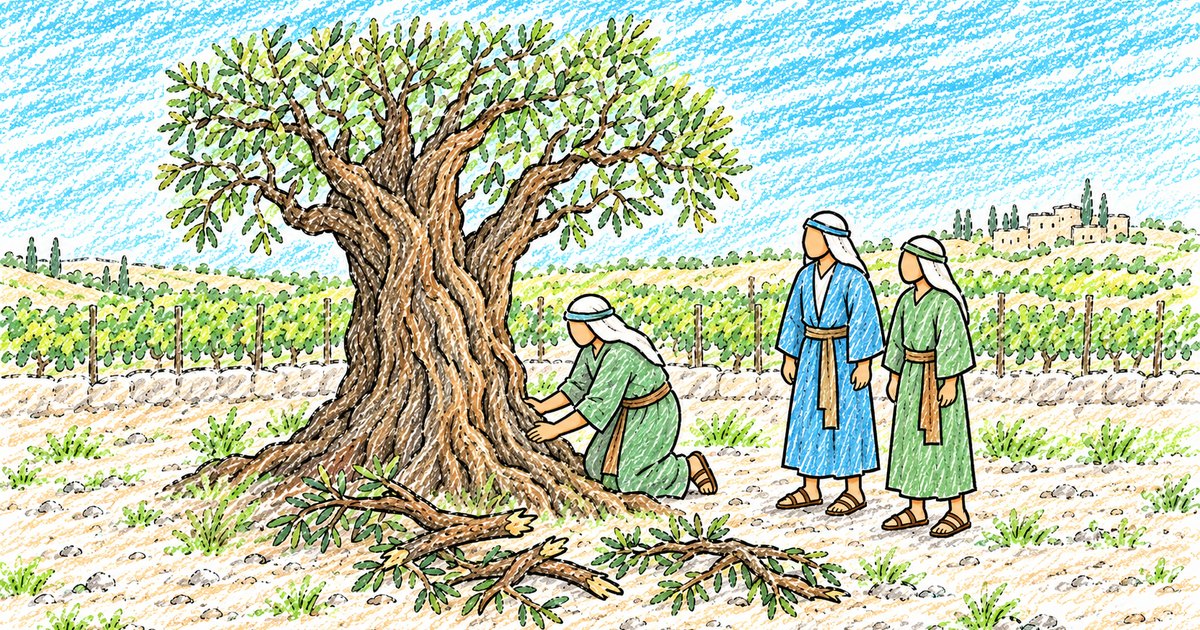
Before you begin
Writing to Gentile Saints in Rome, Paul compared the house of Israel to a tame olive tree. Some natural branches had been broken off because of unbelief, and branches from a wild olive tree, the Gentiles, had been grafted in, sharing “the root and fatness of the olive tree.” Paul warned the grafted branches not to boast, because “thou bearest not the root, but the root thee.”
He also promised that the broken branches could return: “God is able to graft them in again.” The Book of Mormon prophet Zenos told a longer version of this allegory in Jacob 5, where the Lord of the vineyard prunes, digs, grafts and weeps over His trees, saying, “It grieveth me that I should lose this tree,” and finally labors side by side with His servants until the vineyard bears good fruit.
An olive vineyard, in Paul’s letter to the Romans and Zenos’s allegory in Jacob 5.
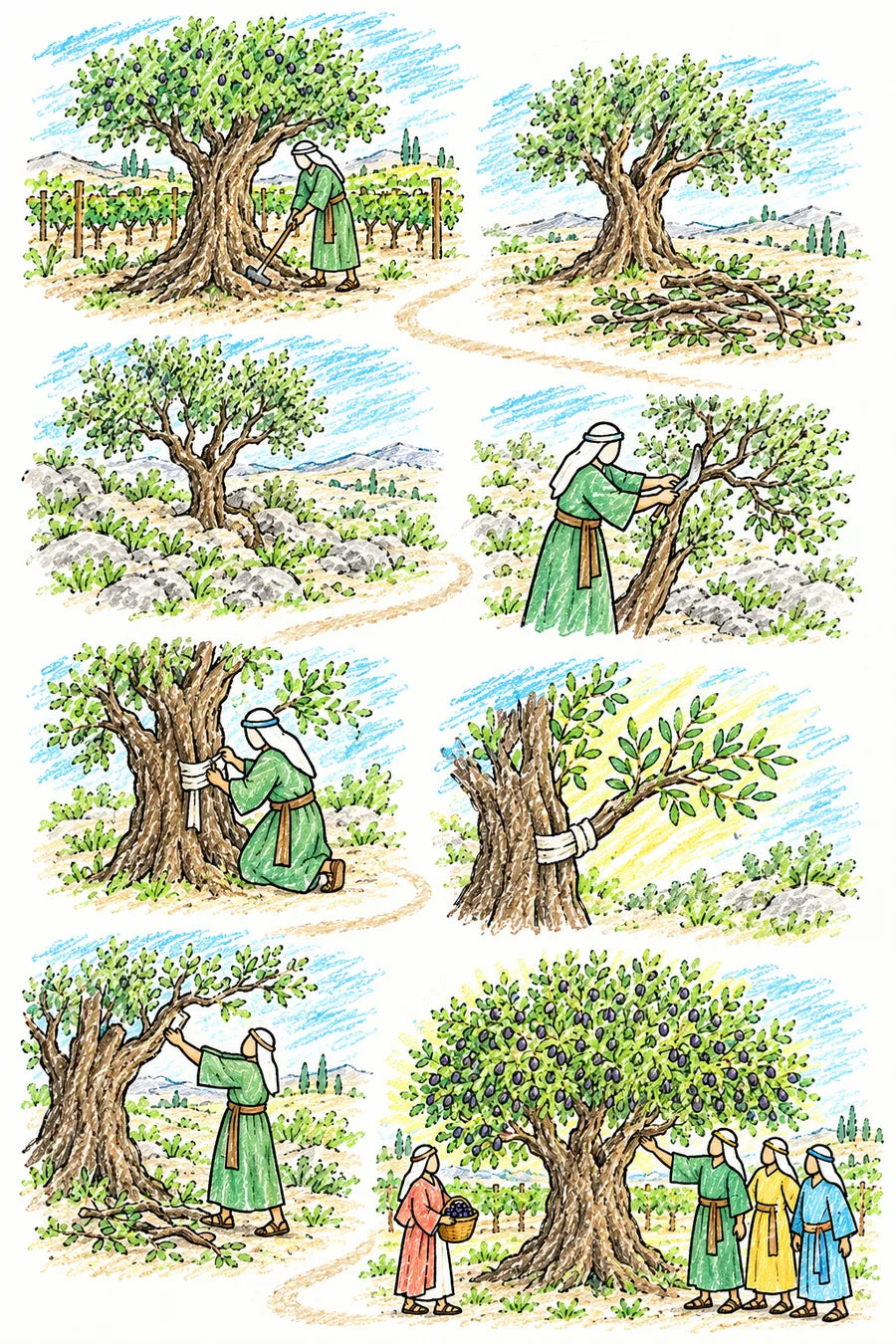
Watch how the Lord keeps working to save every branch, and how every branch lives by the root.
Read it yourself: Romans 11:16–24
Part 1 of 7
Eight stops from the tame tree to the harvest. Scroll, or tap a number on the map.
Part 2 of 7
Four scenes: the old tree, the wild branch, the graft and the harvest. Look for the Savior in each one.
Read it plainly
Tap any dotted word for its meaning. The scripture stays exactly as written.1
Part 3 of 7
Small details tell the story. Some cards are details in the text; others share insights from Church resources. Each card says which.
All nine. The root, the branch, the wild branch, the graft, the oil, the broken branch, the hand, the pruning hook and the olives. Romans 11:16–24
Part 4 of 7
Feeling wild, broken off, tempted to boast, or grafted and growing. Which feels most like you right now?
A next step for you
Your choice is saved only on this device.
Try it
A grafted branch lives only while it stays bound to the tree. Press and hold to keep the branch bound, and watch it leaf out and bear olives. Let go, and it starts to wilt.
“Abide in me, and I in you.” John 15:4
Part 5 of 7
A little background helps us see olive trees and grafting. Outside sources are labeled.
The student manual: Paul’s branches “grafted in” refer “to Gentiles who were ‘adopted in’ to the house of Israel.”8
Covenant, not birth, makes the family.
“In the natural world, grafted branches control the destiny of the tree.” Paul described the reverse.8
The good root changes the wild branch.
Elder Russell M. Nelson quoted Nephi: “The natural branches of the olive-tree … should be grafted in, or come to the knowledge of the true Messiah.”7
Grafting means coming to Christ.
Elder Gerrit W. Gong: the Lord “and his servants bring forth precious fruit and strengthen each tree by binding together the strengths and weaknesses of all the trees.”6
Wards and branches work the same way.
Word study · Greek
egkentrizō ἐγκεντρίζω · “grafted in” (Romans 11:17)
Word study · Greek
agrielaios ἀγριέλαιος · “wild olive tree” (Romans 11:17)
What the text does not say
The story does not say a broken branch is gone for good. Paul wrote, “God is able to graft them in again.”1
Part 6 of 7
The Lord of the vineyard digs, prunes, grafts and weeps. He labors beside His servants.
The Lord of the vineyard: “What could I have done more for my vineyard?”
Jacob 5:412“The great Lord of the vineyard throws down his spade and his pruning shears and weeps, crying out to any who would listen, ‘What could I have done more for my vineyard?’”
“What an indelible image of God’s engagement in our lives!”
“Today children of God gather as one in Jesus Christ.”
Jesus
“Abide in me, and I in you. As the branch cannot bear fruit of itself, except it abide in the vine; no more can ye, except ye abide in me.” John 15:4
Zenos, in Jacob
“The servants did go and labor with their mights; and the Lord of the vineyard labored also with them.” Jacob 5:72
Part 7 of 7
A question to ask in prayer
Where do I need to stay bound? Romans 11:22
Paul said we remain “if thou continue in his goodness.” Ask Heavenly Father which daily habit keeps you most connected to the Savior, and which one has slipped.
One step each day. It saves on this device, one day at a time.
0 of 7 today
Seven days in the vineyard. Come again tomorrow.
A quiet moment
“It grieveth me that I should lose this tree.”
Read Jacob 5:41, 47 and 72 slowly. Then think about how much the Lord of the vineyard cares for you, and thank Him. Jacob 5:41–47
A verse to hold
Talk about it
For adults and deeper study
Longer readings, harder questions, and where to study next. Each one says what it is before you click.
How a weeping God, and the weeping Lord of the vineyard, reveal the true nature of the Father and the Son.4
Read the talk →New members around the world fulfilling the allegory of the olive tree, and making room for everyone.5
Read the talk →Covenant Israel, the remnant, adoption, and why Paul’s graft runs “contrary to nature.”8
Read the chapter →Zenos’s full allegory of the tame and wild olive trees, the Book of Mormon’s longest chapter.2
Read Jacob 5 →Every quotation, gloss, and piece of background on this page is listed here: scripture first, then Church sources, then outside scholarship (labeled).
Quotations checked against the linked pages on October 10, 2026. Scripture is quoted from the King James Version as published in the Gospel Library.
No branch is too wild or too broken for the Lord of the vineyard. Romans 11:23
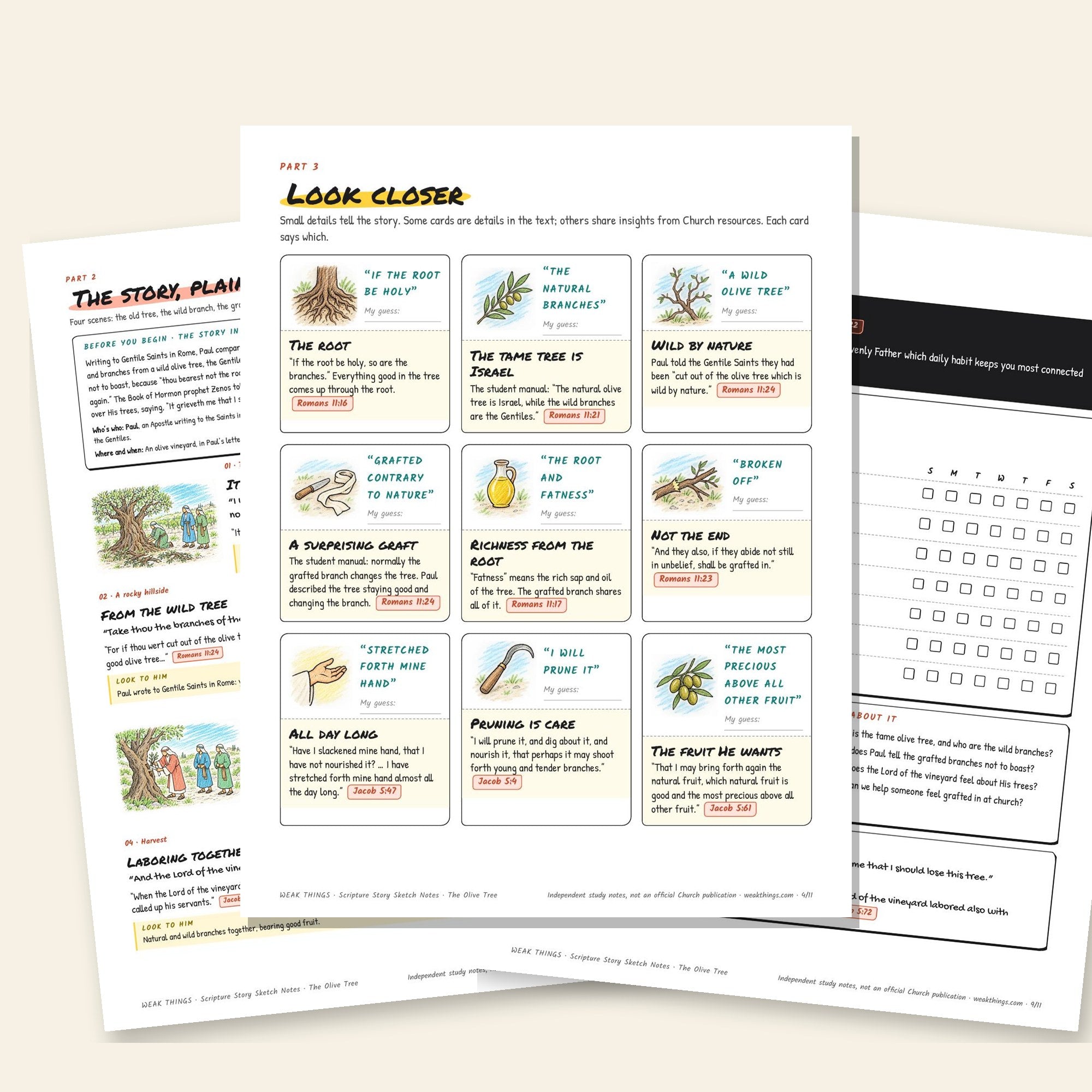
Printable sketch notes
Everything on this page as a 11-page letter-size PDF: the map, scenes, cards, activity, word studies, tracker, Go deeper and sources. For home, class or a quiet Sunday.
More stories
The Olive Tree and the Grafting is part of the Scripture Story Sketch Notes for the New Testament, set alongside Come, Follow Me for August 9–15, 2027 (Romans 7–16).
See every story See all 2027 weeksIndependent study notes from Weak Things, not an official publication of The Church of Jesus Christ of Latter-day Saints. Scripture quotations are from the King James Version. The story is told in Romans 11:16–24, with Jacob 5; the insights in “Look closer” are labeled by source.