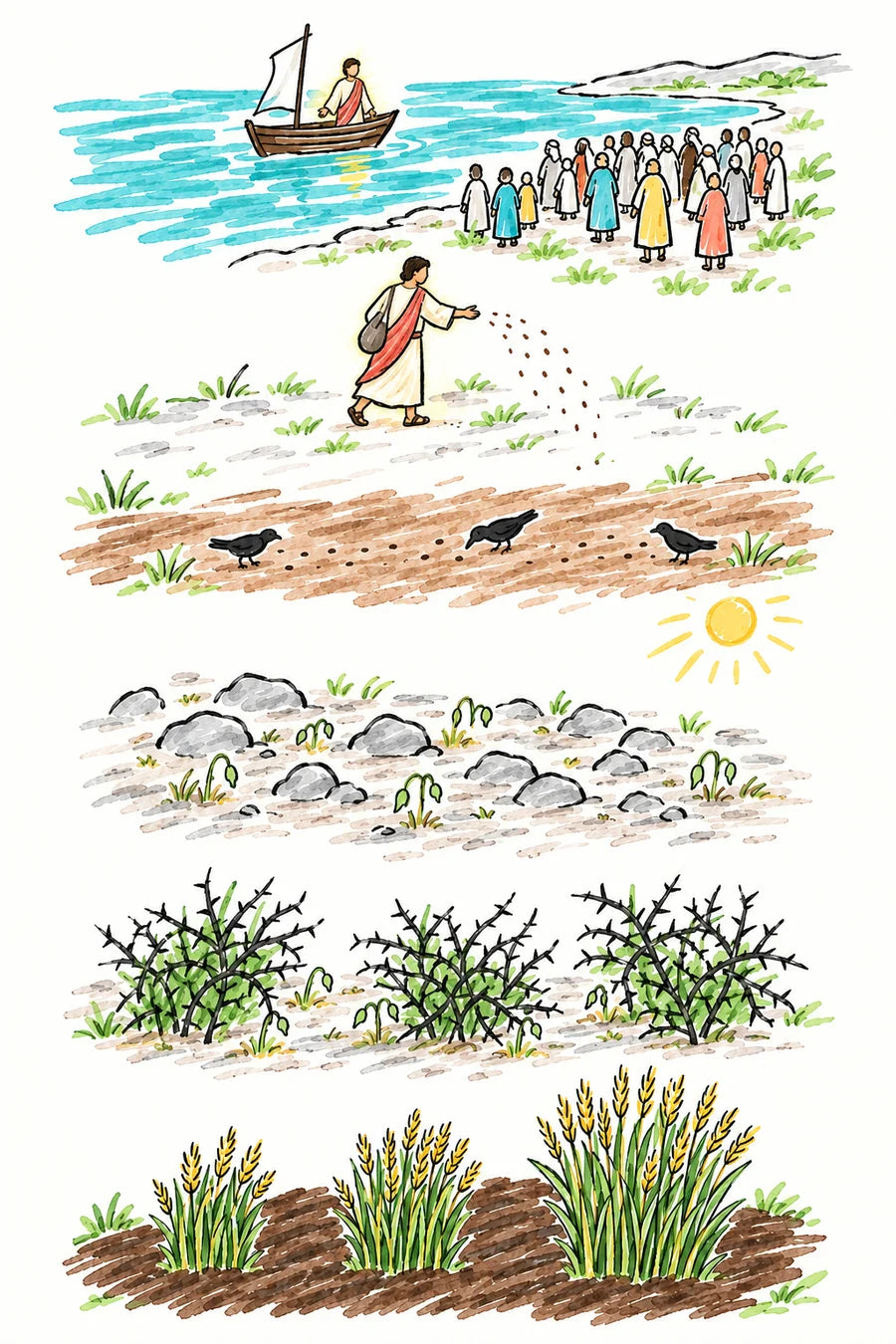
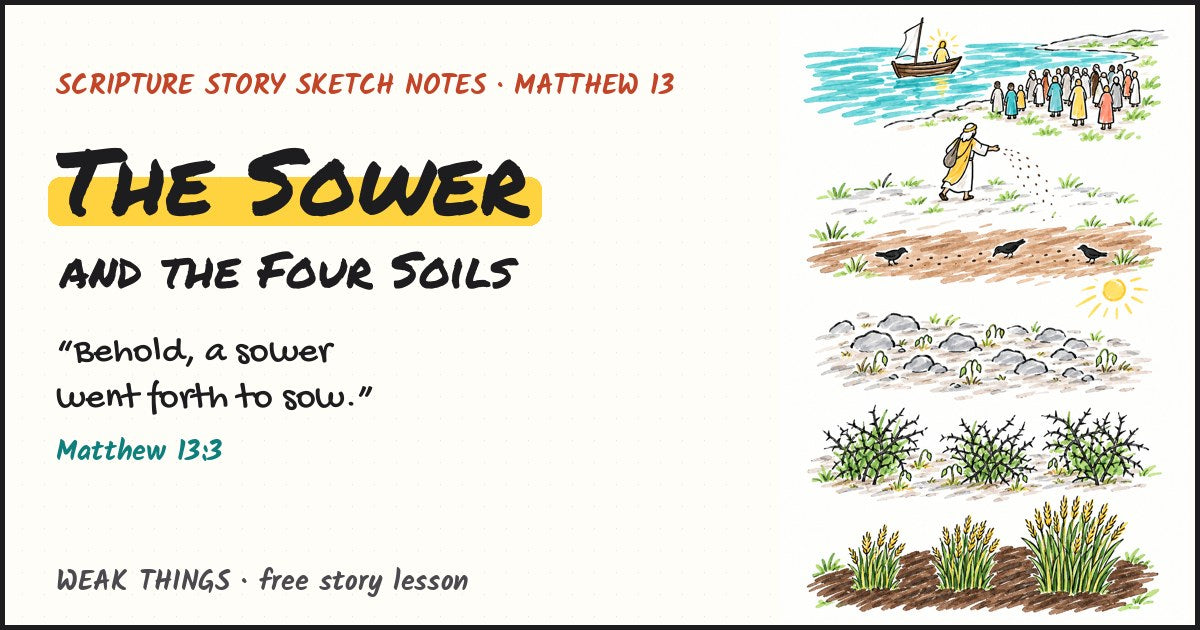
Jesus often taught in parables: simple stories about everyday life that carry deeper truths for anyone ready to hear them. One day the crowd on the shore of the Sea of Galilee was so large that He got into a boat and taught them from the water.
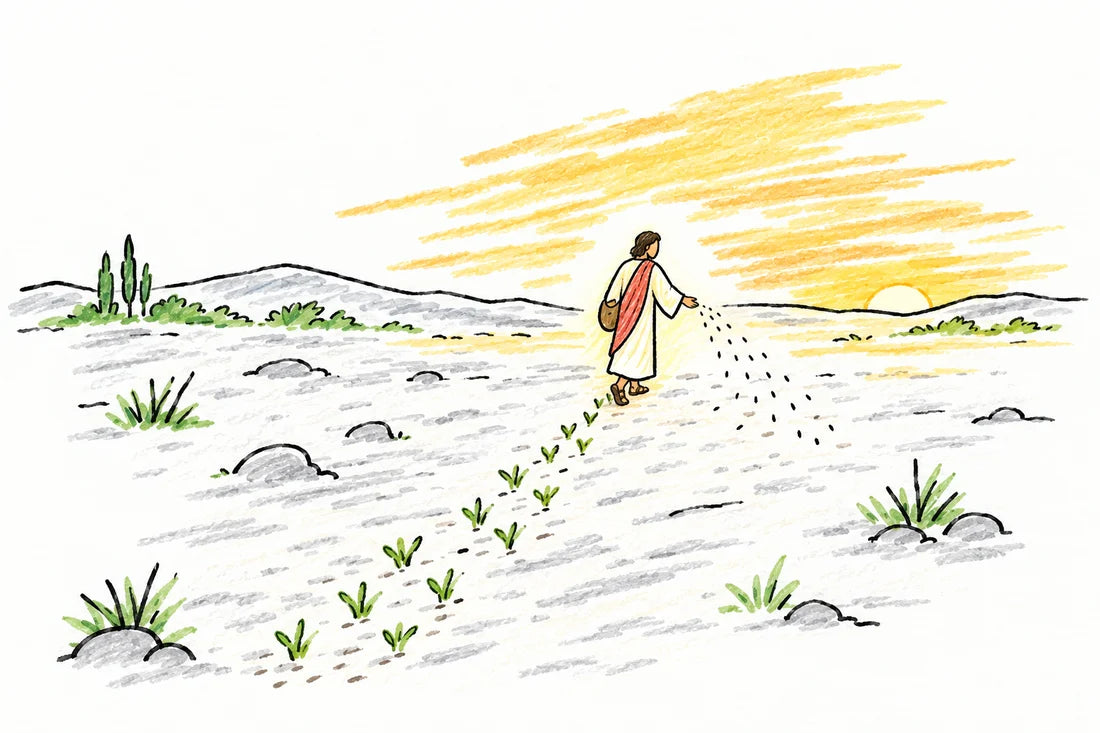
He told of a farmer who scattered seed. Some fell on a hard path, some on rocky ground, some among thorns and some on good ground, and each grew differently. Later His disciples asked what it meant, and Jesus explained it Himself: the seed is the word of God, and the kinds of ground are the different ways our hearts receive it.
Who’s who
Jesus: the Teacher, telling the story from a boat
The sower: the farmer in the story, scattering seed everywhere
The multitude: the crowd on the shore, all hearing the same words
The disciples: who asked Jesus what the parable meant
Where and when
The shore of the Sea of Galilee. In Jesus’s day, farmers often scattered seed by hand across their fields.
Watch for the Savior
Jesus explained this parable Himself (Matthew 13:18–23). Listen for His meaning, and ask which ground is most like your heart.
Eight stops, from the shore where Jesus sat to the good ground. Scroll, or tap a number on the map.
Part 2 of 7
The story, plainly
Three scenes from the same day. Look for the Savior in each one.
Read it plainly
The words that trip people up
Tap any dotted word for its meaning. The scripture stays exactly as written.1
Matthew 13:4 “some seeds fell by the Meaning: the hard, packed footpath along or through the field, where feet had pressed the dirt flat., and the Meaning: birds. came and devoured them up”
Matthew 13:5 “Some fell upon Meaning: rocky ground with only a thin layer of soil on top., where they had not much earth: and Meaning: right away. they sprung up”
Matthew 13:20–21 “Meaning: immediately. with joy receiveth it; Yet hath he not root in himself, but Meaning: lasts only a short time.: for when tribulation or persecution ariseth because of the word, Meaning: soon, before long. he is Meaning: he stumbles and falls away. (See the Greek word in Part 5.)”
Matthew 13:22 “the care of this world, and the Meaning: riches that mislead: they promise more than they can give., choke the word, and he becometh Meaning: bearing no fruit.”
Matthew 13:23 “bringeth forth, some an Meaning: a hundred times as much as was planted., some sixty, some thirty.”
Part 3 of 7
What Jesus explained
This is one of the few parables Jesus explained Himself.1 Guess what each piece means, then turn the card to see His answer.
“The different soils on which the seeds fell represent different ways in which mortals receive and follow these teachings.”6 Most of us have had all four kinds of days.
A next step for you
Your choice is saved only on this device. Souls, like soils, can change.9
Try it
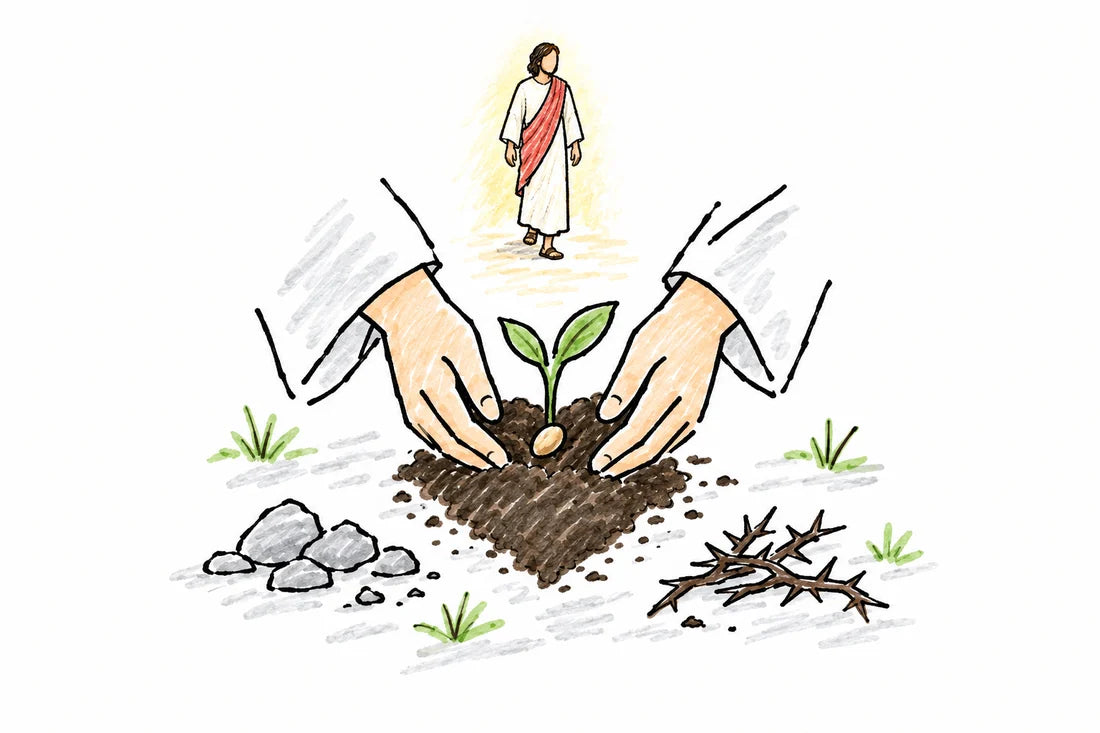
Prepare your ground
This activity applies prophets’ teaching to the parable. Elder Talmage observed that the Savior never said the wayside “might not be plowed,” the stones “broken up and removed,” or the thorns “uprooted.”9
Part 5 of 7
Their world, their words
A little background helps the story land the way it did for the people on the shore. Outside sources are labeled.
Bible Dictionary
Why parables?
The Bible Dictionary explains that a parable “conveys to the hearer religious truth exactly in proportion to his faith and intelligence.” To some it is “a mere story”; to the prepared it reveals “the mysteries … of the kingdom.” And: “Only he who seeks finds.”8
So the story itself is a test of soil.
Outside · scholars disagree
Seed first, plow second?
Many scholars think farmers in Jesus’ day often scattered seed and then plowed it in, which would explain why seed landed on paths, rocks, and thorns.10 Others argue that plowing usually came first.11 Either way, this sower scatters widely.
The point is not carelessness. The seed goes everywhere.
Outside
Stony places
In the hill country of Galilee, a thin layer of soil often sits over limestone bedrock. Plants sprout fast in that warm, shallow soil but have no moisture reserve when summer heat comes.10 Matthew says it simply: “they had not much earth.”1
It looks like the best ground at first. It isn’t.
Outside
Thorns
Thorny weeds grew vigorously at field edges and in uncultivated patches, and could crowd out the grain before it matured.10 In the parable, the thorns “sprung up” right alongside the seed.1
The lexicon gives “to put together,” and so, mentally, “to comprehend.”12 The way side hearer “understandeth it not.” The good-ground hearer “understandeth it.” Same word, opposite results.1
Understanding here is more than hearing. It is taking the word in and putting it together with your life. That is why the disciples kept asking. Our observation
From skandalon, a stumbling block. Strong’s defines it as “to entrap, i.e. trip up,” or figuratively “to stumble.”13
The stony-ground hearer is not just annoyed. When the heat comes, he trips and falls away. The same word appears when Jesus later warns the disciples about the night of His arrest (Matthew 26:31).13
What the text does not say
It never says the seed was bad: “In this parable the seed is the same, but it lands on four different kinds of soil.”7 It never says the sower was wasteful. And it never says a soil is stuck forever. Halverson suggests the Savior “must have intended it as a continuum upon which hearers were in constant motion, not merely as a dresser with four unchangeable drawers.”9Outside
Part 6 of 7
Look to the Sower
The story is about soil, but the One telling it is the Sower.
He keeps sowing
“He that soweth the good seed is the Son of man.” Matthew 13:37
He scattered seed on paths, on rocks and among thorns. He taught the whole multitude, then explained it again to the few who asked.1 He did not wait for perfect ground before He sowed.
The seed is “the word of God.”3 John calls Jesus Himself “the Word” (John 1:1). To receive the word is, in the end, to receive Him.
What prophets have taught
“The suitability of the soil depends upon the heart of each one of us who is exposed to the gospel seed.”
Elder Dallin H. Oaks, “The Parable of the Sower,” April 20156
“We must also seek that mighty change of heart (see Alma 5:12–14) that replaces evil desires and selfish concerns with the love of God and the desire to serve Him and His children.”
Alma picks up the same picture: “Now, we will compare the word unto a seed.” If it is nourished “with great diligence, and with patience,” it takes root. If it is neglected, “when the heat of the sun cometh and scorcheth it, because it hath no root it withers away.” Alma 32:28, 38, 41
Jesus’ parable describes the ground. Alma describes how to tend it.
Notice
“This is not because the seed was not good”
Alma says the same thing Jesus’ story shows: when nothing grows, “this is not because the seed was not good … but it is because your ground is barren, and ye will not nourish the tree.” Alma 32:39
Part 7 of 7
Good ground today
The Savior’s question
“Know ye not this parable? and how then will ye know all parables?” Mark 4:13
He treats this story as a key to the rest. Before you move on, ask yourself what kind of listener you want to be this week.
This week
Tend your ground, one small thing at a time
“It is up to each of us to set the priorities and to do the things that make our soil good and our harvest plentiful.”6
Try it today
Each thing you do grows the plant. It saves on this device, one day at a time.
0 of 6 today
This week:0 of 7 days
Some thirty, some sixty, some a hundred. Keep going tomorrow.
A quiet moment
“Who hath ears to hear, let him hear.”
Read Matthew 13:9 slowly. Put the screen down for one minute. What is the Spirit asking you to hear right now? Matthew 13:9
A verse to hold
Talk about it
Why do you think Jesus explained this parable only to the ones who asked?
What makes a heart “hard” like the path? What softens it?
What are the thorns that grow fastest in our home?
Thirty, sixty, a hundred: why might the Lord accept different harvests?
Open
For adults and deeper study
Go deeper
Longer readings, harder questions, and where to study next. Each one says what it is before you click.
Apostle
Elder Dallin H. Oaks, “The Parable of the Sower” (2015)
Walks through each soil and applies it to modern life. He calls the cares, riches and pleasures of life “the most subtle thorns,” and teaches that “the possession of wealth or significant income is not a mark of heavenly favor, and their absence is not evidence of heavenly disfavor.” Ends with how conversion deepens roots.6
President James E. Faust, “Of Seeds and Soils” (1999)
A farmer’s reading of the parable: plowing with prayer, harrowing away pride, preparing the seedbed by keeping the commandments, and nourishing faith so it keeps taking root.7
Argues the four soils are a continuum, not four fixed types: “souls, like soils, could change.” Traces how Joseph Smith read Matthew 13 as a sequence of the kingdom’s history, and how Mark’s ascending yields (thirty, sixty, a hundred) suggest growth over time.9
Jesus quotes Isaiah: “their eyes they have closed” (Matthew 13:15). Who closed them? What does that say about hearing?
“Whosoever hath, to him shall be given” (Matthew 13:12). How does that fit a story about soil?
If the thorny ground still grows the word, what does “unfruitful” mean in your life?
Sources
Every quotation, gloss, and piece of background on this page is listed here: scripture first, then Church sources, then outside scholarship (labeled).
Scripture
Matthew 13: the parable (vv. 1–9), why Jesus taught in parables (vv. 10–17), and His explanation (vv. 18–23); the next parable names the sower (v. 37).
Mark 4: “Know ye not this parable?” (v. 13) and the seed that grows “he knoweth not how” (vv. 26–29).
Luke 8: “The seed is the word of God” (v. 11), “cares and riches and pleasures of this life” (v. 14), and “bring forth fruit with patience” (v. 15).
Alma 32: Alma compares the word to a seed (vv. 28–43).
Jared M. Halverson, “Of Soils and Souls: The Parable of the Sower”, Religious Educator 9, no. 3 (2008): 31–48, BYU Religious Studies Center. Includes Elder James E. Talmage’s comments from Jesus the Christ, quoted there.
The Sower and the Four Soils, ready to print $3.99
Everything on this page as an 11-page letter-size PDF: the map, scenes, cards, activity, word studies, tracker, Go deeper and sources. For home, class or a quiet Sunday.
The Sower is part of the Scripture Story Sketch Notes for the New Testament, set alongside Come, Follow Me for March 15–21, 2027 (Matthew 13; Luke 8; 13).
Independent study notes from Weak Things, not an official publication of The Church of Jesus Christ of Latter-day Saints. Scripture quotations are from the King James Version. Symbol meanings come from the Savior’s own explanation in Matthew 13:18–23 and Luke 8:11–15; outside sources are labeled.