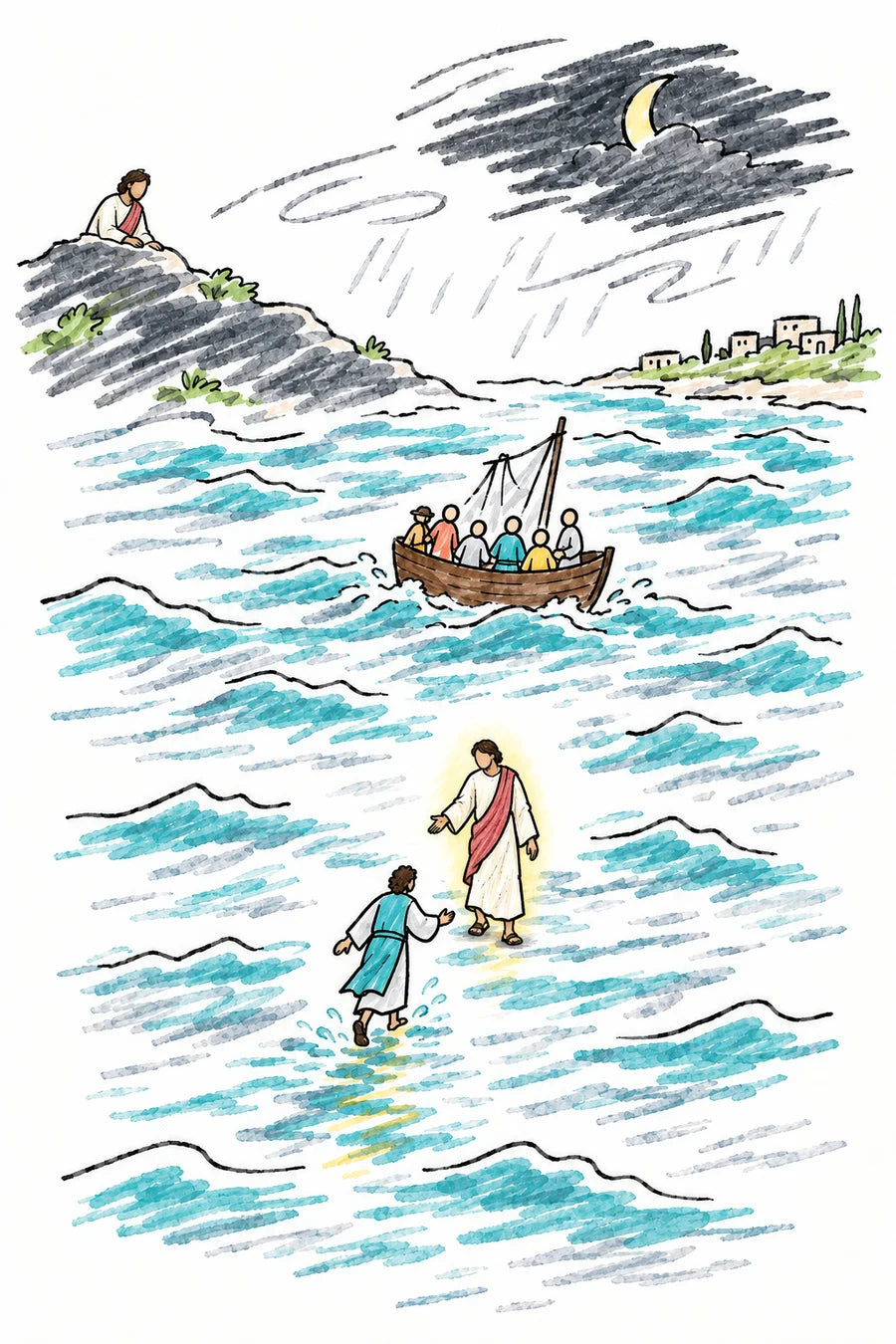
Earlier that day, Jesus had fed more than five thousand people with five loaves and two fishes. That evening He sent His disciples ahead across the Sea of Galilee by boat, and He went up a mountain alone to pray.
Through the night a strong wind blew against them, and they rowed for hours without getting far. Near dawn Jesus came to them, walking on the water. Peter asked to come to Him, and for a few steps Peter walked on the water too. When he looked at the wind he began to sink, and Jesus immediately reached out and caught him. When they climbed into the boat the wind stopped, and the disciples worshipped Him: “Of a truth thou art the Son of God.”
Who’s who
Jesus: who prayed alone on the mountain, then came to His disciples in the storm
Peter: a fisherman and Apostle, bold enough to ask to come to Jesus
The disciples: His followers in the boat, several of them fishermen
Where and when
The Sea of Galilee, a large lake in northern Israel, at night. Jesus came “in the fourth watch,” about 3 to 6 a.m.
Watch for the Savior
Watch how Jesus sees them struggling, comes to them, and reaches for Peter the moment he cries out.
Seven stops, from the mountain where He prayed to the far shore. Scroll, or tap a number on the map.
Part 2 of 7
The story, plainly
Six scenes, evening to dawn. Look for the Savior in each one.
Read it plainly
The words that trip people up
Tap any dotted word for its meaning. The scripture stays exactly as written.1
Matthew 14:22 “And Meaning: right away. Jesus Meaning: strongly urged; He made them go. his disciples to get into a ship”
Matthew 14:25 “And in the Meaning: the last part of the night, about 3 to 6 a.m. (See Part 5.) of the night Jesus went unto them, walking on the sea.”
Matthew 14:26 “they were troubled, saying, It is a Meaning: a ghost.; and they cried out for fear.”
Matthew 14:27 “Meaning: take courage.; it is I; be not afraid.”
Matthew 14:28 “Lord, if it be thou, Meaning: tell me to come; command me to come. unto thee on the water.”
Matthew 14:30 “when he saw the wind Meaning: strong and violent., he was afraid”
Matthew 14:31 “O thou of little faith, Meaning: why. didst thou Meaning: waver, as if pulled two ways. (See the Greek word in Part 5.)?”
Matthew 14:33 “Meaning: truly. thou art the Son of God.”
Part 3 of 7
Look closer
This story is not a parable, so these are not symbols with assigned meanings. They are details in the text. Turn each card to see what it shows. Each back says where the insight comes from.
0 of 9 turned
All nine. He prayed, He saw, He came, He spoke, He reached. Matthew 14:23–33
Part 4 of 7
Where are you tonight?
Everyone in this story was in one of four places. Most of us have been in all four.
A next step for you
Your choice is saved only on this device.
Try it
Eyes on the Light
Press and hold on the Light, and follow it as it moves. While your finger stays on Him, Peter walks. Let the wind pull you away and he begins to sink.
“While Peter kept his eyes focused on Jesus, he could walk on water.” Elder Alvin F. Meredith III9
Part 5 of 7
Their world, their words
A little background helps us feel the night the way the disciples did. Outside sources are labeled.
Bible Dictionary
A lake that makes sudden storms
The Sea of Galilee is about 12½ miles long and 7½ miles across. “It lies 680 feet below sea-level; the heat is very great, and the cold air rushing down from the hills often produces sudden storms.”12
Fishermen like Peter knew this water, and they were still afraid.
Bible Dictionary
The fourth watch
The Jews divided the night into three watches, but “the Romans had four watches, and it is their practice that is followed in Matt. 14:25.”13 The fourth watch was about 3 to 6 a.m.16
He came at the darkest, most tired part of the night.
Scripture
How far out were they?
John says they had rowed “about five and twenty or thirty furlongs.”3 A furlong (Greek stadion) is commonly estimated at about 600 feet, so about three miles of hard rowing, into the wind.
Too far to swim back. Too far from the other shore.
Outside
What a boat looked like
In 1986, low water on the Sea of Galilee uncovered a first-century fishing boat, about 27 feet long and 7½ feet wide.18 It helps us picture the kind of boat the disciples rowed that night.
A small boat in a big storm.
Word study · Greek
egō eimi ἐγώ εἰμι · “It is I” (Matthew 14:27)
Keller writes: “Ego eimi means ‘I am’ or ‘I am he.’” When Jesus says it while walking on the sea, “He is giving his first explicit hint of His real identity. … He is I AM, Jehovah, the God of the Old Testament …”14Outside · BYU RSC
Keller also notes that Peter calls Him kyrie, “Lord,” both when he asks to come and when he cries “Lord, save me,” “stressing once again that Jesus is the Lord—Jehovah.”14 The One who made the sea is walking on it.
Word study · Greek
distazō διστάζω · “doubt” (Matthew 14:31)
The lexicon gives “to doubt, to waver,” and connects it to dis, “twice.” Strong’s: “properly, to duplicate, i.e. (mentally) to waver.”17The “twice” derivation is traditional; not every scholar treats it as the word’s core meaning.
It appears only twice in the New Testament: here, and on the mountain after the Resurrection, “they worshipped him: but some doubted.”4,17 Doubt here is not refusing. It is being pulled two ways, eyes on Him and eyes on the wind.
What the text does not say
It does not say Peter failed. He walked on water, and when he sank he did the right thing: he cried to the Lord.1 Mark and John tell of Jesus walking on the sea but do not mention Peter’s walk at all; only Matthew does.2,3 And the wind did not stop when Peter walked. It ceased “when they were come into the ship.”1
Part 6 of 7
Look to Him
Peter is the one we remember. But every verb that saves someone in this story belongs to Jesus.
He prayed. He saw them toiling. He came to them. He spoke first. He said “Come.” He stretched forth His hand. He caught him. He got into the ship with them.
“The Savior is willing to enter troubled waters for his disciples. … He comes to them.”
Charles Swift, BYU Religious Studies Center Outside15
“It is my firm belief that if as individual people, as families, communities, and nations, we could, like Peter, fix our eyes on Jesus, we too might walk triumphantly over ‘the swelling waves of disbelief’ and remain ‘unterrified amid the rising winds of doubt.’”
President Howard W. Hunter, “The Beacon in the Harbor of Peace,” October 19928
“The Savior, who is always eager to save, reached out and lifted him up to safety.”
Elder Alvin F. Meredith III, “Look down the Road,” October 20219
“Jesus knew the faith Peter had exercised to come unto Him on the water. He was also aware of Peter’s fear.”
Elder Juan Pablo Villar, “His Hand Ready to Help Us,” October 202410
Another Testament
“Look unto me in every thought”
The Lord to Joseph Smith and Oliver Cowdery: “Look unto me in every thought; doubt not, fear not.” Doctrine and Covenants 6:36 Peter’s night in one line.
Another Testament
Faith before the witness
Moroni: “dispute not because ye see not, for ye receive no witness until after the trial of your faith.” Ether 12:6 Peter stepped out before he knew the water would hold.
Part 7 of 7
Eyes on Him today
The Savior’s question
“O thou of little faith, wherefore didst thou doubt?” Matthew 14:31
He asked it while He was holding Peter up. “His words were not to scold Peter but to remind him that He, the Messiah, was with him and the disciples.”10 What pulls your eyes two ways?
Try it today
Each thing you do is one more step toward Him. It saves on this device, one day at a time.
0 of 6 today
This week:0 of 7 days
Six steps on the water. Keep looking tomorrow.
A quiet moment
“Be of good cheer; it is I; be not afraid.”
Picture your own boat and your own wind. Read Matthew 14:27 three times, slowly, and hear Him say it to you. Then sit still for one minute. Matthew 14:27
A verse to hold
Talk about it
The disciples were obeying Jesus and still hit a storm. What does that teach us?
What “wind” pulls our family’s eyes away from the Savior?
Why do you think Jesus let Peter come, knowing he might sink?
When has someone reached out a hand to you “immediately”?
Open
For adults and deeper study
Go deeper
Longer readings, harder questions, and where to study next. Each one says what it is before you click.
Apostle
President Howard W. Hunter, “The Beacon in the Harbor of Peace” (1992)
Retells the night in vivid detail, then applies it to individuals, families and nations: if we look to “the power and fury of those terrible and destructive elements around us rather than to him who can help and save us, then we shall inevitably sink.”8
Elder Juan Pablo Villar, “His Hand Ready to Help Us” (2024)
Focuses on the Savior’s response: He knew Peter’s faith and his fear, and He reached “immediately.” Reads the question “wherefore didst thou doubt?” as reassurance, not rebuke.10
Elder Meredith’s “Look down the Road” is about focus: “The storm, the waves, and the wind could not hinder him as long he centered his focus on the Savior.” President Eyring reads Peter’s whole life: he “came to trust the Lord enough to stay faithful in His service all the way to his martyrdom.”9,11
Keller, “Jesus Is Jehovah” and Swift, “Three Stories”
Keller traces how the Gospels reveal Jesus as Jehovah, including the “I am” on the water. Swift reads Matthew 14 as three linked stories and notes, “Neither the winds nor the waves are sinking him: his fear is.”14,15
Mark: He “would have passed by them,” and they were amazed, “for they considered not the miracle of the loaves: for their heart was hardened.” Mark 6:48–52
John: “Then they willingly received him into the ship: and immediately the ship was at the land.” John 6:19–21
Isaiah: “I the Lord thy God will hold thy right hand, saying unto thee, Fear not; I will help thee.” Isaiah 41:13
Everything on this page as a 11-page letter-size PDF: the map, scenes, cards, activity, word studies, tracker, Go deeper and sources. For home, class or a quiet Sunday.
Peter Walks on the Water is part of the Scripture Story Sketch Notes for the New Testament, set alongside Come, Follow Me for March 29–April 4, 2027 (Matthew 14; Mark 6; John 5–6).
Independent study notes from Weak Things, not an official publication of The Church of Jesus Christ of Latter-day Saints. Scripture quotations are from the King James Version. This is a historical account, not a parable; the insights in “Look closer” are labeled by source.