New Testament Student Manual: Acts 16–20
Athens, the Epicureans and Stoics, the unknown god, our divine parentage and why some mocked the Resurrection.2
Read the chapter →Scripture Story Sketch Notes · Acts 17:16–34
“For in him we live, and move, and have our being.” Acts 17:28
A city full of statues, a marketplace full of ideas, and an altar to an unknown god. On a rocky hill, Paul tells the Athenians who God is, and that He is not far away.
Before you begin
While Paul waited in Athens for Silas and Timothy, his spirit was stirred to see a city full of idols. He taught in the synagogue and in the marketplace every day, and Epicurean and Stoic philosophers, curious about this “new doctrine,” brought him to Mars’ hill, where the city council met.
Paul began with an altar he had seen inscribed “TO THE UNKNOWN GOD” and declared that God. He taught that God made the world, does not live in temples made with hands, and is “not far from every one of us,” for “we are also his offspring.” He called them to repent and testified that God had raised Jesus from the dead. Some mocked, some wanted to hear more, and some believed, including Dionysius, a member of the council, and a woman named Damaris.
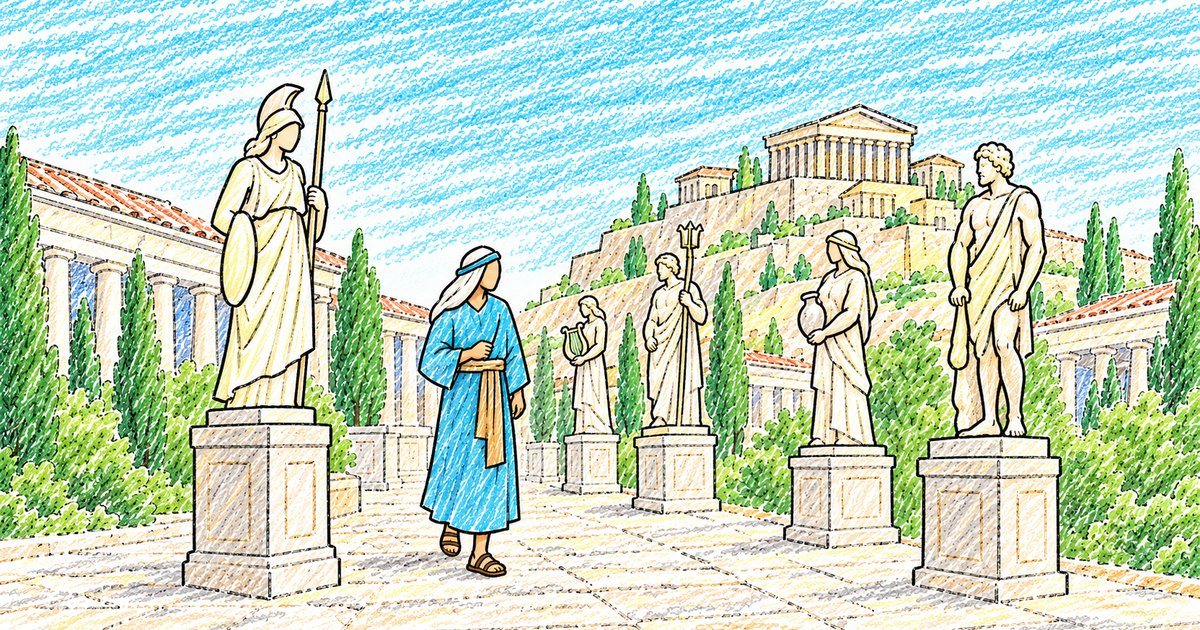
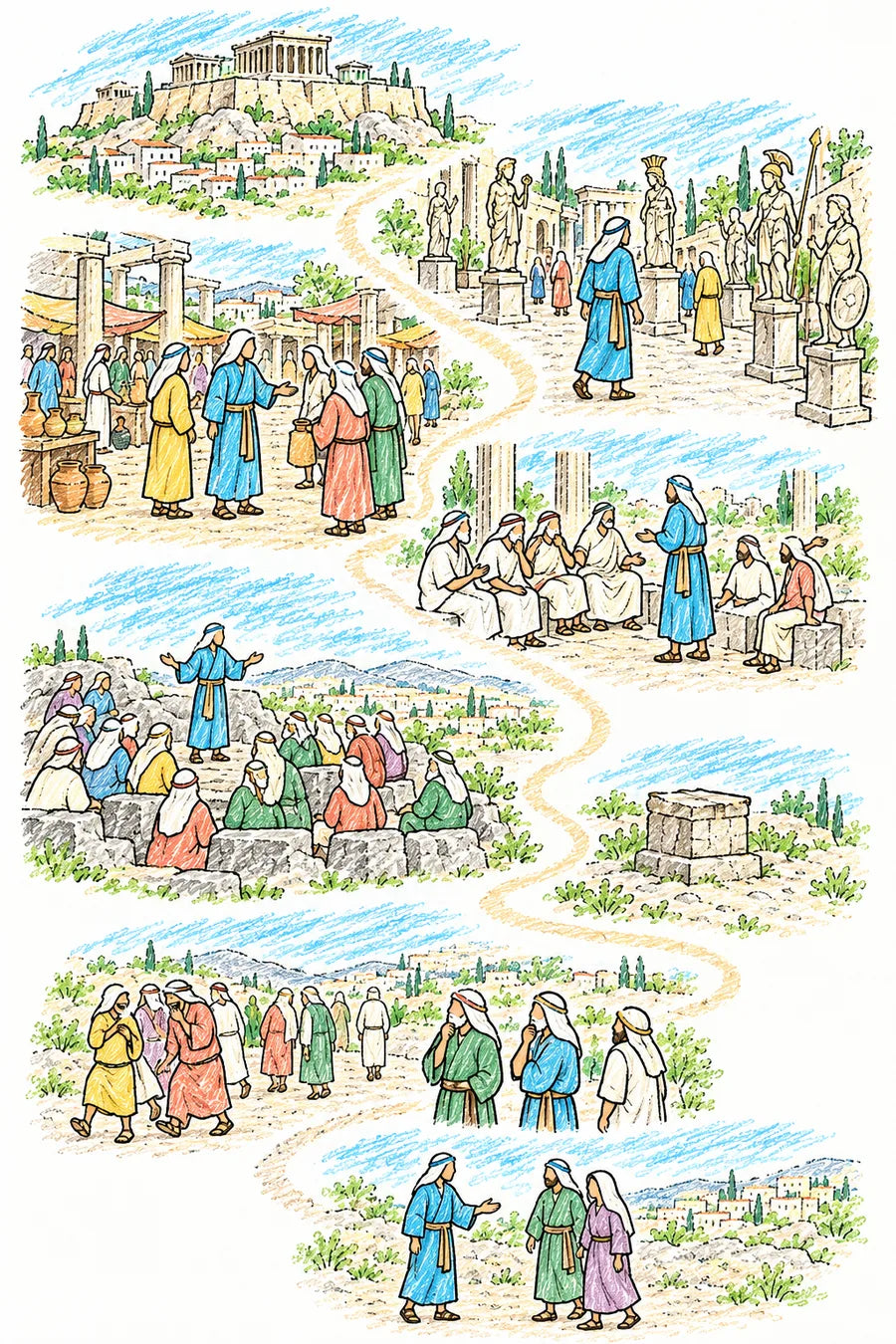
Athens, Greece: its streets of statues, its marketplace, and Mars’ hill (the Areopagus).
Watch how Paul starts with common ground and leads to the living God and the risen Christ.
Read it yourself: Acts 17:16–34
Part 1 of 7
Eight stops from the statues of Athens to two new believers. Scroll, or tap a number on the map.
Part 2 of 7
Four scenes: the streets, the marketplace, the hill and the response. Look for the Savior in each one.
Read it plainly
Tap any dotted word for its meaning. The scripture stays exactly as written.1
Part 3 of 7
Small details tell the story. Some cards are details in the text; others share insights from prophets or Church resources. Each card says which.
All nine. The statues, the market, the hill, the altar, the world, the temple, the family, the reaching hand and the empty tomb. Acts 17:16–34
Part 4 of 7
Searching, surrounded by opinions, still thinking, or ready to believe. Which feels most like you right now?
A next step for you
Your choice is saved only on this device.
Try it
The Athenians had ideas about the gods. Paul answered each one with truth about our Heavenly Father and His Son. Tap each card to see what Paul taught.
“Whom therefore ye ignorantly worship, him declare I unto you.” Acts 17:23
Part 5 of 7
A little background helps us see Athens and its philosophers. Outside sources are labeled.
The student manual: they taught “the world came into existence by chance and was without purpose or design.”2
Paul taught a Creator with a purpose.
Stoics “believed that man was endowed with a spark of reason and should seek harmony with the divine order of things.”2
Paul quoted their own poets.
“For we are also his offspring” came from Aratus. Paul was “establishing beliefs that he had in common with his listeners.”2
He started where they were.
He was “called ‘the Areopagite,’ probably meaning that he was a member of the Areopagus.”2
A council member believed.
Word study · Greek
agnōstos ἄγνωστος · “unknown” (Acts 17:23)
Word study · Greek
genos γένος · “offspring” (Acts 17:28)
What the text does not say
The story does not say Paul failed in Athens. Some mocked, but others wanted to hear more, and “certain men clave unto him, and believed.”1
Part 6 of 7
Paul “preached unto them Jesus, and the resurrection.” He began with an unknown god and ended with a risen Lord.
The council’s question: “May we know what this new doctrine, whereof thou speakest, is?”
Acts 17:191“Thus it is the spirit which is the offspring of God.”
“The only single quality that should characterize us is that we are a son or daughter of God.”
“We have access to the source of pure truth, even God Himself.”
Paul
“And the times of this ignorance God winked at; but now commandeth all men every where to repent.” Acts 17:30
Part 7 of 7
A question to ask in prayer
How near is He? Acts 17:27
Paul said God is “not far from every one of us.” Ask Heavenly Father to help you notice one way He is near you this week, and write it down when you see it.
One step each day. It saves on this device, one day at a time.
0 of 7 today
Seven days of seeking. Come again tomorrow.
A quiet moment
“Though he be not far from every one of us.”
Read Acts 17:24–28 slowly. Then sit quietly and thank Heavenly Father that you are His child, and that He is near. Acts 17:24–28
A verse to hold
Talk about it
For adults and deeper study
Longer readings, harder questions, and where to study next. Each one says what it is before you click.
Athens, the Epicureans and Stoics, the unknown god, our divine parentage and why some mocked the Resurrection.2
Read the chapter →An overview of Paul’s teaching in Athens and other cities, with lessons for youth.3
Read the overview →President Monson pointed to Hebrews, where Heavenly Father is called “the Father of spirits.”
Read Hebrews 12 →Before Athens: the Bereans who “received the word with all readiness of mind.”
Read Acts 17:1–15 →Every quotation, gloss, and piece of background on this page is listed here: scripture first, then Church sources, then outside scholarship (labeled).
Quotations checked against the linked pages on October 10, 2026. Scripture is quoted from the King James Version as published in the Gospel Library.
The God they called unknown is your Father, and He is near. Acts 17:27
Printable sketch notes
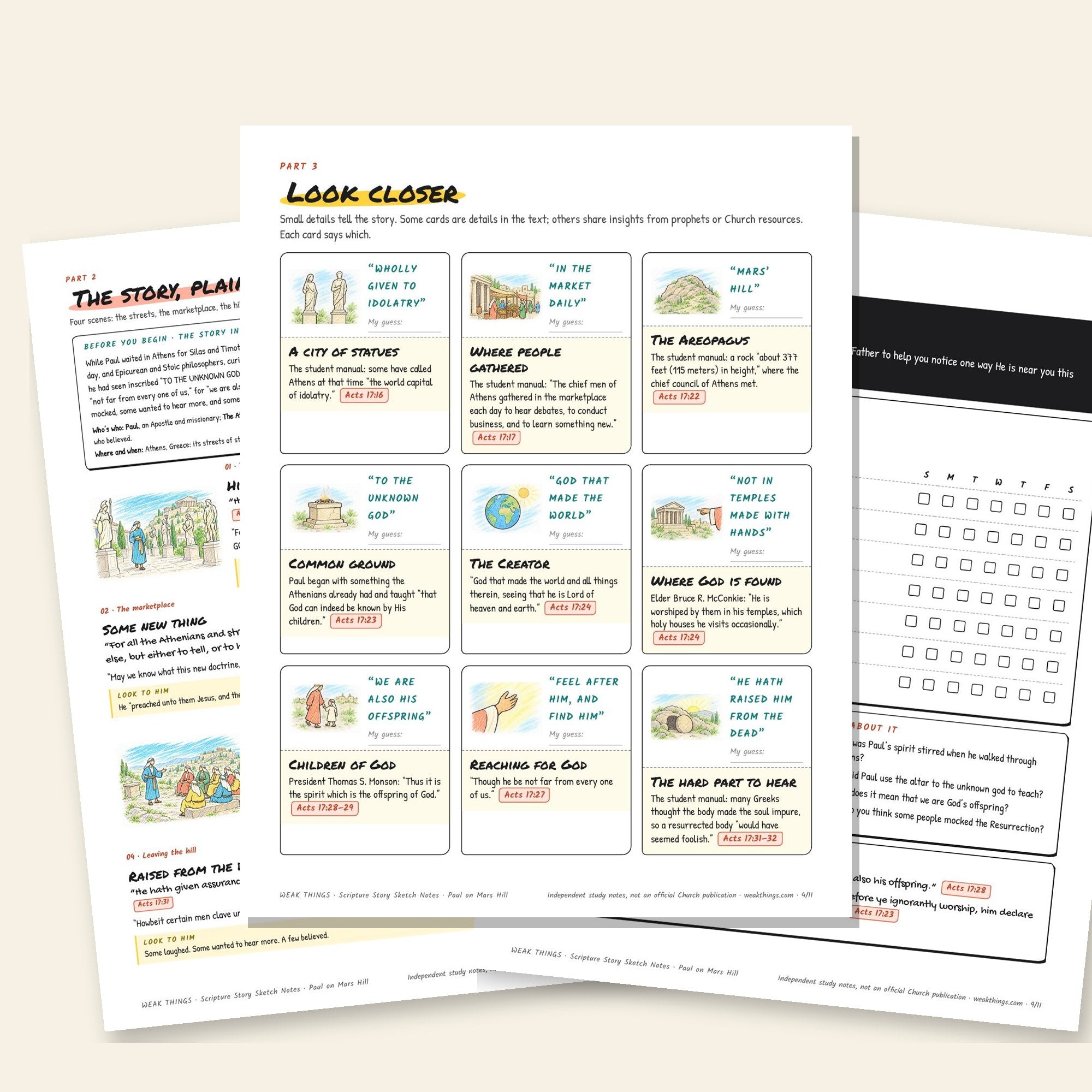
Everything on this page as a 11-page letter-size PDF: the map, scenes, cards, activity, word studies, tracker, Go deeper and sources. For home, class or a quiet Sunday.
More stories
Paul on Mars Hill is part of the Scripture Story Sketch Notes for the New Testament, set alongside Come, Follow Me for July 19–25, 2027 (Acts 16–21).
See every story See all 2027 weeksIndependent study notes from Weak Things, not an official publication of The Church of Jesus Christ of Latter-day Saints. Scripture quotations are from the King James Version. The story is told in Acts 17:16–34; the insights in “Look closer” are labeled by source.