New Testament Student Manual: Acts 13–15
The call of Saul and Barnabas, setting apart, the first journey, Lystra, and why trials refine us.6
Read the chapter →Scripture Story Sketch Notes · Acts 13–14; Acts 16:6–15; Acts 18:1–11; Acts 20:17–38
“Come over into Macedonia, and help us.” Acts 16:9
A call by revelation, a stoning at Lystra, a vision at Troas, an opened heart in Philippi, tents in Corinth, and a tearful goodbye on the shore. Sail the routes and follow the Spirit.
Before you begin
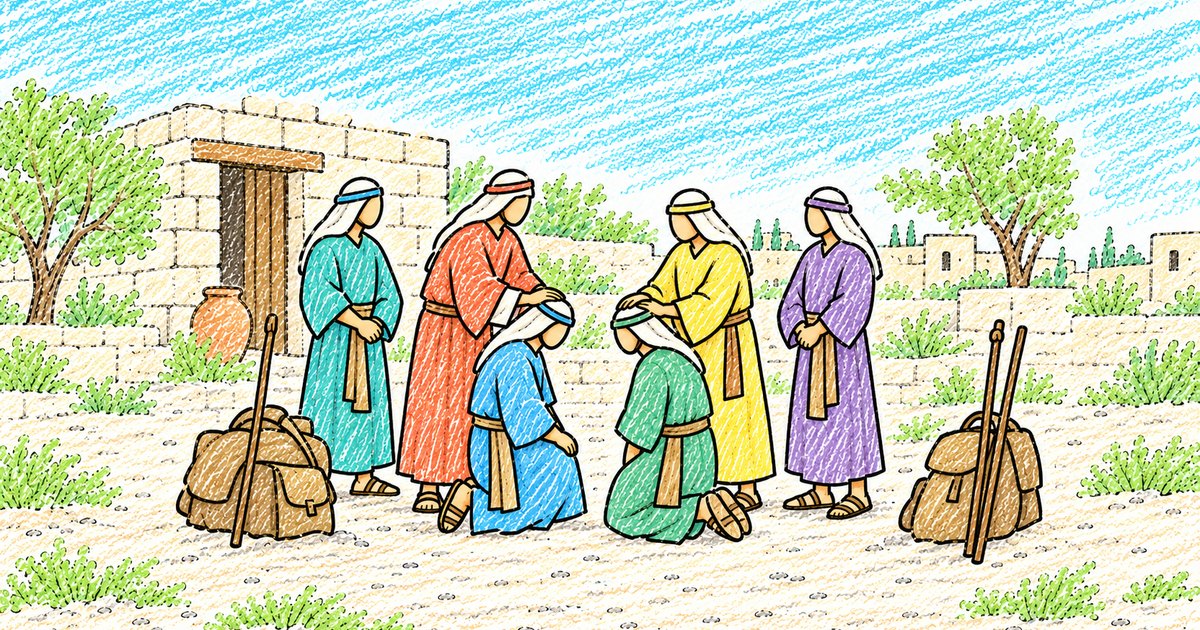
In Antioch, the Holy Ghost said, “Separate me Barnabas and Saul for the work.” After fasting and prayer, Church leaders laid their hands on them and sent them out. On this first journey, Paul was stoned at Lystra and left for dead, yet he returned to strengthen the new branches.
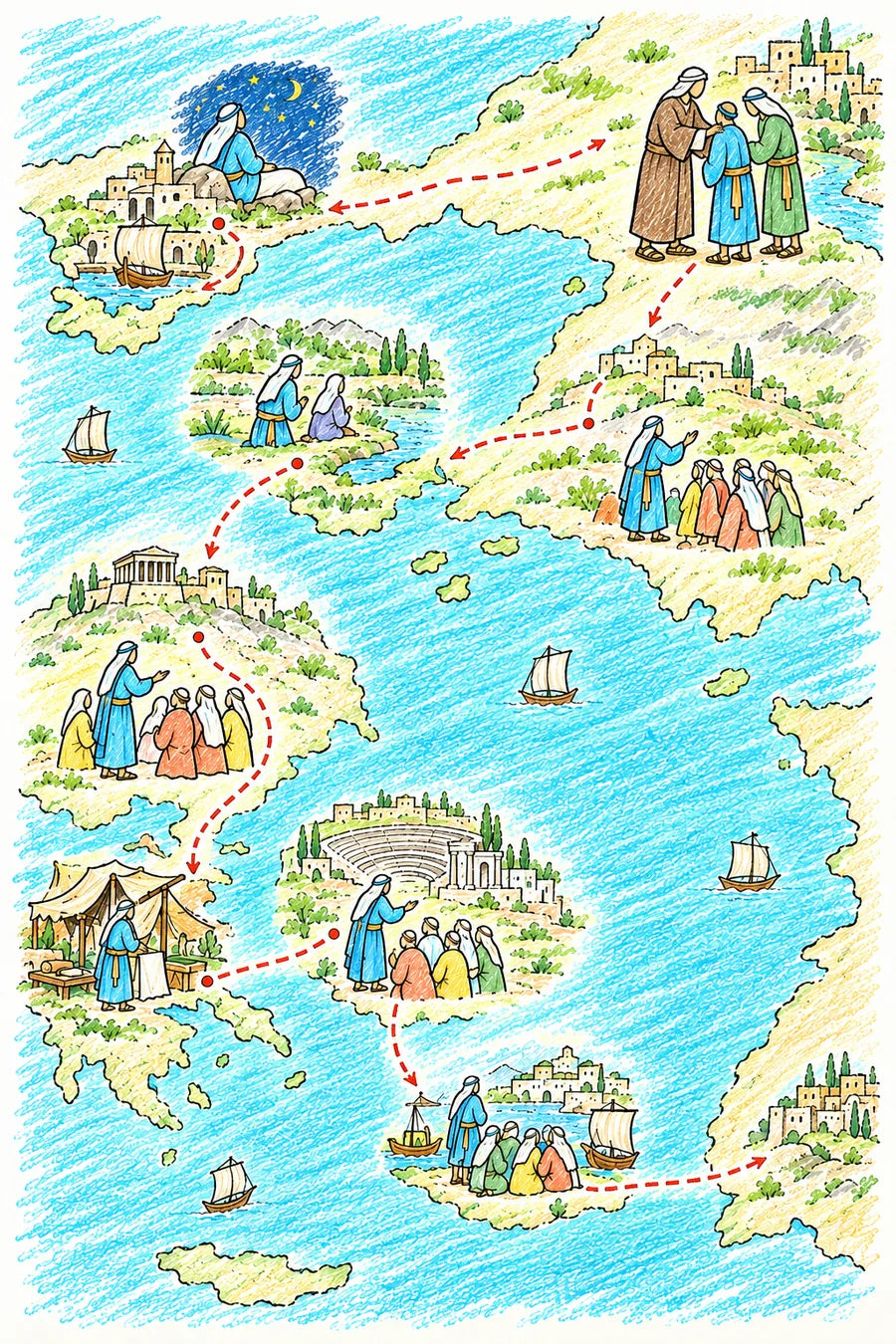
On his second journey, the Spirit closed the way into Asia, and at Troas Paul saw a vision of a man pleading, “Come over into Macedonia, and help us.” He went immediately. In Philippi the Lord opened Lydia’s heart; in Athens he taught of the unknown God; in Corinth he made tents with Aquila and Priscilla. On his third journey the word grew mightily in Ephesus, and at Miletus Paul knelt and prayed with the Ephesian elders, reminding them of the Lord’s words, “It is more blessed to give than to receive.”
Antioch, Lystra, Troas, Philippi, Athens, Corinth, Ephesus and Miletus, across the eastern Mediterranean.
Watch how the Holy Ghost guides every step, and how Paul keeps testifying of the grace of Jesus Christ.
Read it yourself: Acts 13:1–4; Acts 16:6–15; Acts 20:17–38
Part 1 of 7
Eight stops across the sea, from Antioch to Miletus. Scroll, or tap a number on the map.
Part 2 of 7
Four scenes: the call, the vision, the workshop and the farewell. Look for the Savior in each one.
Read it plainly
Tap any dotted word for its meaning. The scripture stays exactly as written.3
Part 3 of 7
Small details tell the story. Some cards are details in the text; others share insights from prophets or Church resources. Each card says which.
All nine. The hands, the ship, the sandals, the dream, the tent, the letters, the window, the farewell and the path. Acts 13–20
Part 4 of 7
Ready to set out, facing a closed door, serving in ordinary work, or saying goodbye. Which feels most like you right now?
A next step for you
Your choice is saved only on this device.
Try it
Follow Paul across the sea, one city at a time. A light goes ahead of you, and the route you’ve traveled stays on the map. At Troas, you choose.
“Come over into Macedonia, and help us.” Acts 16:9
Part 5 of 7
A little background helps us see how far Paul traveled, and why. Outside sources are labeled.
The Bible Dictionary: Paul “started with Barnabas and Mark on his first missionary journey,” and his second “lasted about three years.”10
Thousands of miles, on foot and by ship.
The student manual: the leaders who called Saul and Barnabas “had fasted and received revelation before making this important calling.”6
Missionaries are still called this way.
“She has the distinction of being Paul’s first known European convert.”7
Her heart “the Lord opened.”
The student manual: the words “we” and “us” starting in Acts 16:10 “indicate that this part of Luke’s record is an eyewitness account.”7
Luke joined Paul at Troas.
Word study · Greek
parakaleō παρακαλέω · “prayed him” (Acts 16:9)
Word study · Greek
episterizō ἐπιστηρίζω · “confirming” (Acts 14:22)
What the text does not say
The story does not say Paul’s journeys were easy or always successful. He was stoned, beaten and turned away, and he taught that “we must through much tribulation enter into the kingdom of God.”2
Part 6 of 7
Paul went “to testify the gospel of the grace of God.” Every road led back to Jesus.
Paul’s farewell: “It is more blessed to give than to receive.”
Acts 20:35, quoting the Lord Jesus5“The Lord had a people there prepared for the Gospel. They were praying for light and truth, and the Lord sent me to them.”
“We are part of a great movement—the gathering of scattered Israel.”
“In the school of mortality, the tutor is often pain and tribulation, but the lessons are meant to refine and bless us and strengthen us, not to destroy us.”
Paul to the Ephesian elders
“So that I might finish my course with joy, and the ministry, which I have received of the Lord Jesus, to testify the gospel of the grace of God.” Acts 20:24
The Lord to Paul in Corinth
“Be not afraid, but speak, and hold not thy peace: for I am with thee.” Acts 18:9–10
Part 7 of 7
A question to ask in prayer
Who is asking me to come and help? Acts 16:9
The man of Macedonia pleaded for help. Ask Heavenly Father who near you is quietly hoping someone will come, and how you could help.
One port each day. It saves on this device, one day at a time.
0 of 7 today
Seven ports along the way. Come again tomorrow.
A quiet moment
“For I am with thee.”
Read Acts 16:6–10 and Acts 18:9–10 slowly. Then sit in quiet and ask Heavenly Father where He is leading you, and listen. Acts 16:6–10
A verse to hold
Talk about it
For adults and deeper study
Longer readings, harder questions, and where to study next. Each one says what it is before you click.
The call of Saul and Barnabas, setting apart, the first journey, Lystra, and why trials refine us.6
Read the chapter →The Macedonian call, Lydia, Luke’s eyewitness account, tentmaking in Corinth and the farewell at Miletus.7
Read the chapter →Missionary work as part of the great latter-day gathering, on both sides of the veil.8
Read the talk →An overview of Paul’s later journeys, with lessons for youth.9
Read the overview →Every quotation, gloss, and piece of background on this page is listed here: scripture first, then Church sources, then outside scholarship (labeled).
Quotations checked against the linked pages on October 10, 2026. Scripture is quoted from the King James Version as published in the Gospel Library.
He calls, He sends, and He goes with you. Acts 20:24

Printable sketch notes
Everything on this page as a 11-page letter-size PDF: the map, scenes, cards, activity, word studies, tracker, Go deeper and sources. For home, class or a quiet Sunday.
More stories
Paul’s Missionary Journeys is part of the Scripture Story Sketch Notes for the New Testament, set alongside Come, Follow Me for July 19–25, 2027 (Acts 16–21).
See every story See all 2027 weeksIndependent study notes from Weak Things, not an official publication of The Church of Jesus Christ of Latter-day Saints. Scripture quotations are from the King James Version. The story draws on Acts 13–20; the insights in “Look closer” are labeled by source.