Elder Ulisses Soares, “How Can I Understand?” (2019)
The Ethiopian’s question as a call to learn and teach one another, at home and at church, and to act on what we learn.3
Read the talk →Scripture Story Sketch Notes · Acts 8:26–40; Isaiah 53:7–8
“How can I, except some man should guide me?” Acts 8:31
A desert road, a chariot, a scroll of Isaiah, a humble question, and water by the way. Ride along, open the scripture, and find Jesus in it.
Before you begin
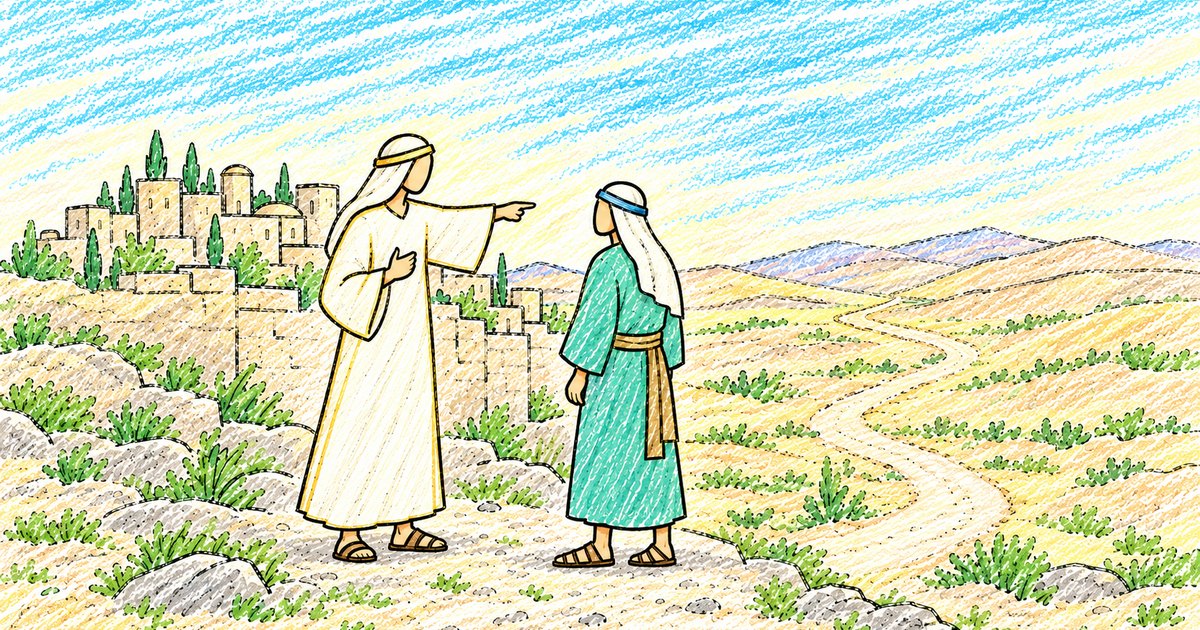
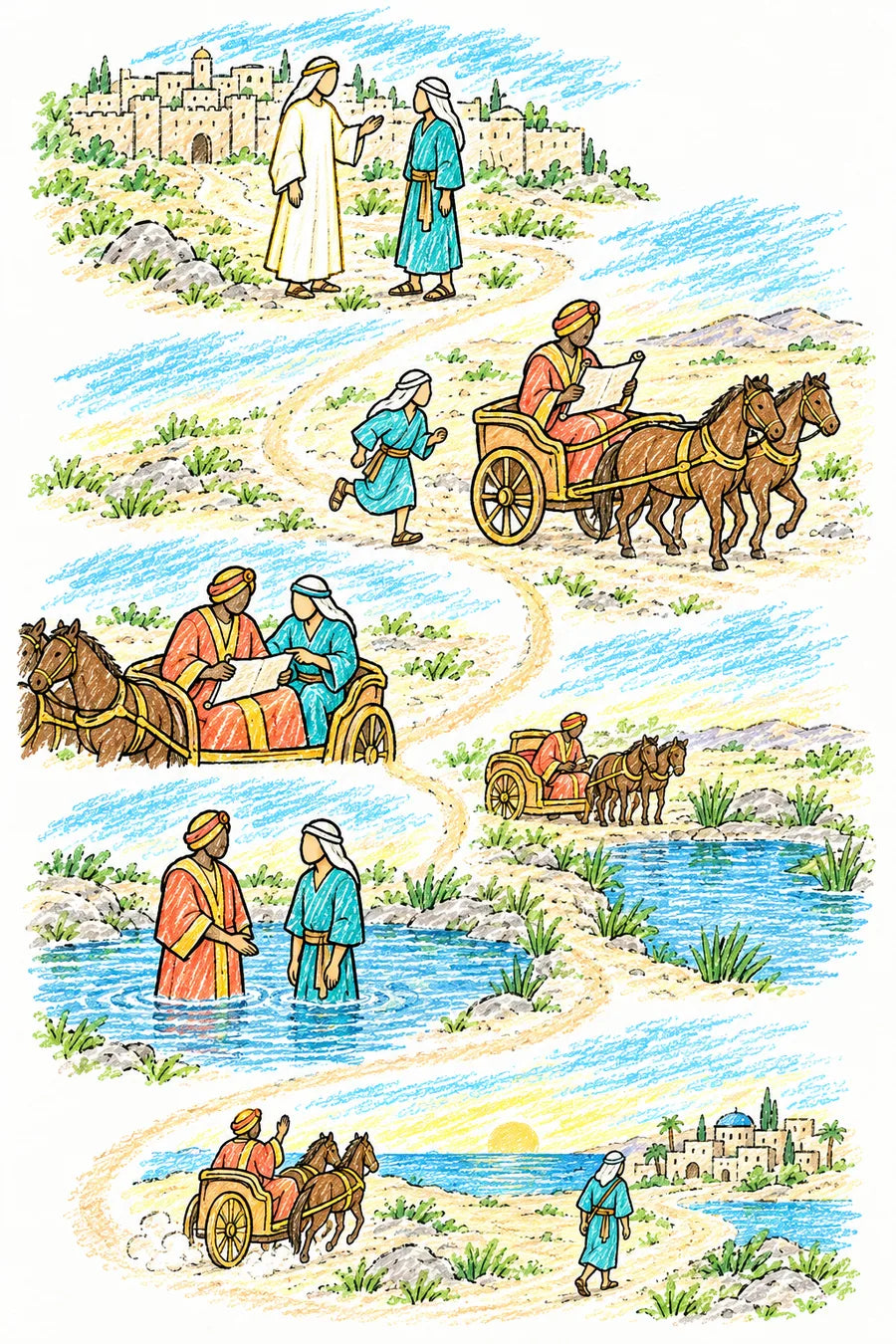
Philip, one of the seven men chosen to serve, had been teaching in Samaria. An angel told him to go south to the desert road that ran from Jerusalem to Gaza. He arose and went.
On the road was an important official from Ethiopia, the treasurer of the queen, riding home in his chariot after worshipping in Jerusalem. He was reading the prophet Isaiah. The Spirit told Philip to go near, so Philip ran to the chariot and asked, “Understandest thou what thou readest?” The man answered, “How can I, except some man should guide me?” He was reading Isaiah’s words about a lamb led to the slaughter. Philip began with that scripture and taught him about Jesus. When they came to water, the man asked to be baptized. Philip baptized him, and the man went on his way rejoicing.
The desert road from Jerusalem toward Gaza, soon after the Church began to spread beyond Jerusalem.
Watch how one scripture in Isaiah leads to Jesus, and how the Lord guides Philip to one person.
Read it yourself: Acts 8:26–40
Part 1 of 7
Eight stops from Jerusalem down the desert road. Scroll, or tap a number on the map.
Part 2 of 7
Four scenes: the angel, the chariot, the scripture and the water. Look for the Savior in each one.
Read it plainly
Tap any dotted word for its meaning. The scripture stays exactly as written.1
Part 3 of 7
Small details tell the story. Some cards are details in the text; others share insights from prophets. Each card says which.
All nine. The desert road, the chariot, Isaiah, the lamb, the guide, the water, the Spirit, the run and the rejoicing. Acts 8:26–40
Part 4 of 7
Reading but not understanding, ready to guide, held back, or going on rejoicing. Which feels most like you right now?
A next step for you
Your choice is saved only on this device.
Try it
Follow Philip down the desert road, one stop at a time. A light goes ahead of you, and the trail you’ve traveled stays on the map. Near the end, you choose.
“Go near, and join thyself to this chariot.” Acts 8:29
Part 5 of 7
A little background helps us see who was on that road. Outside sources are labeled.
The Bible Dictionary: Philip was “one of the seven; an evangelist,” who “preaches at Samaria, and to the Ethiopian eunuch.”5
Not the Apostle Philip, but one of the seven chosen to serve.
Ancient Ethiopia, also called Cush, “extended from Syene on the frontier of Egypt southward to the neighborhood of Khartoum.”6
He had traveled a very long way to worship.
The seminary manual explains that “a eunuch is a trusted servant.” He had “the charge of all her treasure.”41
He was an important official of the queen.
“He was oppressed, and he was afflicted, yet he opened not his mouth: he is brought as a lamb to the slaughter.”2
Isaiah 53 is a prophecy of the Savior’s suffering.
Word study · Greek
hodēgeō ὁδηγέω · “guide” (Acts 8:31)
Word study · Greek
chairō χαίρω · “rejoicing” (Acts 8:39)
What the text does not say
The story does not say the man was foolish for not understanding. He was humble enough to ask. Elder Soares teaches that sometimes we are like the Ethiopian and sometimes like Philip.3
Part 6 of 7
Every scripture can lead us to Jesus. Philip began with one verse in Isaiah and “preached unto him Jesus.”
Elder Ulisses Soares: “How can I [understand], except some man should guide me?”
Elder Ulisses Soares, “How Can I Understand?,” April 20193“We are sometimes like the Ethiopian—we need the help of a faithful and inspired teacher; and we are sometimes like Philip—we need to teach and strengthen others in their conversion.”
“He acted upon the truth he learned from Philip. He asked to be baptized. He came to know that Jesus Christ was the Son of God.”
“The question asked by this Ethiopian man is a reminder of the divine mandate we all have to seek to learn and to teach one another the gospel of Jesus Christ.”
Isaiah
“He is brought as a lamb to the slaughter, and as a sheep before her shearers is dumb, so he openeth not his mouth.” Isaiah 53:7
The Ethiopian’s testimony
“I believe that Jesus Christ is the Son of God.” Acts 8:37
Part 7 of 7
A question to ask yourself
“Understandest thou what thou readest?” Acts 8:30
Pick one verse you are reading this week. Ask: what does this teach me about Jesus? If you are not sure, ask someone to read it with you.
One step down the road each day. It saves on this device, one day at a time.
0 of 7 today
Seven days on the road. Come again tomorrow.
A quiet moment
“And preached unto him Jesus.”
Read Acts 8:26–40 and Isaiah 53:3–7 slowly. Then sit in quiet and ask Heavenly Father who you could read with, and listen. Acts 8:26–40
A verse to hold
Talk about it
For adults and deeper study
Longer readings, harder questions, and where to study next. Each one says what it is before you click.
The Ethiopian’s question as a call to learn and teach one another, at home and at church, and to act on what we learn.3
Read the talk →Using the scriptures to help others come unto Jesus Christ, with a study chart for Acts 8:26–35 and a link to Isaiah 53.4
Lesson 86 →The chapter the Ethiopian was reading: a prophecy of the Savior who “hath borne our griefs, and carried our sorrows.”2
Read Isaiah 53 →Philip’s earlier ministry in Samaria, where “there was great joy in that city.”1
Read Acts 8 →Every quotation, gloss, and piece of background on this page is listed here: scripture first, then Church sources, then outside scholarship (labeled).
Quotations checked against the linked pages on October 10, 2026. Scripture is quoted from the King James Version as published in the Gospel Library.

Every scripture can lead us to Jesus. Open one and find Him. Acts 8:39
Printable sketch notes
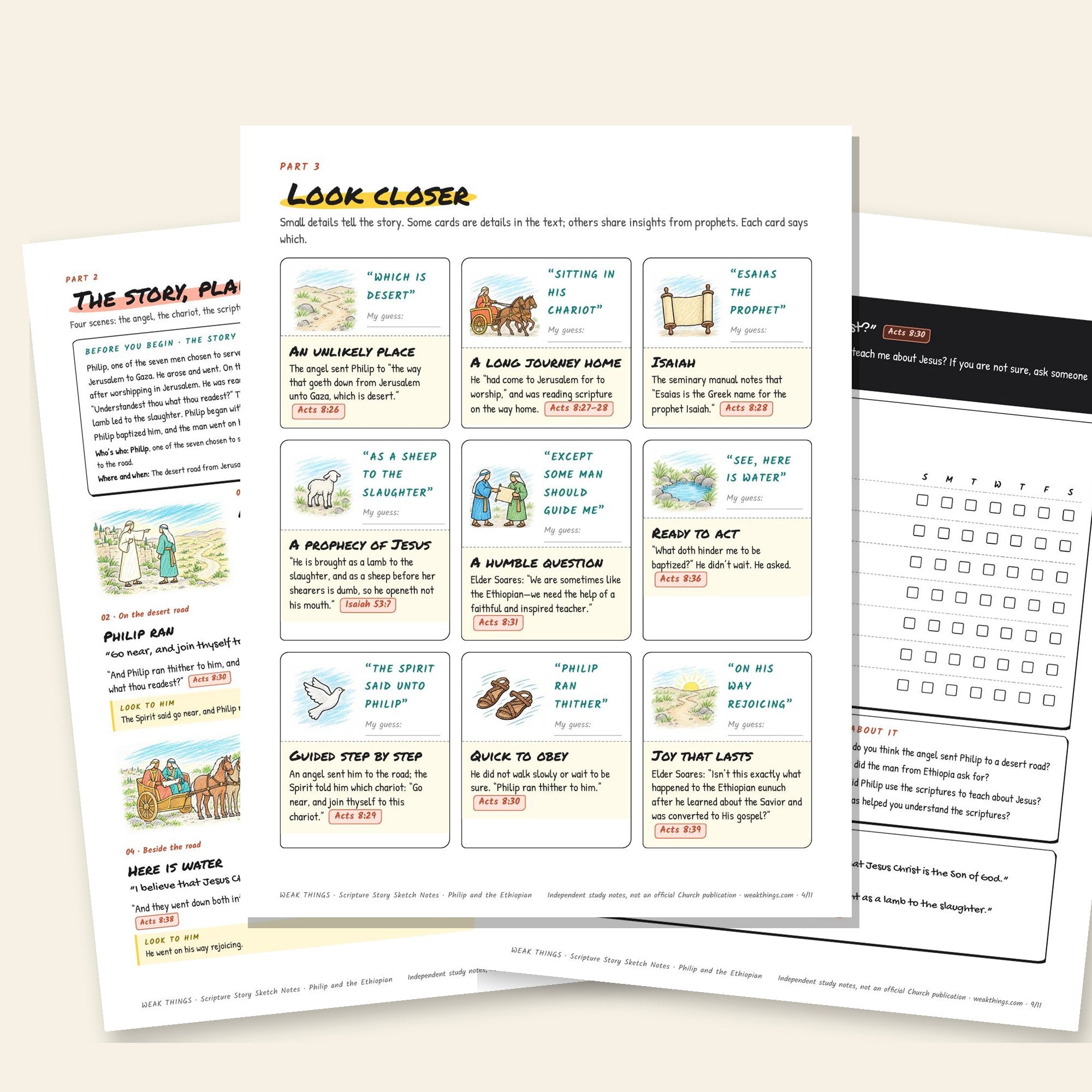
Everything on this page as a 11-page letter-size PDF: the map, scenes, cards, activity, word studies, tracker, Go deeper and sources. For home, class or a quiet Sunday.
More stories
Philip and the Ethiopian is part of the Scripture Story Sketch Notes for the New Testament, set alongside Come, Follow Me for July 5–11, 2027 (Acts 6–9).
See every story See all 2027 weeksIndependent study notes from Weak Things, not an official publication of The Church of Jesus Christ of Latter-day Saints. Scripture quotations are from the King James Version. The story is told in Acts 8:26–40, with the passage from Isaiah 53; the insights in “Look closer” are labeled by source.