President Dieter F. Uchtdorf, “Waiting on the Road to Damascus” (2011)
Why most testimonies come step by step, and the danger of waiting for a dramatic sign before committing to follow the Savior.4
Read the talk →Scripture Story Sketch Notes · Acts 9:1–22; Acts 22:6–16; Acts 26:12–19
“Lord, what wilt thou have me to do?” Acts 9:6
A man on a mission against the Church, a light at noon, a voice, three days in the dark, and a disciple who was afraid but went. Walk the road and let the scales fall away.
Before you begin
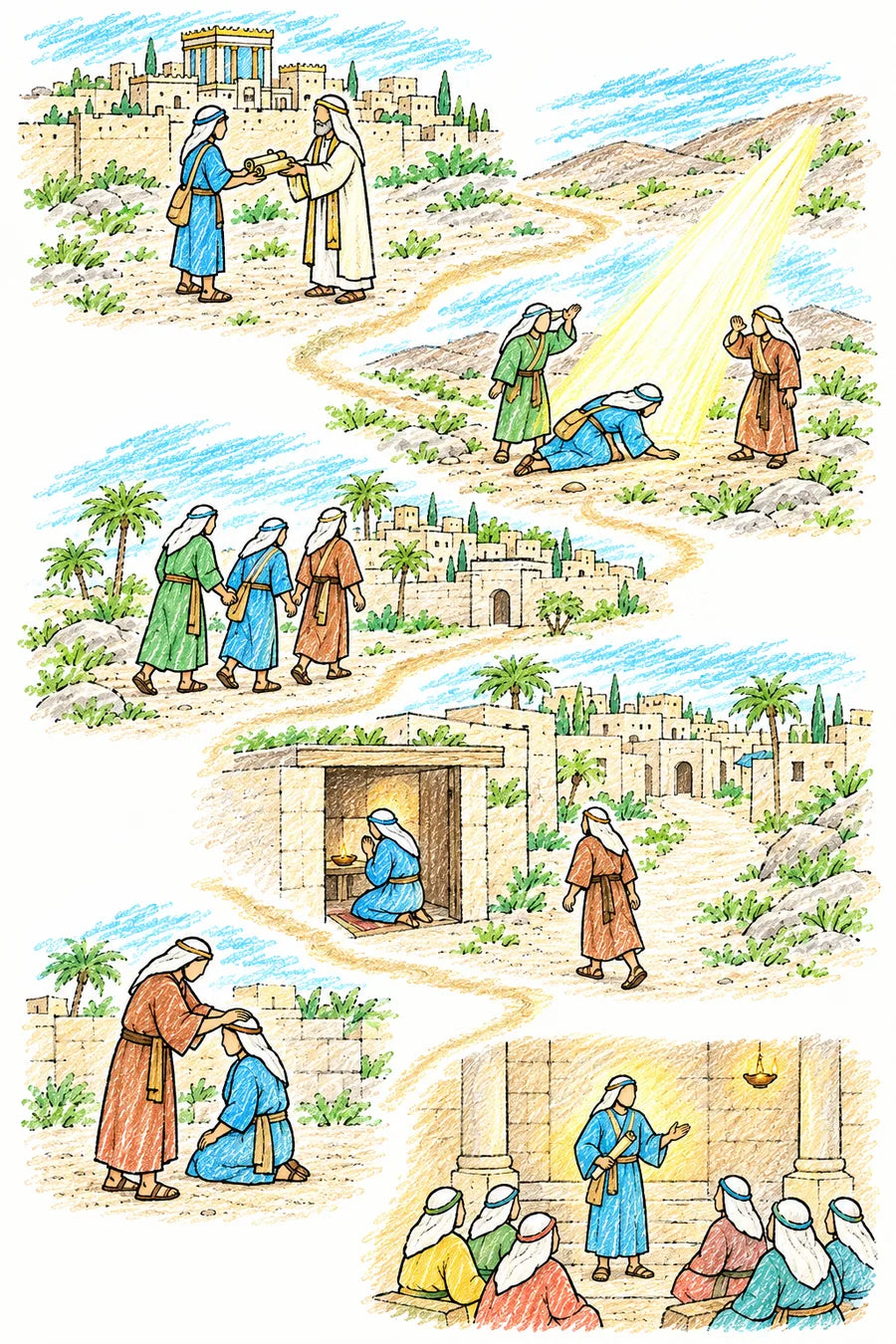
After Stephen was killed, a young Pharisee named Saul worked hard to stop the followers of Jesus. He went to the high priest and asked for letters to the synagogues in Damascus, so that he could bring any disciples he found back to Jerusalem bound.
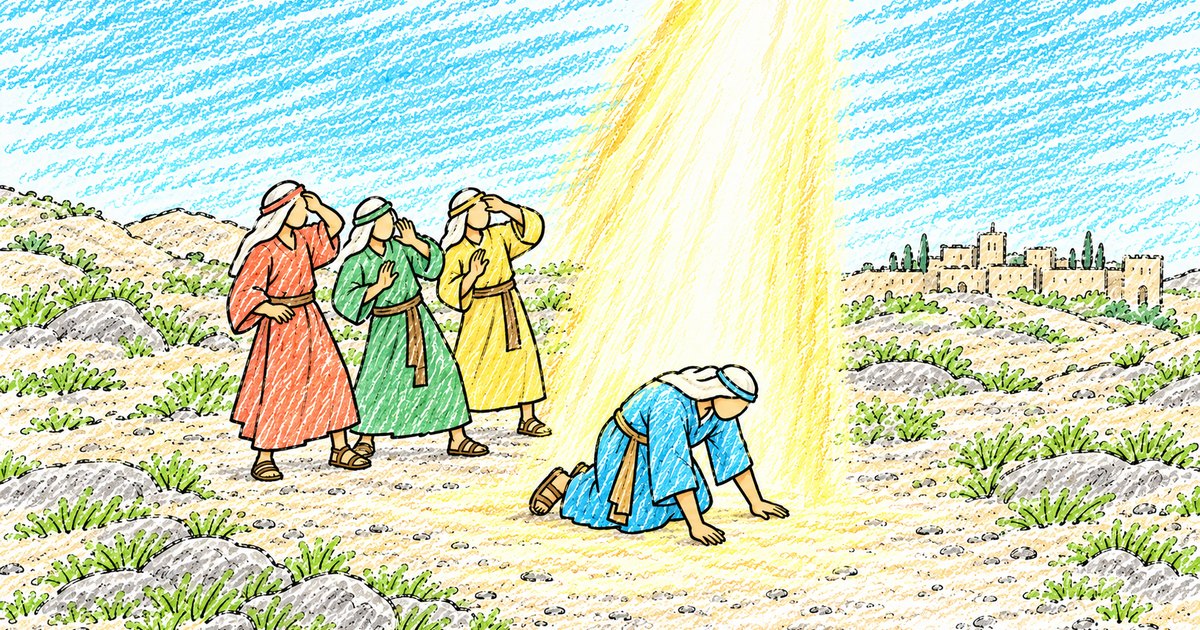
Near Damascus, a light from heaven shone around him, and he fell to the earth. A voice said, “Saul, Saul, why persecutest thou me?” It was Jesus. Saul, trembling, asked, “Lord, what wilt thou have me to do?” Blind, he was led into the city, where he fasted and prayed for three days. The Lord sent a disciple named Ananias, who was afraid but went. He called him “Brother Saul,” and something like scales fell from Saul’s eyes. Saul was baptized and began to preach that Jesus is the Son of God.
The road from Jerusalem to Damascus, a city in Syria, a few years after the Resurrection. The light came “at midday” (Acts 26:13).
Watch how Jesus calls Saul by name, and how He sees who Saul can become.
Read it yourself: Acts 9:1–22
Part 1 of 7
Eight stops from Jerusalem to the synagogues of Damascus. Scroll, or tap a number on the map.
Part 2 of 7
Four scenes: the light, the dark, the disciple who went, and the scales. Look for the Savior in each one.
Read it plainly
Tap any dotted word for its meaning. The scripture stays exactly as written.1
Part 3 of 7
Small details tell the story. Some cards are details in the text; others share insights from prophets or context. Each card says which.
All nine. The letters, the light, the goad, the voice, the hand, the three days, the street, the scales and the chosen vessel. Acts 9:1–22
Part 4 of 7
Saul, his companions, Ananias, and anyone who is still waiting. Which one feels most like you right now?
A next step for you
Your choice is saved only on this device.
Try it
For three days Saul waited in the dark, praying. Then the Lord sent Ananias. Press and hold the button, and keep holding, to let the light in. As it grows, the words of the story appear. Let go and it waits for you.
“Lord, what wilt thou have me to do?” Acts 9:6
Part 5 of 7
A little background helps us see the road as Saul saw it. Outside sources are labeled.
The Bible Dictionary: Damascus is “an ancient city of Syria, standing on a rich plain on the edge of the desert.”8
Saul traveled far from Jerusalem to find the disciples there.
Paul later said: “At midday, O king, I saw in the way a light from heaven, above the brightness of the sun.”3
The light was brighter than the noon sun.
Ananias said: “And now why tarriest thou? arise, and be baptized, and wash away thy sins, calling on the name of the Lord.”2
Saul’s change led straight to baptism.
Sister Craig: “Even in our busy lives, we can follow the example of Jesus and see individuals—their needs, their faith, their struggle, and who they can become.”6
Ananias learned to see Saul the way the Lord did.
Word study · Greek
kentron κέντρον · “pricks” (Acts 26:14)
Word study · Greek
skeuos σκεῦος · “vessel” (Acts 9:15)
What the text does not say
The story does not say Saul was beyond hope, or that only dramatic experiences count. Most conversion comes step by step; President Uchtdorf taught, “Belief Comes One Step at a Time.”4
Part 6 of 7
The risen Lord went looking for Saul. He knew his name, his heart and who he could become.
Saul’s question: “Lord, what wilt thou have me to do?”
Acts 9:61“This transformative moment changed Saul forever. Indeed, it changed the world.”
“Saul’s answer is a model for each of us: ‘Lord, what wilt thou have me to do?’”
“We know men and women can change—and change for the better.”
Paul’s own words
“Whereupon, O king Agrippa, I was not disobedient unto the heavenly vision.” Acts 26:19
Paul’s own words
“And now why tarriest thou? arise, and be baptized, and wash away thy sins, calling on the name of the Lord.” Acts 22:16
Part 7 of 7
A question to ask in prayer
“Lord, what wilt thou have me to do?” Acts 9:6
Saul asked it trembling on the road. President Monson called his answer “a model for each of us.”5 Ask it tonight, then listen.
One step on the road each day. It saves on this device, one day at a time.
0 of 7 today
Seven steps on the road. Come again tomorrow.
A quiet moment
“Lord, what wilt thou have me to do?”
Read Acts 9:1–22 slowly. Then sit in quiet and ask Heavenly Father Saul’s question. Write down what comes to mind, and listen. Acts 9:1–22
A verse to hold
Talk about it
For adults and deeper study
Longer readings, harder questions, and where to study next. Each one says what it is before you click.
Why most testimonies come step by step, and the danger of waiting for a dramatic sign before committing to follow the Savior.4
Read the talk →Saul’s question as a model for us, and the truth that people can change for the better.5
Read the talk →Seeing others as Jesus sees them: their needs, their faith, their struggle and who they can become.6
Read the talk →Two lessons on Saul’s conversion and on Ananias seeing Saul as the Lord saw him, with questions for youth.7
Lesson 87 → Lesson 88 →Paul retells his conversion twice, adding the light at noon, the goads, and Ananias’s words, “why tarriest thou?”3
Read Acts 22 → Read Acts 26 →Every quotation, gloss, and piece of background on this page is listed here: scripture first, then Church sources, then outside scholarship (labeled).
Quotations checked against the linked pages on October 10, 2026. Scripture is quoted from the King James Version as published in the Gospel Library.
He knows your name and your road. Ask, and take the next step. Acts 9:6

Printable sketch notes
Everything on this page as a 11-page letter-size PDF: the map, scenes, cards, activity, word studies, tracker, Go deeper and sources. For home, class or a quiet Sunday.
More stories
Saul on the Road to Damascus is part of the Scripture Story Sketch Notes for the New Testament, set alongside Come, Follow Me for July 5–11, 2027 (Acts 6–9).
See every story See all 2027 weeksIndependent study notes from Weak Things, not an official publication of The Church of Jesus Christ of Latter-day Saints. Scripture quotations are from the King James Version. The story is told in Acts 9, with Paul’s own retellings in Acts 22 and 26; the insights in “Look closer” are labeled by source.