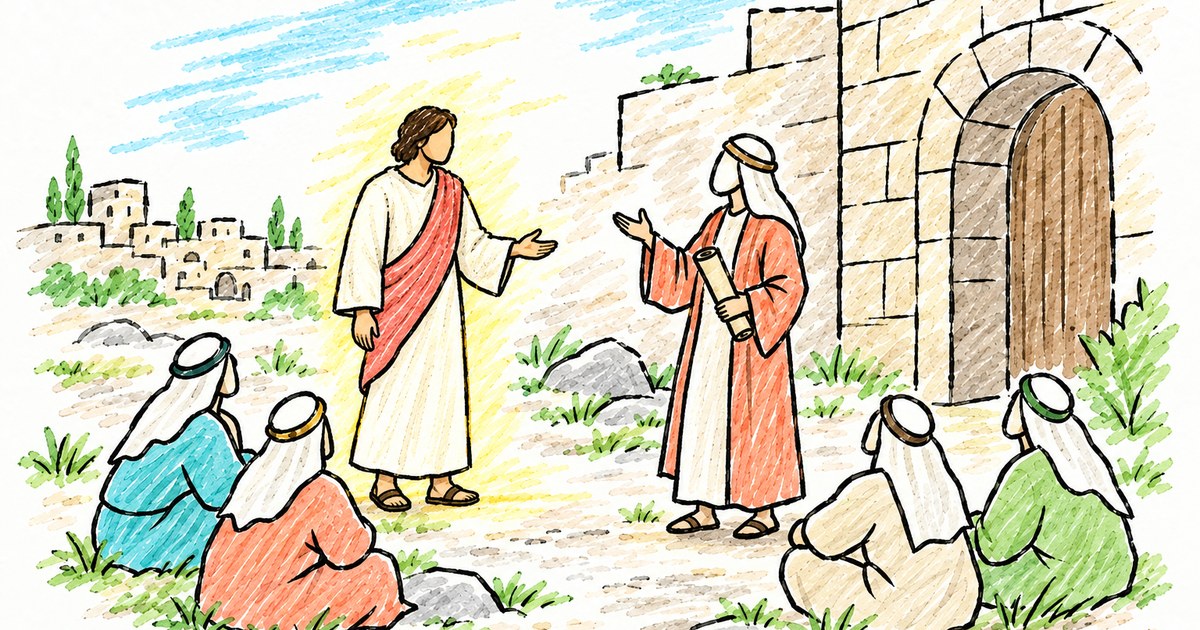
Elder Thomas S. Monson, “Your Jericho Road” (1977)
How each of us travels our own Jericho road, with stories of people who stopped to help and of a boy who learned to give.3
Read the talk →Scripture Story Sketch Notes · Luke 10:25–37
“Go, and do thou likewise.” Luke 10:37
A question about neighbours, a dangerous road, two men who passed by and one who stopped. Walk the road, look closer, and see the Savior who stops for us.
Before you begin
A lawyer asked Jesus what he must do to inherit eternal life. He answered with the law: love God, and love “thy neighbour as thyself.” Then, wanting to justify himself, he asked, “And who is my neighbour?” Jesus answered with a story.
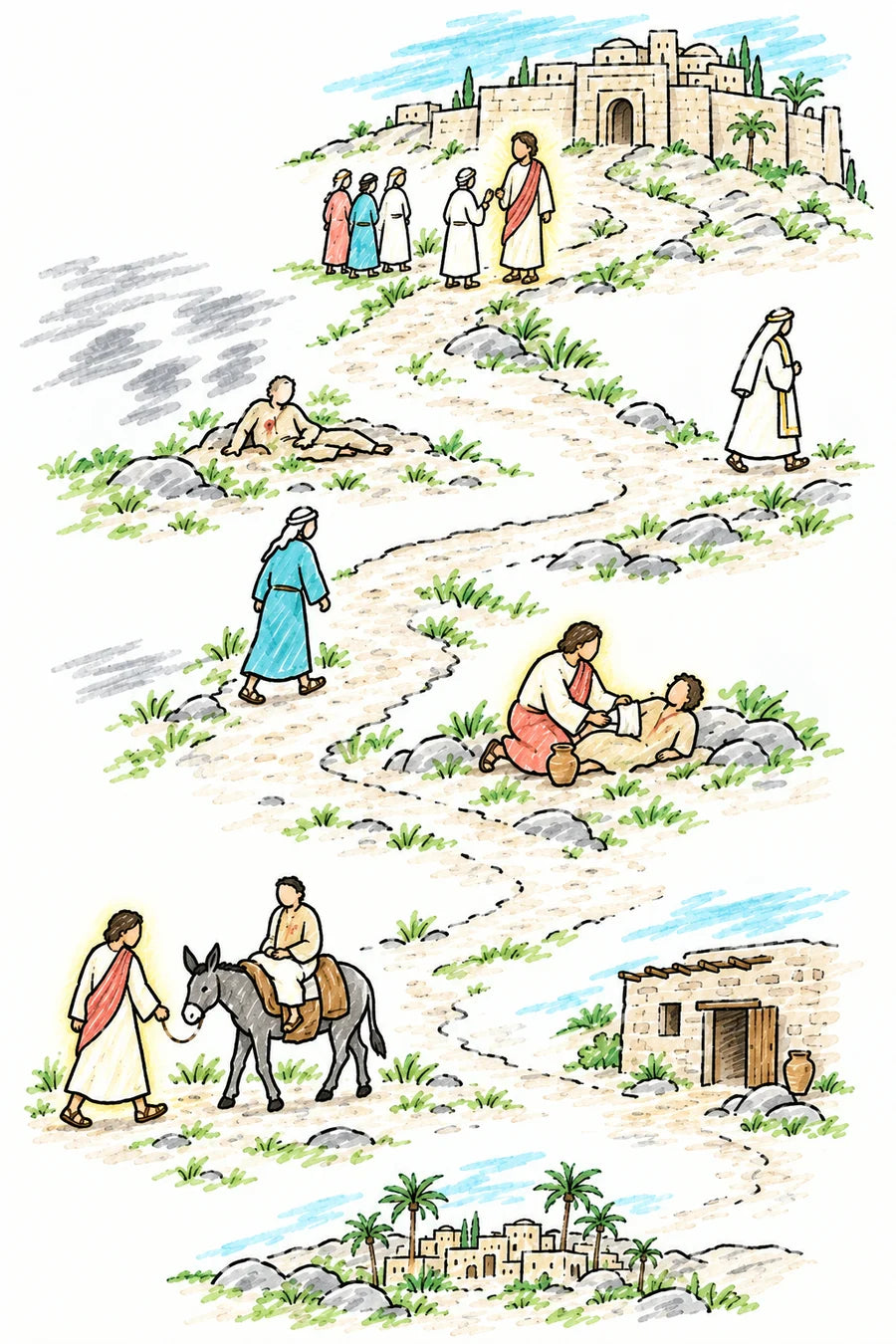
A man going down from Jerusalem to Jericho was robbed, beaten and left half dead. A priest saw him and passed by. A Levite looked and passed by. But a Samaritan had compassion. He bound up his wounds, set him on his own beast, took him to an inn and paid for his care. Jesus asked which one was a neighbour, and said, “Go, and do thou likewise.”
The steep road down from Jerusalem to Jericho.
Who saw the hurt man, and who stopped?
Read it yourself: Luke 10:25–37
Part 1 of 7
Eight stops from Jerusalem down to the inn. Scroll, or tap a number on the map.
Part 2 of 7
Four scenes: the question, the two who passed by, the one who stopped, and the inn. Look for the Savior in each one.
Read it plainly
Tap any dotted word for its meaning. The scripture stays exactly as written.1
Part 3 of 7
This is a parable. Jesus did not explain each detail, so some cards share details in the text, others share insights from prophets, and some share early Christian readings from an outside source. Each card says which.
All nine. The road, the wounds, compassion, oil, wine, the beast, the inn, two pence and a promise to come again. Luke 10:30–35
Part 4 of 7
People on this road were hurt, too busy to stop, ready to help, or asked to keep caring. Which feels most like you right now?
A next step for you
Your choice is saved only on this device.
Try it
Walk down the Jericho road one stop at a time. A light goes ahead of you, and the trail you’ve walked stays on the map. At the last stop, you choose.
“Go, and do thou likewise.” Luke 10:37
Part 5 of 7
A little background helps us see why this story surprised the people who first heard it. Outside sources are labeled.
When Jesus said, “This do, and thou shalt live,” Elder Talmage writes: “These simple words conveyed a rebuke, as the lawyer must have realized; they indicated the contrast between knowing and doing.”4
He knew the law. Jesus asked him to live it.
Elder Talmage: “If he had to love his neighbors as he loved himself, he wanted to have as few neighbors as possible.”4
Jesus made the circle bigger.
Elder Talmage: “Jericho was prominent as a residence place for priests and Levites.” The two who passed by were men of the temple.4
Knowing the law did not make them stop.
Elder Talmage: “To a Jew, none but Jews were neighbors.” “That the merciful one was a Samaritan, showed that the people called heretic and despised by the Jews could excel in good works.”4
The hero was the one they least expected.
Welch: “Before modernity, Christians read this parable allegorically, with the Samaritan, for example, aptly typifying Christ.”5
Many early Christians saw the Savior in the Samaritan.
Word study · Greek
splagchnizomai σπλαγχνίζομαι · “had compassion” (Luke 10:33)
Word study · Greek
plēsion πλησίον · “neighbour” (Luke 10:29)
Part 6 of 7
The Savior asked us to be like the Samaritan, and He is the one who stops for us.
Elder Thomas S. Monson: “Each of us, in the journey through mortality, will travel his own Jericho Road.”
Elder Thomas S. Monson, “Your Jericho Road,” April 19773“Will I fail to notice him who has fallen among thieves and requires my help? Will you?”
“When the Samaritan came along and saw the wretched state of the wounded man, he had no excuse for he wanted none.”
“thanks to the intervention of the Lord, who is the Good Samaritan.”
Gospel of Matthew
“But when he saw the multitudes, he was moved with compassion on them, because they fainted, and were scattered abroad, as sheep having no shepherd.” Matthew 9:36
Gospel of Luke
“Thou shalt love the Lord thy God with all thy heart, and with all thy soul, and with all thy strength, and with all thy mind; and thy neighbour as thyself.” Luke 10:27
Part 7 of 7
His answer
“Go, and do thou likewise.” Luke 10:37
Elder Monson: “Now the Jericho Road may not be clearly marked. Neither may the injured cry out, that we may hear.”3 Who will you stop for this week?
One way to stop a day. It saves on this device, one day at a time.
0 of 7 today
Seven days on the Jericho road. Come again tomorrow.
A quiet moment
“But a certain Samaritan, as he journeyed, came where he was: and when he saw him, he had compassion on him.”
Read Luke 10:30–37 slowly. Then sit in quiet and ask Heavenly Father whom He would like you to stop for this week, and listen. Luke 10:30–37
A verse to hold
Talk about it
For adults and deeper study
Longer readings, harder questions, and where to study next. Each one says what it is before you click.
How each of us travels our own Jericho road, with stories of people who stopped to help and of a boy who learned to give.3
Read the talk →The lawyer’s question, the road between Jerusalem and Jericho, the priest and the Levite, and why the hero was a Samaritan.4
Read chapter 26 →A Latter-day Saint scholar traces the early Christian reading of the parable, in which the Samaritan represents Christ, and explains each detail.5
Read the article →The Savior “moved with compassion” for the multitudes, the same word used of the Samaritan.2
Read Matthew 9 →Every quotation, gloss, and piece of background on this page is listed here: scripture first, then Church sources, then outside scholarship (labeled).
Quotations checked against the linked pages on October 7, 2026. Scripture is quoted from the King James Version as published in the Gospel Library.

He stops for us on our road. Then He asks us to stop for others. Luke 10:37

Printable sketch notes
Everything on this page as a 11-page letter-size PDF: the map, scenes, cards, activity, word studies, tracker, Go deeper and sources. For home, class or a quiet Sunday.
More stories
The Good Samaritan is part of the Scripture Story Sketch Notes for the New Testament, set alongside Come, Follow Me for April 12–18, 2027 (Matthew 18; Luke 10).
See every story See all 2027 weeksIndependent study notes from Weak Things, not an official publication of The Church of Jesus Christ of Latter-day Saints. Scripture quotations are from the King James Version. This is a parable; the early Christian readings in “Look closer” are labeled as outside sources.