Elder Joseph B. Wirthlin, “Living Water to Quench Spiritual Thirst” (1995)
Walks through the conversation at the well and teaches how obedience and the ordinances open the living spring within us.5
Read the talk →Scripture Story Sketch Notes · John 4:1–42
“The water that I shall give him shall be in him a well of water springing up into everlasting life.” John 4:14
A tired traveler at noon, a woman alone with her jar, and an offer of living water. Walk the map, look closer, draw from the well, and come and see.
Before you begin
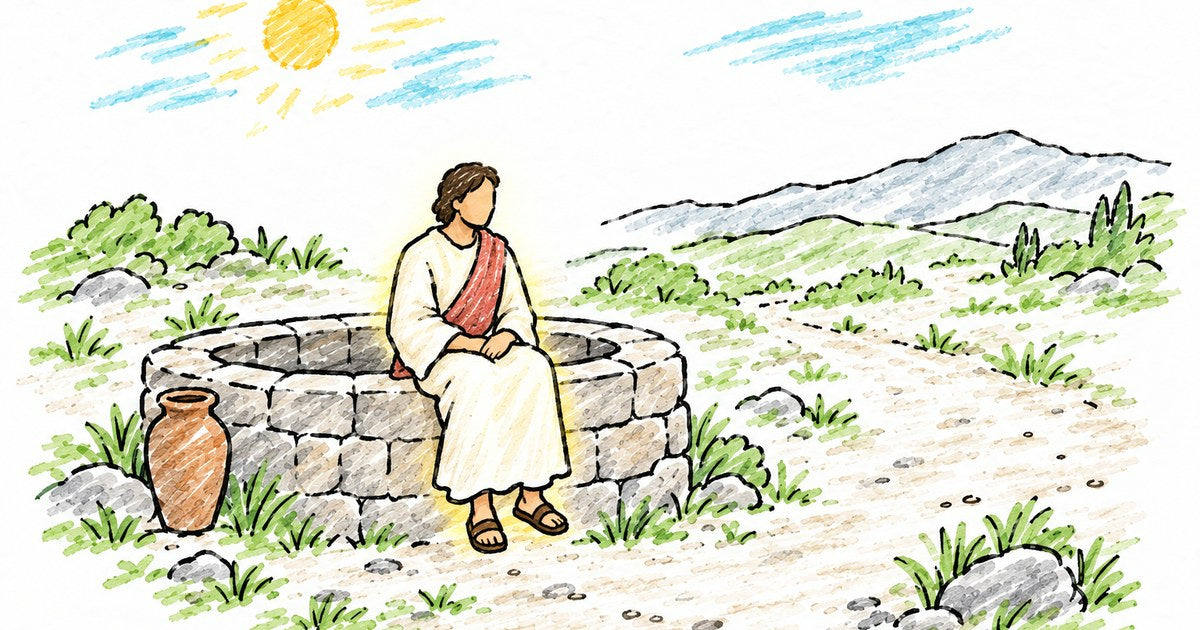
Jews and Samaritans had been divided for centuries and usually avoided each other. Yet on His way from Judea to Galilee, Jesus traveled through Samaria. Tired at noon, He sat by Jacob’s well while His disciples went into town to buy food. A Samaritan woman came to draw water, and Jesus asked her for a drink, which surprised her.
He offered her “living water” that would satisfy her forever, showed that He knew all about her life, and told her plainly that He was the Messiah. She left her water jar, hurried into town and invited everyone to “come, see.” Many came, listened to Jesus for two days and believed He was “the Saviour of the world.”
Jacob’s well near the town of Sychar in Samaria, between Judea and Galilee, at about noon.
Jesus speaks first, offers living water, and tells this woman plainly, “I that speak unto thee am he.”
Read it yourself: John 4:1–42
Part 1 of 7
Eight stops, from the road through Samaria to the fields white to harvest. Scroll, or tap a number on the map.
Part 2 of 7
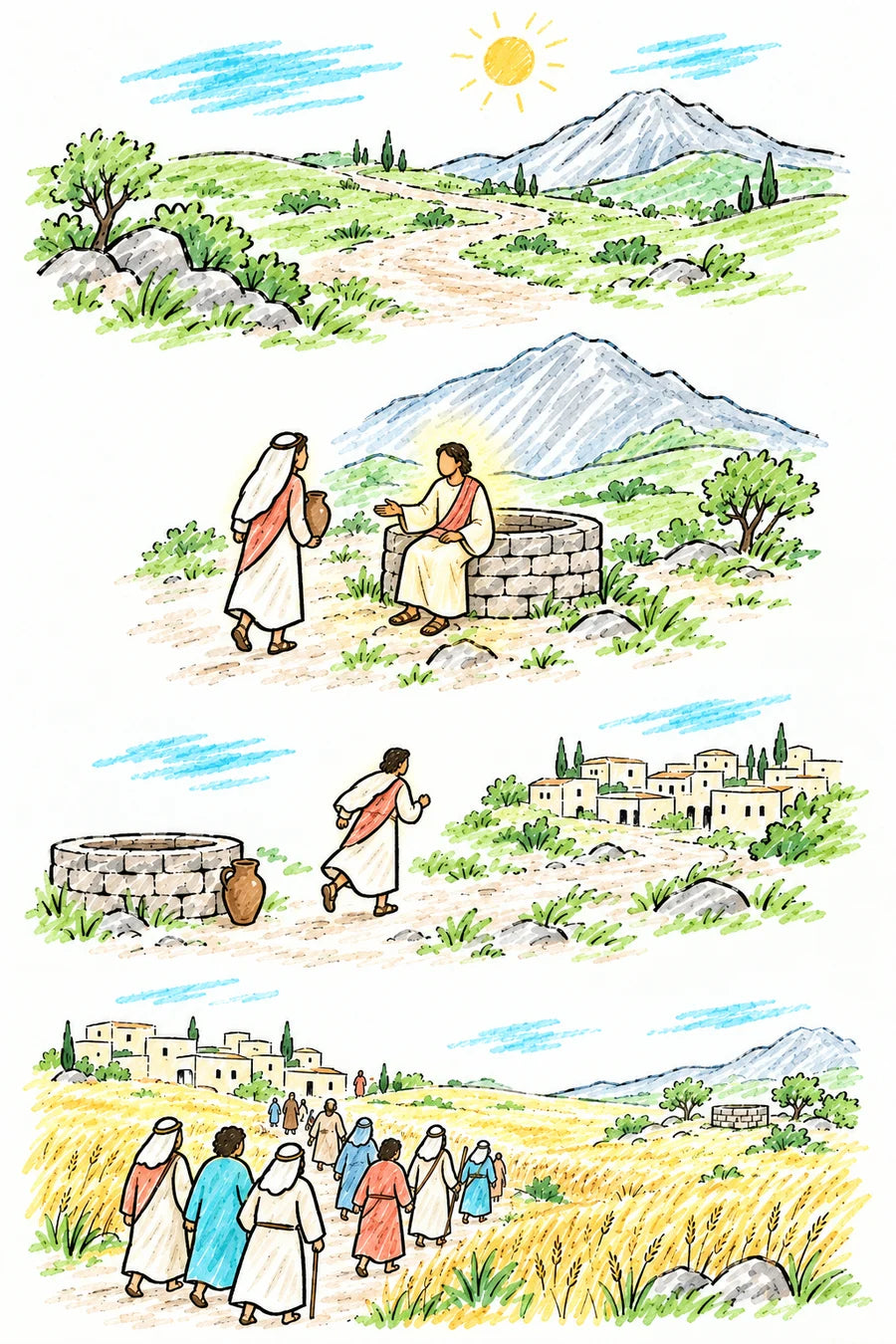
Four scenes: the well at noon, the offer of living water, the road to town and the fields. Look for the Savior in each one.
Read it plainly
Tap any dotted word for its meaning. The scripture stays exactly as written.1
Part 3 of 7
This is a true account, not a parable. Some cards are details in the text; others share insights from prophets and Church resources, and each card says which.
All nine. Jacob’s well, the jar she left, the noon sun, the spring inside, the mountain, the missing bucket, the white fields, a heart fully known and the road to town. John 4
Part 4 of 7
People come to the well thirsty, arguing, afraid to be known, or ready to share. Which feels most like you right now?
A next step for you
Your choice is saved only on this device.
Try it
She came to Jacob’s well to draw water. Draw some yourself and watch what happens to it. Then ask for the water He offered.
“Whosoever drinketh of this water shall thirst again.” John 4:13
Part 5 of 7
A little background shows how far He reached to meet her. Outside sources are labeled.
“By Jesus’s time, relations were so poor that some Jews from Galilee would rather make the long walk around Samaria rather than going through it when traveling to Jerusalem.”9
Yet “he must needs go through Samaria.”
Gaye Strathearn: “The ‘need’ that John refers to was not geographical.” Jesus “had work to do in Samaria.”11
He went because she was there.
The Samaritans “built a rival temple on Mount Gerizim in Samaria. This is the mountain that the woman at the well was referring to.”9
Jesus turned the question from a place to the Father.
The Joseph Smith Translation reads: “For unto such hath God promised his Spirit.” And “we know from latter-day revelation that God the Father and Jesus Christ have tangible, or physical, bodies.”9
The verse is about how to worship: in spirit and in truth.
Word study · Greek
phrear φρέαρ · “the well is deep” (John 4:11)
Word study · Greek
pēgē πηγή · “a well of water springing up” (John 4:14)
What the text does not say
Scripture doesn’t give her name, and it doesn’t say why she came at noon; the manuals say she “may have come at this unusual time to avoid the women of the village.”10 John doesn’t explain her five marriages, and Jesus doesn’t condemn her in the account. He simply knew her, and told her who He is.1
Part 6 of 7
He went out of His way, spoke first, knew her fully and told her plainly who He is. He offers the same living water to you.
Sister Susan H. Porter: “Despite her life’s difficulties, one of the Savior’s first public declarations that He was the Messiah was to her. He said, ‘I that speak unto thee am he.’”
April 20227“No matter our circumstances, our lives are sacred and have meaning and purpose.”
“Christ ministered to the one with love; as a result, others became His devoted disciples.”
“By living the gospel of Jesus Christ, we develop within ourselves a living spring that will quench eternally our thirst for happiness, peace, and everlasting life.”
“Those who drink deeply not only become whole themselves, but they become a fountain to others.”
Another Testament
“The rod of iron … was the word of God, which led to the fountain of living waters, or to the tree of life; which waters are a representation of the love of God.” 1 Nephi 11:25
Another Testament
“Whosoever will come may come and partake of the waters of life.” Alma 42:27
Part 7 of 7
His invitation
“If any man thirst, let him come unto me, and drink.” John 7:37
She left her waterpot and ran to tell others.1 What is one way you can drink from His living water this week, and who could you invite to come and see?
A little living water each day. It saves on this device, one day at a time.
0 of 6 today
Six days at the well. Come again tomorrow.
A quiet moment
“If thou knewest the gift of God.”
Read John 4:10–14 slowly. Picture Him at the well, asking you for a drink and offering you more. Pray now and ask Him for living water; then listen. John 4:10–14
A verse to hold
Talk about it
For adults and deeper study
Longer readings, harder questions, and where to study next. Each one says what it is before you click.
Walks through the conversation at the well and teaches how obedience and the ordinances open the living spring within us.5
Read the talk →Three lessons from the woman at the well: our circumstances do not determine our future, the power is in us, and small things bring great things.7
Read the talk →How living water heals, nourishes and sustains, with personal examples of people who drank deeply and became a fountain to others.6
Read the talk →Jews and Samaritans, Mount Gerizim, the Joseph Smith Translation of John 4:24, and the sixth hour at the well.910
Read Scripture Helps → Read the Student Manual →A close, scholarly reading of John 4: why Jesus went through Samaria, the Greek of the woman’s question, and the waterpot she left behind.11
Read the devotional →Every quotation, gloss, and piece of background on this page is listed here: scripture first, then Church sources, then outside scholarship (labeled).
Quotations checked against the linked pages on October 7, 2026. Scripture is quoted from the King James Version as published in the Gospel Library.
He went out of His way, spoke first, knew her fully and told her plainly who He is. He offers you the same living water. Come and drink. John 4:14

Printable sketch notes
Everything on this page as a 11-page letter-size PDF: the map, scenes, cards, activity, word studies, tracker, Go deeper and sources. For home, class or a quiet Sunday.
More stories
The Woman at the Well is part of the Scripture Story Sketch Notes for the New Testament, set alongside Come, Follow Me for February 1–7, 2027 (John 2–4).
See every story See all 2027 weeksIndependent study notes from Weak Things, not an official publication of The Church of Jesus Christ of Latter-day Saints. Scripture quotations are from the King James Version. This is a true account, not a parable; the insights in “Look closer” are labeled by source.