Amy A. Wright, “Christ Heals That Which Is Broken” (2022)
How the Savior heals broken relationships with God, with others and with ourselves, beginning with this woman.3
Read the talk →Scripture Story Sketch Notes · John 8:1–11
“Neither do I condemn thee: go, and sin no more.” John 8:11
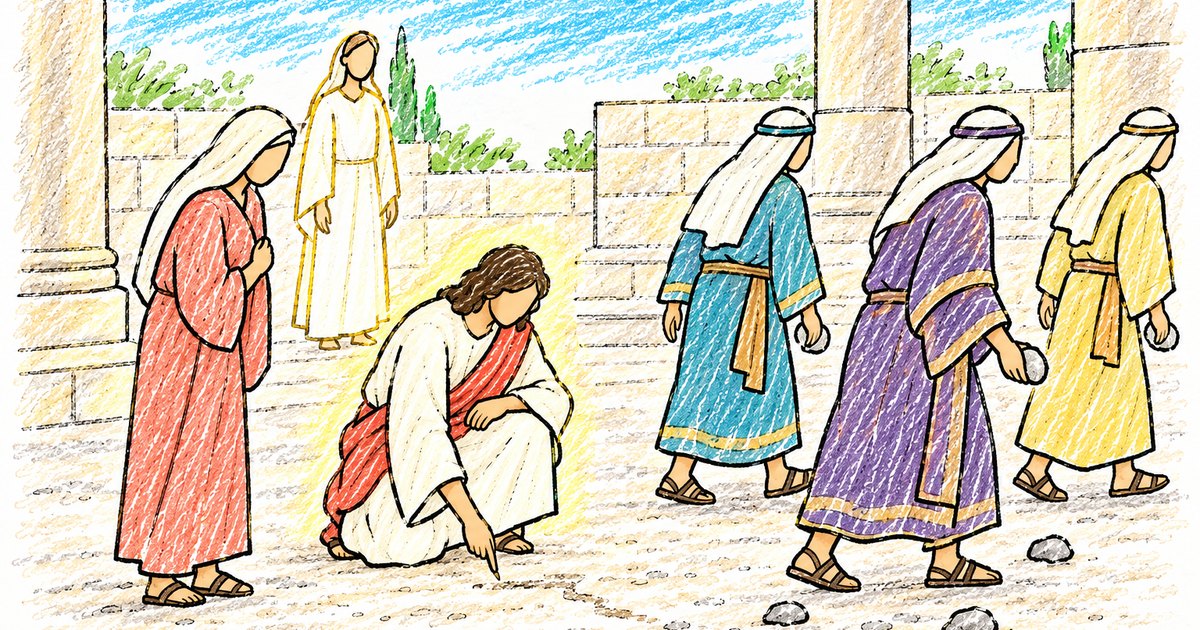
Religious leaders brought a woman to Jesus to trap Him. He stooped and wrote on the ground, then invited anyone without sin to throw the first stone. When they had all gone, He spoke to her with mercy and sent her forward to a new life.
Before you begin
After a night on the mount of Olives, Jesus came early to the temple, sat down and taught the people. Scribes and Pharisees brought Him a woman taken in adultery and set her in the middle of everyone. They reminded Him that the law of Moses commanded such a person to be stoned and asked, “But what sayest thou?” They were trying to trap Him. Jesus stooped down and wrote on the ground with His finger.
When they kept asking, He stood and said, “He that is without sin among you, let him first cast a stone at her,” and stooped to write again. Convicted by their own conscience, they left one by one, beginning with the eldest. When only the woman remained, Jesus asked, “Hath no man condemned thee?” She said, “No man, Lord.” Jesus answered, “Neither do I condemn thee: go, and sin no more.”
In the temple courtyard in Jerusalem, early in the morning.
Watch how Jesus answers both the accusers and the woman.
Read it yourself: John 8:1–11
Part 1 of 7
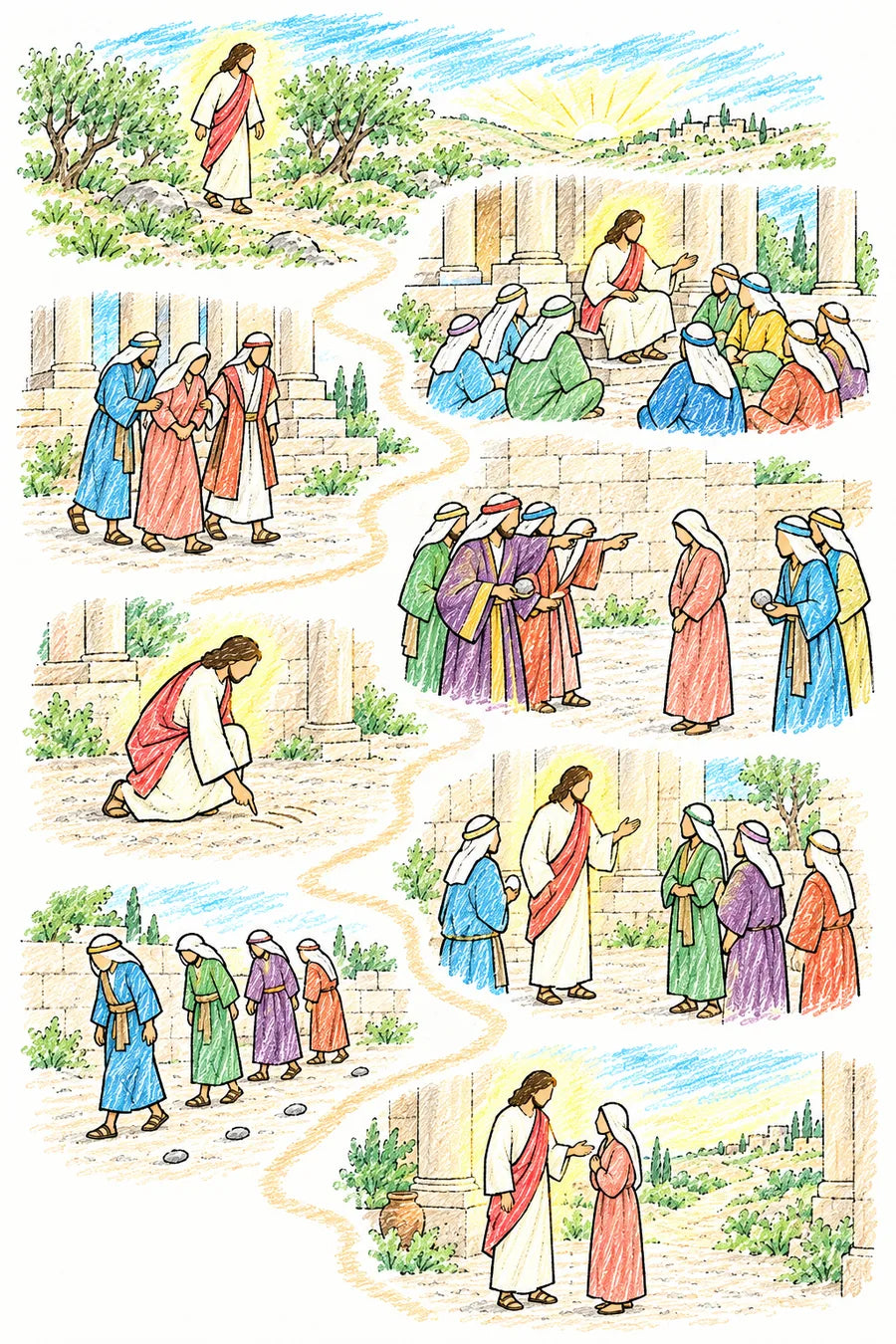
Eight stops from the mount of Olives to a new start. Scroll, or tap a number on the map.
Part 2 of 7
Four scenes: the trap, the writing, the accusers leaving and the merciful words. Look for the Savior in each one.
Read it plainly
Tap any dotted word for its meaning. The scripture stays exactly as written.1
Part 3 of 7
Small details tell the story. Some cards are details in the text; others share insights from Church leaders, Church resources or outside sources. Each card says which.
All nine. The olive hill, the temple, the stones, the writing, the dropped stone, the footsteps, the empty courtyard, the open hands and the path. John 8:1–11
Part 4 of 7
Feeling accused, holding a stone, needing mercy, or a new start. Which feels most like you right now?
A next step for you
Your choice is saved only on this device.
Try it
Tap the moments in John 8 in the order they happened, from the mount of Olives to a new start.
“Neither do I condemn thee: go, and sin no more.” John 8:11
Part 5 of 7
A little background on the trap, the law and two Greek words helps the story come alive. Outside sources are labeled.
The leaders made “an effort to trap Him in His words,” and the Savior “showed compassion in refusing to condemn” the woman.2
Two traps closed.
President Oaks taught that here, “the word condemn apparently refers to the final judgment,” and that the woman “was granted time to repent.”2
Time to change.
“We do not know her full story.” Sister Wright added, “Often the scriptures give only a small portion of someone’s life.”3
More than one moment.
Sister Wright noted that the Joseph Smith Translation “makes it clear that the woman did follow the Savior’s counsel and changed her life.”3
She changed.
Word study · Greek
katakrinó κατακρίνω · “condemn” (John 8:10–11)
Word study · Greek
anamartétos ἀναμάρτητος · “without sin” (John 8:7)
Part 6 of 7
He would not condemn her or excuse sin. He gave her time, mercy and a way forward.
“Jesus Christ was the answer then, and He is the answer now.”
Amy A. Wright3Part 7 of 7
A question to ask in prayer
Lord, what wouldst Thou have me change, and how wilt Thou help me? John 8:11
He offers mercy and a way forward. Ask Him for both.
One step of mercy each day. It saves on this device, one day at a time.
0 of 7 today
Seven days of mercy. Come again tomorrow.
A quiet moment
“Neither do I condemn thee.”
Read John 8:1–11 slowly. Picture the stones falling to the ground one by one. Then picture Jesus looking up at the woman and speaking to her kindly. John 8:1–11
A verse to hold
Talk about it
For adults and deeper study
Longer readings, harder questions, and where to study next. Each one says what it is before you click.
How the Savior heals broken relationships with God, with others and with ourselves, beginning with this woman.3
Read the talk →On judging, grudges and forgiveness, and remembering the Savior’s words before we cast stones.4
Read the talk →The trap the leaders set, and what “neither do I condemn thee” means.2
Read the chapter →Read the whole account, and notice how many times Jesus stoops and rises.1
John 8 →Every quotation, gloss, and piece of background on this page is listed here: scripture first, then Church sources, then outside scholarship (labeled).
Quotations checked against the linked pages on October 11, 2026. Scripture is quoted from the King James Version as published in the Gospel Library.

He met her with mercy and sent her forward. He offers each of us the same: forgiveness, and a new way to walk. John 8:11

Printable sketch notes
Everything on this page as a 11-page letter-size PDF: the map, scenes, cards, activity, word studies, tracker, Go deeper and sources. For home, class or a quiet Sunday.
More stories
The Woman Taken in Adultery is part of the Scripture Story Sketch Notes for the New Testament, set alongside Come, Follow Me for April 19–25, 2027 (John 7–10).
See every story See all 2027 weeksIndependent study notes from Weak Things, not an official publication of The Church of Jesus Christ of Latter-day Saints. Scripture quotations are from the King James Version. The words are in John 8:1–11; the insights in “Look closer” are labeled by source.