President Dieter F. Uchtdorf, “The Gift of Grace” (2015)
Simon and the woman, and why grace is a gift we can’t buy with obedience.4
Read the talk →Scripture Story Sketch Notes · Luke 7:36–50
“Thy faith hath saved thee; go in peace.” Luke 7:50
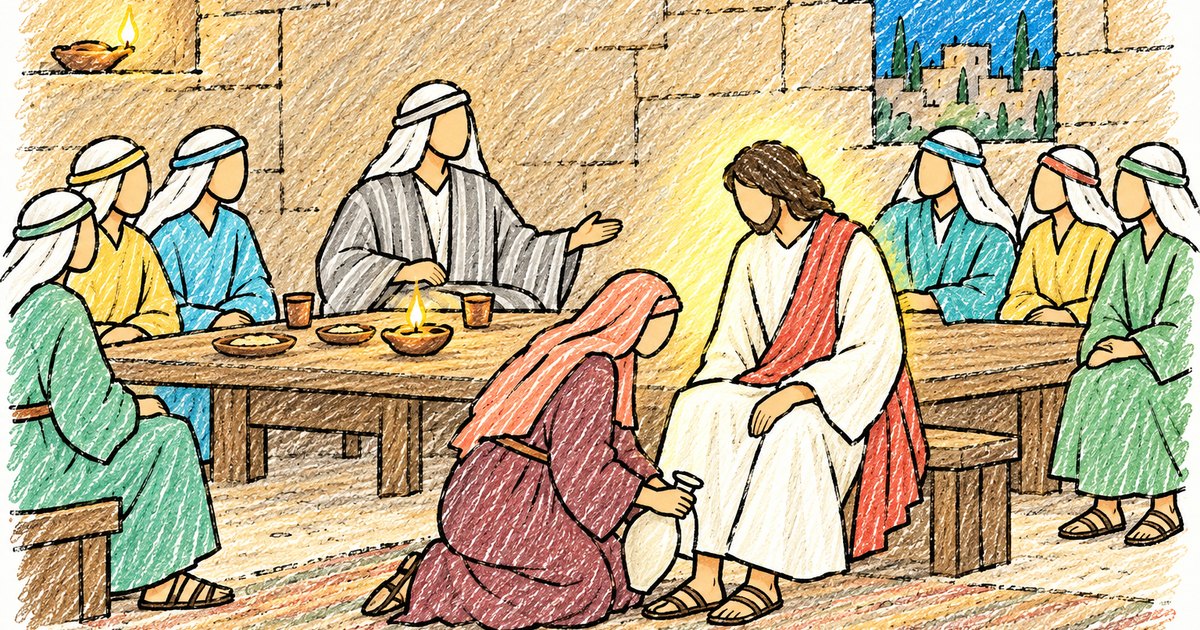
At a Pharisee’s dinner, a woman known as a sinner knelt at Jesus’s feet, washed them with her tears and anointed them. Simon judged her; Jesus forgave her.
Before you begin
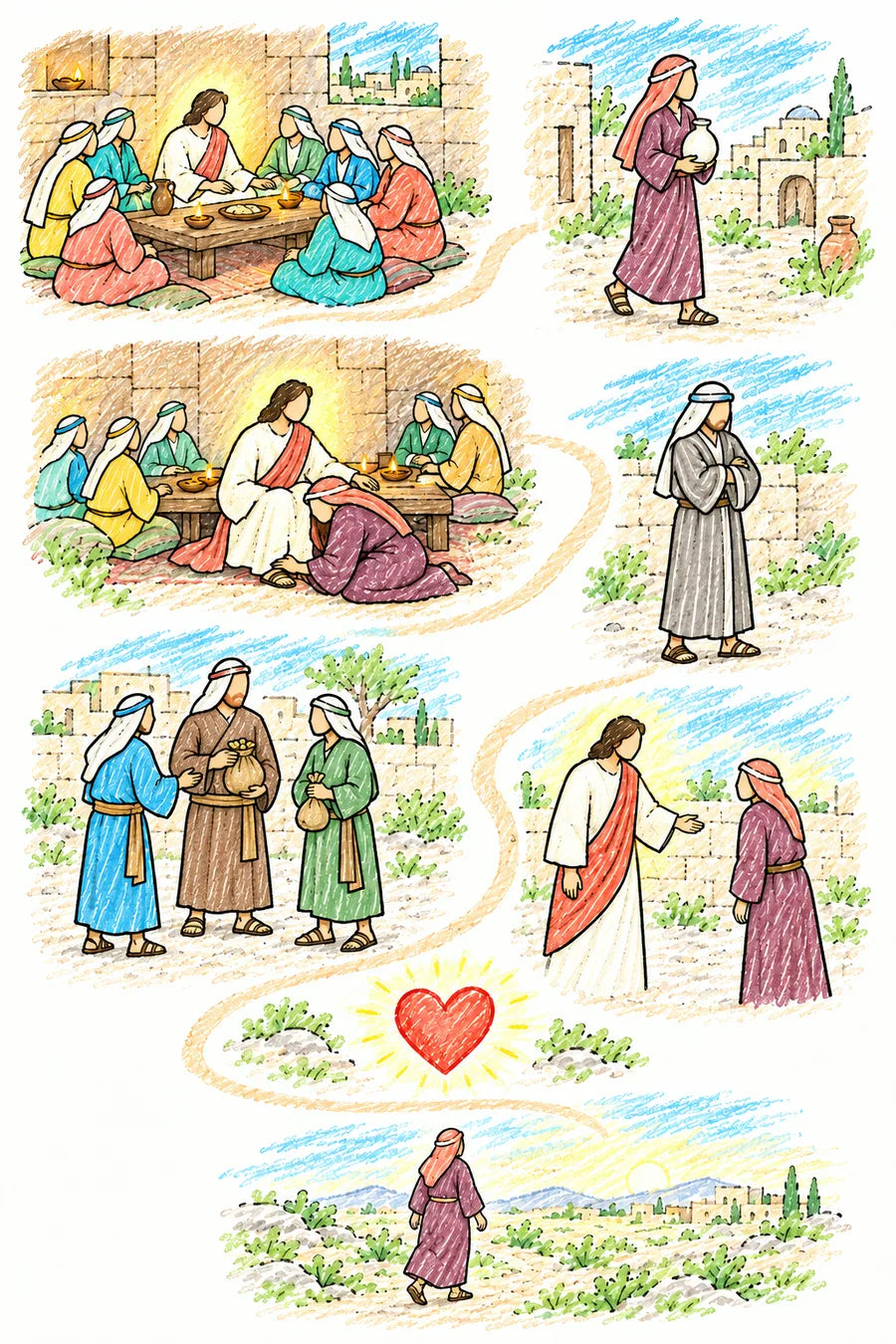
A Pharisee named Simon invited Jesus to dinner. A woman of the city, known as a sinner, heard Jesus was there and came with an alabaster box of ointment. Standing at His feet, she wept, washed His feet with her tears, wiped them with her hair, kissed them and anointed them. Simon thought to himself that if Jesus were a prophet, He would know what kind of woman was touching Him.
Jesus told Simon a story: a creditor had two debtors, one owing five hundred pence and one fifty. Neither could pay, and he freely forgave them both. Which would love him more? Simon answered, the one forgiven most. Jesus pointed out that Simon had given Him no water, no kiss and no oil, but she had done all of these. “Her sins, which are many, are forgiven; for she loved much.” Then He told her, “Thy faith hath saved thee; go in peace.”
Simon the Pharisee’s house, in a town in Galilee.
Watch what Simon thinks, and how Jesus answers what Simon never said out loud.
Read it yourself: Luke 7:36–50
Part 1 of 7
Eight stops from Simon’s table to a road of peace. Scroll, or tap a number on the map.
Part 2 of 7
Four scenes: the street, the feet, the table talk, and the doorway. Look for the Savior in each one.
Read it plainly
Tap any dotted word for its meaning. The scripture stays exactly as written.1
Part 3 of 7
Small details tell the story. Some cards are details in the text; others share insights from Church leaders, Church resources or outside sources. Each card says which.
All nine. The jar, the tear, the sandal, the oil, the coins, the note, the basin, the heart and the dove. Luke 7:36–50
Part 4 of 7
Judged, carrying a lot, judging others, or forgiven. Which feels most like you right now?
A next step for you
Your choice is saved only on this device.
Try it
Jesus compared what Simon did with what the woman did. Read each line and decide who it describes.
“Seest thou this woman?” Luke 7:44
Part 5 of 7
A little background on dinner customs helps the story come alive. Outside sources are labeled.
She could enter “because of social customs that allowed people in need to visit banquets and receive leftover food.”3
She came for more than food.
Jesus “told a parable that presented both Simon and the woman as sinners who owed a debt to divine justice.”3
Everyone needs Him.
Elder Marion D. Hanks: “There is here, of course, no encouragement or condoning of sin.”3
She had sorely repented.
In another parable, laborers agreed to work “for a penny a day.”2
Five hundred pence was a huge debt.
Word study · Greek
alabastron ἀλάβαστρον · “alabaster box” (Luke 7:37)
Word study · Greek
dénarion δηνάριον · “pence” (Luke 7:41)
What the text does not say
Jesus doesn’t say that Simon owed nothing, or that the woman’s sins didn’t matter. Both debtors in His story owed and couldn’t pay. He doesn’t tell her to earn forgiveness first. He says, “Thy faith hath saved thee; go in peace.”1
Part 6 of 7
He sees the heart, not the label. He forgives freely and sends us away in peace.
“Which of these two people are we most like?”
President Dieter F. Uchtdorf4“I testify that the Savior is able and eager to forgive our sins.”
“Perhaps it would be better if we sit at Jesus’s feet and plead for mercy for our own imperfections, as did the repentant woman in the Pharisee’s house.”
“When we kneel to pray, is it to replay the greatest hits of our own righteousness, or is it to confess our faults, plead for God’s mercy, and shed tears of gratitude for the amazing plan of redemption?”
Part 7 of 7
A question to ask in prayer
Am I more like Simon or like the woman today, and what would it look like to love Thee more? Luke 7:47
Be honest and listen. Then do one thing to show Him your love.
One way to come to His feet each day. It saves on this device, one day at a time.
0 of 7 today
Seven days at His feet. Come again tomorrow.
A quiet moment
“Go in peace.”
Read Luke 7:44–50 slowly. Picture the Savior turning toward you, as He turned toward her. What does He see? What does He say? Luke 7:44–50
A verse to hold
Talk about it
For adults and deeper study
Longer readings, harder questions, and where to study next. Each one says what it is before you click.
Simon and the woman, and why grace is a gift we can’t buy with obedience.4
Read the talk →Simon’s judgment, the woman’s contrition, and seeing others through the Savior’s eyes.5
Read the talk →Banquet customs, the debtors parable, and Elder Andersen and Elder Hanks on forgiveness.3
Read the chapter →Read the whole account, noticing every time Jesus speaks to Simon and to the woman.1
Luke 7 →Every quotation, gloss, and piece of background on this page is listed here: scripture first, then Church sources, then outside scholarship (labeled).
Quotations checked against the linked pages on October 11, 2026. Scripture is quoted from the King James Version as published in the Gospel Library.

He sees the heart, forgives freely, and sends us away in peace. Come to His feet. Luke 7:50
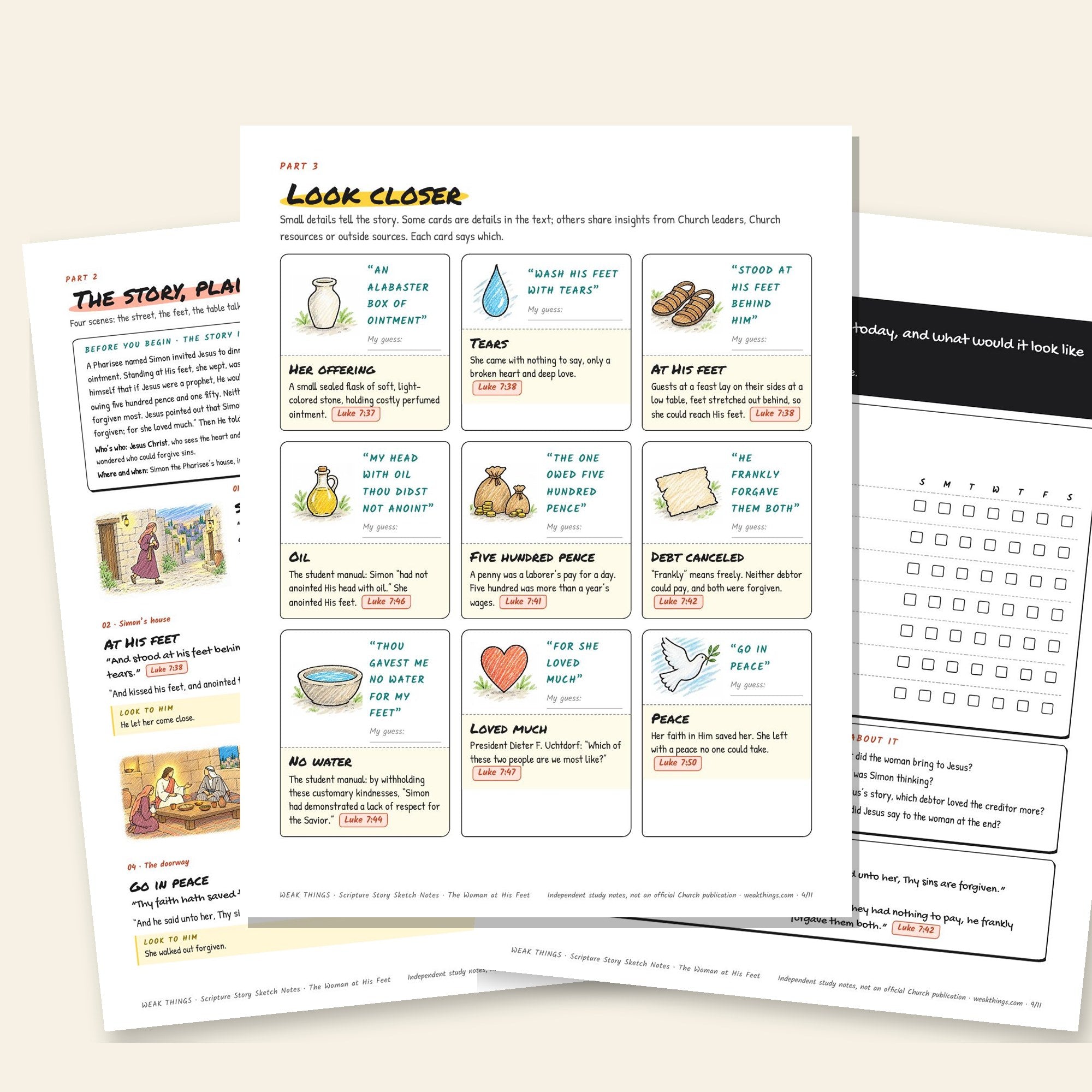
Printable sketch notes
Everything on this page as a 11-page letter-size PDF: the map, scenes, cards, activity, word studies, tracker, Go deeper and sources. For home, class or a quiet Sunday.
More stories
The Woman Who Washed His Feet is part of the Scripture Story Sketch Notes for the New Testament, set alongside Come, Follow Me for February 22–28, 2027 (Matthew 8; Mark 2–4; Luke 7).
See every story See all 2027 weeksIndependent study notes from Weak Things, not an official publication of The Church of Jesus Christ of Latter-day Saints. Scripture quotations are from the King James Version. The words are in Luke 7:36–50; the insights in “Look closer” are labeled by source.