Elder John K. Carmack, “Faith Yields Priesthood Power” (1993)
Putting faith first, and what we learn from the centurion and the woman of Canaan.4
Read the talk →Scripture Story Sketch Notes · Matthew 8:5–13; Luke 7:1–10
“Speak the word only, and my servant shall be healed.” Matthew 8:8
A Roman officer in Capernaum had a servant near death. He felt unworthy to have Jesus enter his home, but he believed one word from Jesus would be enough.
Before you begin
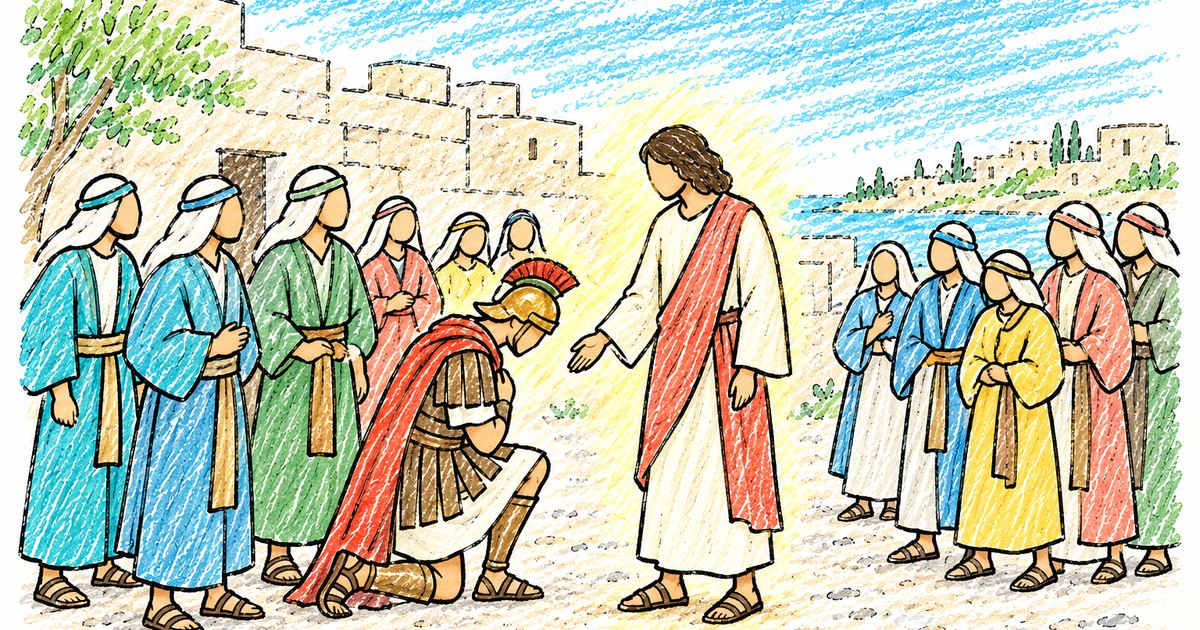
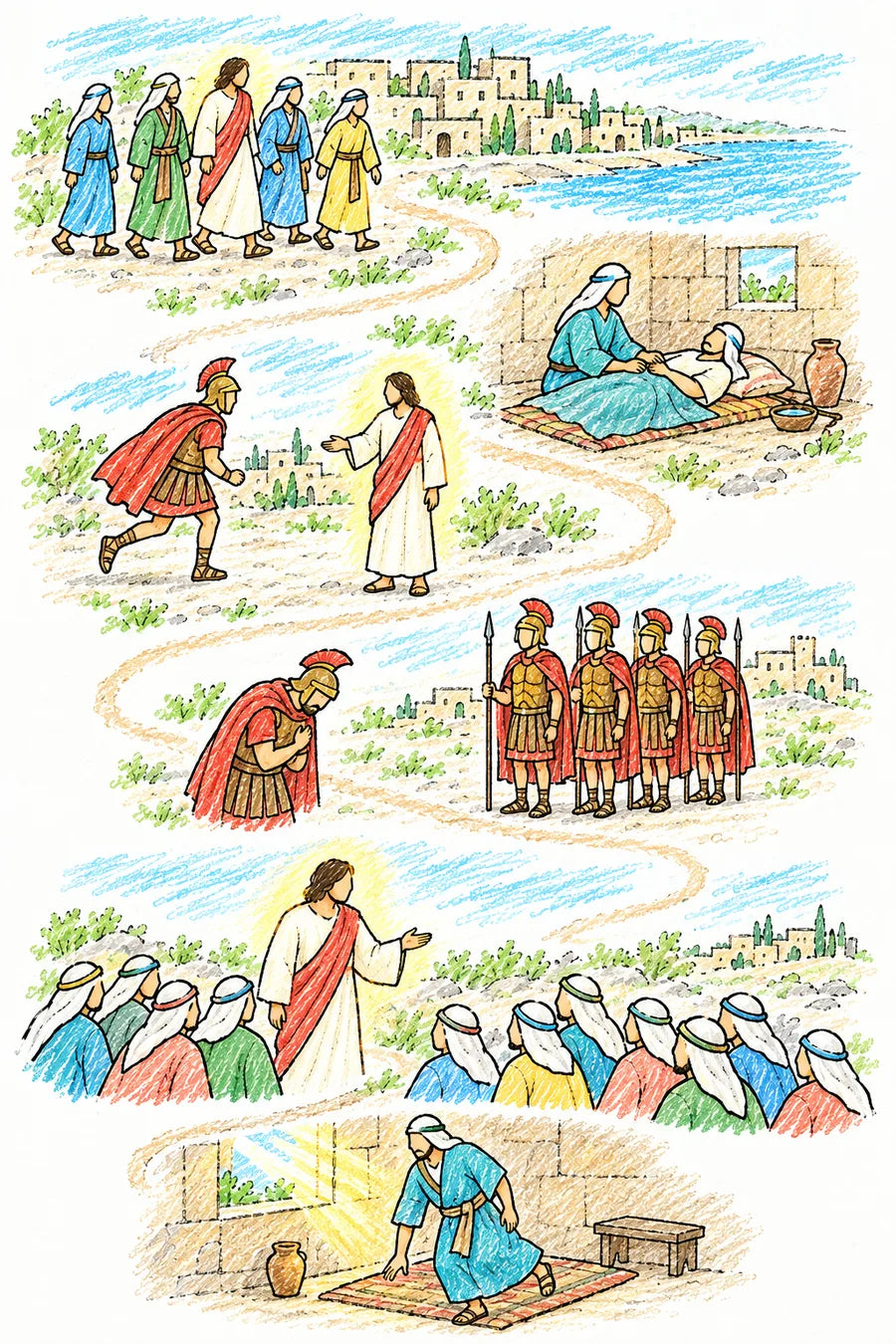
When Jesus came into Capernaum, a Roman centurion, an army officer, had a servant he cared about deeply who was paralyzed and close to death. Luke says Jewish elders came to Jesus on his behalf, explaining that this Gentile officer loved their people and had built their synagogue. Jesus said, “I will come and heal him,” and started toward the house.
Before Jesus arrived, the centurion sent word: “Lord, I am not worthy that thou shouldest come under my roof: but speak the word only, and my servant shall be healed.” As a soldier, he knew how a command works from a distance. Jesus marvelled and told the crowd, “I have not found so great faith, no, not in Israel.” He told the centurion, “As thou hast believed, so be it done unto thee,” and the servant was healed in that same hour.
Capernaum, a fishing town on the north shore of the Sea of Galilee, where Jesus often taught.
Watch how the centurion speaks about himself, and what Jesus says about his faith.
Read it yourself: Matthew 8:5–13; Luke 7:1–10
Part 1 of 7
Eight stops from the edge of Capernaum to a servant made whole. Scroll, or tap a number on the map.
Part 2 of 7
Four scenes: the elders plead, the centurion’s message, the crowd, and the house. Look for the Savior in each one.
Read it plainly
Tap any dotted word for its meaning. The scripture stays exactly as written.2
Part 3 of 7
Small details tell the story. Some cards are details in the text; others share insights from Church leaders, Church resources or outside sources. Each card says which.
All nine. The helmet, the mat, the sandal, the roof, the voice, the soldiers, the synagogue, the table and the hourglass. Matthew 8:5–13
Part 4 of 7
Worried for someone, not worthy, an outsider, or trusting. Which feels most like you right now?
A next step for you
Your choice is saved only on this device.
Try it
The centurion trusted Jesus’s word without seeing Him come. Press and hold the button while the messengers walk back to the house. As you hold, His words appear.
“Speak the word only.” Matthew 8:8
Part 5 of 7
A little background on Roman officers and Capernaum helps the story come alive. Outside sources are labeled.
“The Jews generally viewed centurions with contempt, for they symbolized the Roman political and military authority.”3
This one was different.
“The centurion’s goodness was affirmed by elders of the Jews. He demonstrated genuine humility.”3
Humble and kind.
“The centurion, however, did not allow his feelings of unworthiness to prevent him from seeking the Savior’s help.”3
He still came.
Matthew tells it simply; Luke adds that the centurion sent elders, then friends, and “neither thought I myself worthy to come unto thee.”2
Read both together.
Word study · Greek
hekatontarchés ἑκατοντάρχης · “centurion” (Matthew 8:5)
Word study · Greek
hikanos ἱκανός · “worthy” (Matthew 8:8)
What the text does not say
Jesus doesn’t turn him away for feeling unworthy. He doesn’t require the centurion to be an Israelite, or to bring the servant to Him. He offers to come, then praises a humble outsider’s faith.1
Part 6 of 7
He was willing to come, and His word had power to heal from a distance. He welcomes all who believe.
“We can be worthy to enjoy certain privileges without being perfect.”
Elder Marvin J. Ashton5“The Roman centurion held no priesthood, but through faith he asked the Lord to heal his servant.”
“Clearly the power to do great works comes from faith in Christ.”
“When we take it upon ourselves to pass self-judgment and simply declare, ‘I am not worthy,’ we build a barrier to progress.”
The elders (Luke 7)
“That he was worthy for whom he should do this: For he loveth our nation, and he hath built us a synagogue.” Luke 7:4–5
The friends (Luke 7)
“Lord, trouble not thyself: for I am not worthy that thou shouldest enter under my roof.” Luke 7:6
Part 7 of 7
A question to ask in prayer
Who is someone I can bring to Thee in prayer, and what promise of Thine can I trust for them? Luke 7:2
Listen for a name. Then pray for that person, trusting His word.
One way to trust His word each day. It saves on this device, one day at a time.
0 of 7 today
Seven days of trusting His word. Come again tomorrow.
A quiet moment
“Speak the word only.”
Read Matthew 8:5–13 slowly. Picture Jesus turning to the crowd and marvelling. What would it feel like to trust Him that much? Matthew 8:5–13
A verse to hold
Talk about it
For adults and deeper study
Longer readings, harder questions, and where to study next. Each one says what it is before you click.
Putting faith first, and what we learn from the centurion and the woman of Canaan.4
Read the talk →Why we shouldn’t declare ourselves unworthy, and how worthiness differs from perfection.5
Read the talk →Centurions, the Capernaum synagogue, and the centurion’s humility and faith.3
Read the chapter →Read both accounts side by side to see what each Gospel writer adds.2
Luke 7 → Matthew 8 →Every quotation, gloss, and piece of background on this page is listed here: scripture first, then Church sources, then outside scholarship (labeled).
Quotations checked against the linked pages on October 11, 2026. Scripture is quoted from the King James Version as published in the Gospel Library.

He was willing to come, and His word was enough. Bring your needs to Him, and trust what He says. Matthew 8:8
Printable sketch notes
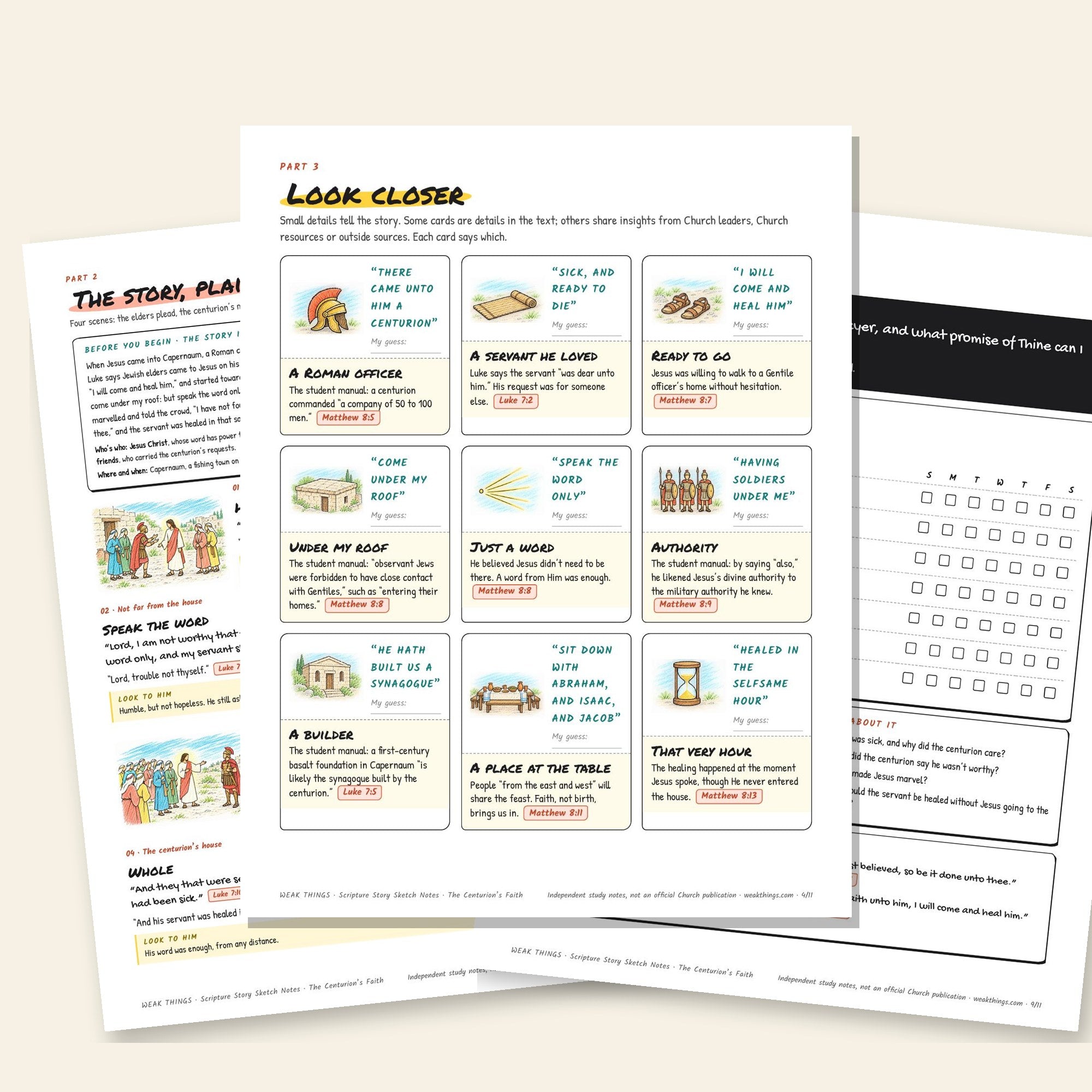
Everything on this page as a 11-page letter-size PDF: the map, scenes, cards, activity, word studies, tracker, Go deeper and sources. For home, class or a quiet Sunday.
More stories
The Centurion’s Faith is part of the Scripture Story Sketch Notes for the New Testament, set alongside Come, Follow Me for February 22–28, 2027 (Matthew 8; Mark 2–4; Luke 7).
See every story See all 2027 weeksIndependent study notes from Weak Things, not an official publication of The Church of Jesus Christ of Latter-day Saints. Scripture quotations are from the King James Version. The words are in Matthew 8:5–13 and Luke 7:1–10; the insights in “Look closer” are labeled by source.