Elder L. Whitney Clayton, “Whatsoever He Saith unto You, Do It” (2017)
Mary’s trust at Cana, and how obedience in advance brings miracles into our lives.5
Read the talk →Scripture Story Sketch Notes · John 2:1–11
“Whatsoever he saith unto you, do it.” John 2:5
At a wedding in Cana, the wine ran out. Mary turned to Jesus, the servants filled six stone jars with water, and the Savior’s first recorded miracle showed His glory.
Before you begin
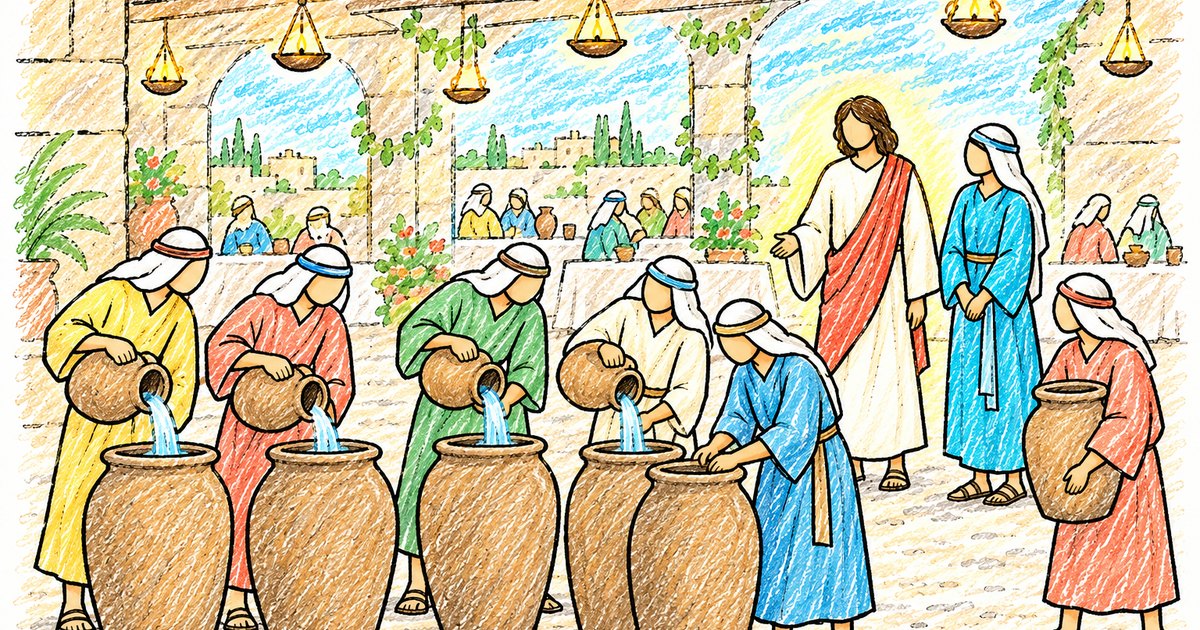
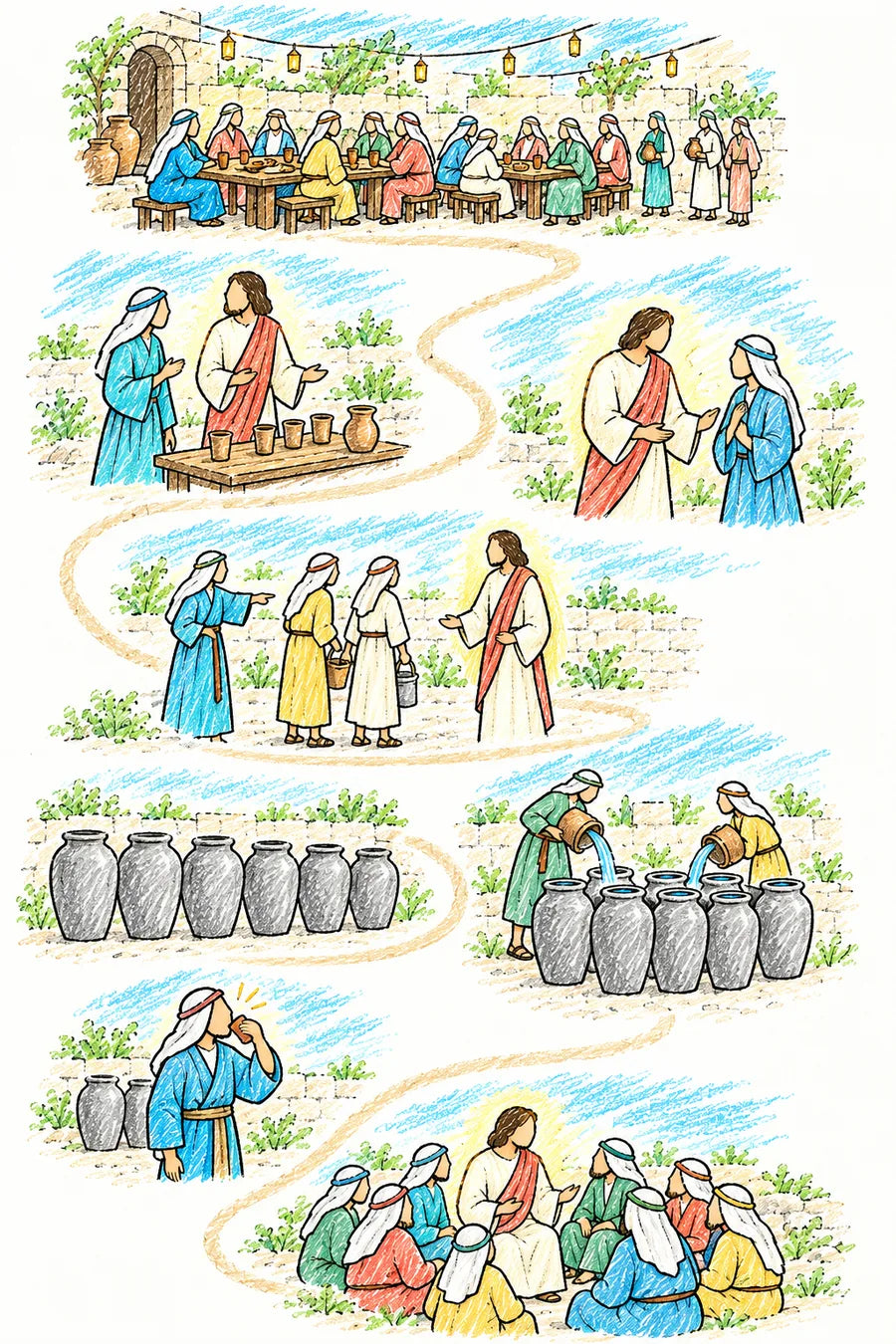
Jesus, His disciples and His mother, Mary, were guests at a wedding in Cana, a village in Galilee. Partway through the celebration the wine ran out. Mary told Jesus, “They have no wine.” He answered that His hour had not yet come, but Mary turned to the servants and said, “Whatsoever he saith unto you, do it.”
Six large stone jars stood nearby, used for Jewish washing rituals. Jesus told the servants to fill them with water, and they filled them to the brim. When the man in charge of the feast tasted it, it had become wine, better than what had been served before. This was the first of His miracles, and His disciples believed on Him.
A wedding in Cana of Galilee, near the very start of Jesus’s ministry.
Watch who does the ordinary part, and who does the miracle.
Read it yourself: John 2:1–11
Part 1 of 7
Eight stops from the wedding to His glory. Scroll, or tap a number on the map.
Part 2 of 7
Four scenes: running out, filling the jars, the taste, and belief. Look for the Savior in each one.
Read it plainly
Tap any dotted word for its meaning. The scripture stays exactly as written.1
Part 3 of 7
Small details tell the story. Some cards are details in the text; others share insights from Church leaders, Church resources or outside sources. Each card says which.
All nine. The ring, the empty cup, the hourglass, the pointing hand, the jar, the brim, the ladle, the goblet and the sun. John 2:1–11
Part 4 of 7
Running out, waiting, doing the ordinary, or seeing His glory. Which feels most like you right now?
A next step for you
Your choice is saved only on this device.
Try it
Everyone at the wedding had a part. Tap each card to see what they said or did, then add your own part.
“Whatsoever he saith unto you, do it.” John 2:5
Part 5 of 7
A little background on weddings and stone jars helps the miracle come alive. Outside sources are labeled.
“Vessels made of stone retained their ritual purity, while ceramic vessels could become ritually impure.”4
Jars for washing, not for wine.
A firkin “was about nine gallons,” so the six pots “could have held between 100 and 160 gallons.”4
He gave abundantly.
Elder James E. Talmage: “its use was really an expression of opposite import,” honor, not harshness.4
He said it again from the cross.
The Joseph Smith Translation of John 2:4: “Woman, what wilt thou have me to do for thee? that will I do.”4
He was willing.
Word study · Greek
guné γυνή · “Woman” (John 2:4)
Word study · English
firkin “firkins” (John 2:6)
What the text does not say
John doesn’t say how the water changed, or even when. He tells us who acted on His word: Mary trusted, the servants filled the jars, and only they knew where the good wine came from. The quiet obedience is part of the miracle.1
Part 6 of 7
He cares about ordinary needs, He works in the Father’s timing, and He saves the best for last.
“She had unshakable confidence in Him and in His divine power.”
Elder L. Whitney Clayton5“Her simple, straightforward instruction to the servants had no caveats, no qualifications, no limitations.”
“This manifestation of His power to effect change can help us understand how the Savior can change us.”
“Can it be thought that in this supreme moment, our Lord’s concern for the mother from whom He was about to be separated by death was associated with any emotion other than that of honor, tenderness and love?”
Jesus (John 19)
“When Jesus therefore saw his mother, and the disciple standing by, whom he loved, he saith unto his mother, Woman, behold thy son!” John 19:26
King Benjamin (Book of Mormon)
We can become new “through the atonement of Christ the Lord.” The One who changed water can change hearts. Mosiah 3:19
Part 7 of 7
A question to ask in prayer
What is He asking me to do right now, even if it seems ordinary? John 2:5
Listen for a simple, clear task. Then fill your jar to the brim.
One way to do whatever He says each day. It saves on this device, one day at a time.
0 of 7 today
Seven days of filling the jars. Come again tomorrow.
A quiet moment
“Whatsoever he saith unto you, do it.”
Read John 2:3–7 slowly. Picture yourself as one of the servants carrying water. What would it feel like to watch Him change it? John 2:3–7
A verse to hold
Talk about it
For adults and deeper study
Longer readings, harder questions, and where to study next. Each one says what it is before you click.
Mary’s trust at Cana, and how obedience in advance brings miracles into our lives.5
Read the talk →Stone jars, firkins, the meaning of “Woman,” and Joseph Smith Translation insights.4
Read the chapter →The same tender word, at the end of His mortal life.2
John 19 →How the Savior’s Atonement changes who we are.3
Mosiah 3:19 →Every quotation, gloss, and piece of background on this page is listed here: scripture first, then Church sources, then outside scholarship (labeled).
Quotations checked against the linked pages on October 11, 2026. Scripture is quoted from the King James Version as published in the Gospel Library.

Bring Him the need, do the simple part all the way, and let Him do the rest. John 2:5
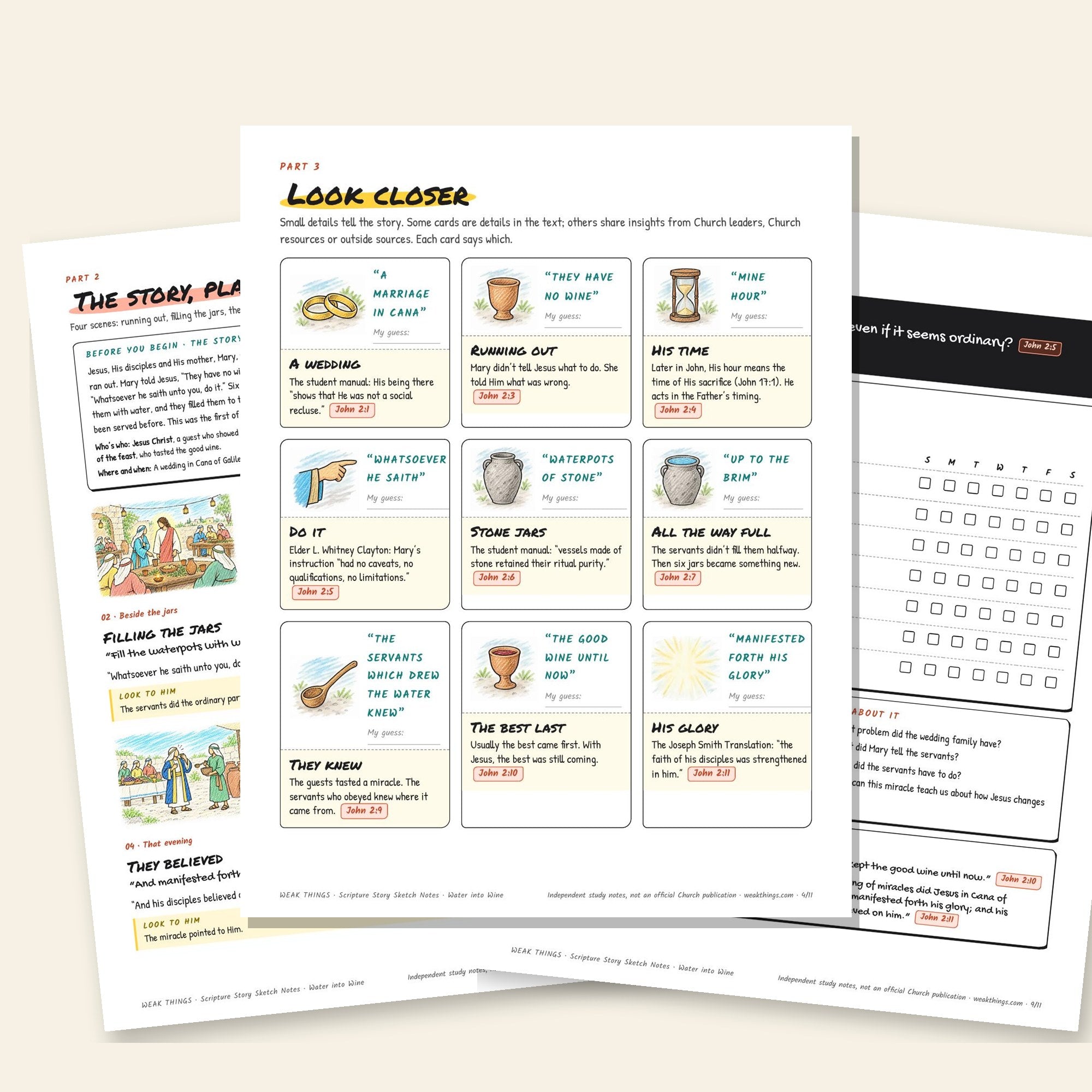
Printable sketch notes
Everything on this page as a 11-page letter-size PDF: the map, scenes, cards, activity, word studies, tracker, Go deeper and sources. For home, class or a quiet Sunday.
More stories
Water into Wine is part of the Scripture Story Sketch Notes for the New Testament, set alongside Come, Follow Me for February 1–7, 2027 (John 2–4).
See every story See all 2027 weeksIndependent study notes from Weak Things, not an official publication of The Church of Jesus Christ of Latter-day Saints. Scripture quotations are from the King James Version. The words are in John 2:1–11; the insights in “Look closer” are labeled by source.