Elder Talmage, Jesus the Christ, chapter 7
A full chapter on “Gabriel’s Annunciation of John and of Jesus”: the course of Abia, the Holy Place, Zacharias’s silence and song, and Mary’s visit to Elisabeth.4
Read chapter 7 →Scripture Story Sketch Notes · Luke 1
“For with God nothing shall be impossible. And Mary said, Behold the handmaid of the Lord; be it unto me according to thy word.” Luke 1:37–38
One messenger, two impossible promises: a priest in the temple and a young woman in Nazareth. Walk the map, look closer, and sort out who said what.
Before you begin
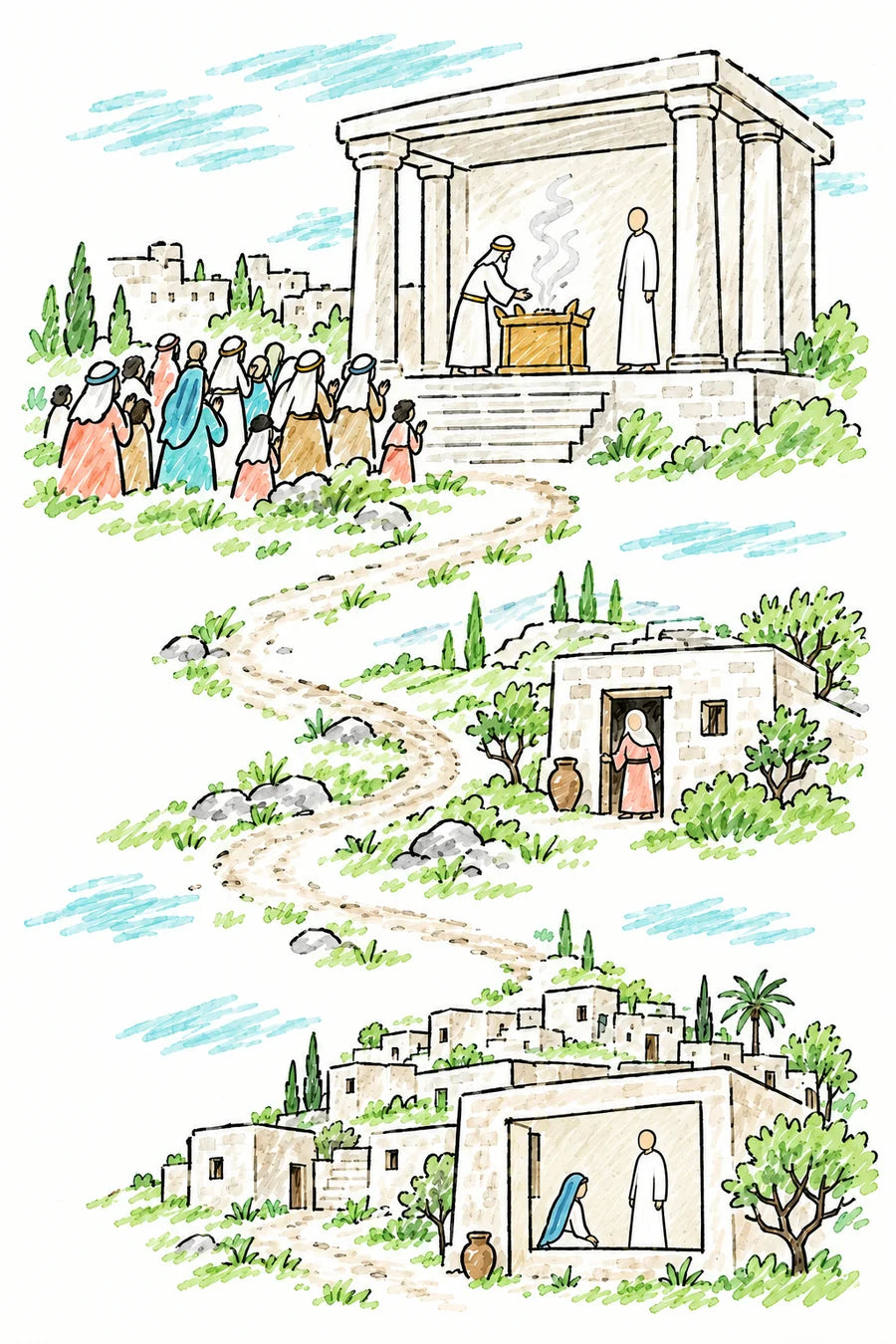
Before Jesus was born, God sent the angel Gabriel with two announcements. First, in the temple at Jerusalem, Gabriel appeared to an older priest named Zacharias. He and his wife, Elisabeth, had prayed for a child, and Gabriel promised they would have a son, John, who would “make ready a people prepared for the Lord.” Zacharias doubted, and he could not speak until the promise came true.
Six months later Gabriel came to Mary in the village of Nazareth, who was engaged to Joseph. He told her she would be the mother of the Son of God. Mary asked how this could be, then answered in faith: “Behold the handmaid of the Lord; be it unto me according to thy word.”
First the temple in Jerusalem, then, six months later, the town of Nazareth in Galilee.
Both announcements point to Jesus: John would prepare the way, and Mary’s Son would be called “the Son of the Highest.”
Read it yourself: Luke 1:5–38
Part 1 of 7
Nine stops, from the Holy Place in the temple to a small house in Nazareth. Scroll, or tap a number on the map.
Part 2 of 7
Four scenes, two visits from the same messenger. Look for the Savior in each one.
Read it plainly
Tap any dotted word for its meaning. The scripture stays exactly as written.1
Part 3 of 7
This is a true account, not a parable. Some cards are details in the text; others share insights from prophets and scholars, and each card says which.
All nine. A lot, an altar, a silent priest, a feather, a hidden house and an open hand, all getting ready for the Son of God. Luke 1:5–38
Part 4 of 7
Zacharias and Mary each met an impossible promise. Which response feels most like you right now?
A next step for you
Your choice is saved only on this device.
Try it
Gabriel came to two people with two impossible promises. Both asked a question. Both ended up singing praise to God. Read each line and choose who said it.
“For with God nothing shall be impossible.” Luke 1:37
Part 5 of 7
A little background helps us see the two scenes. Outside sources are labeled.
Priests served in twenty-four divisions, each “one week twice a year.” Zacharias’s division was large, so he “actually serves no more than one day of his assigned week,” and by tradition “a priest can offer the incense once in his lifetime.”10
On the one day he stood in the Holy Place, God answered his prayer.
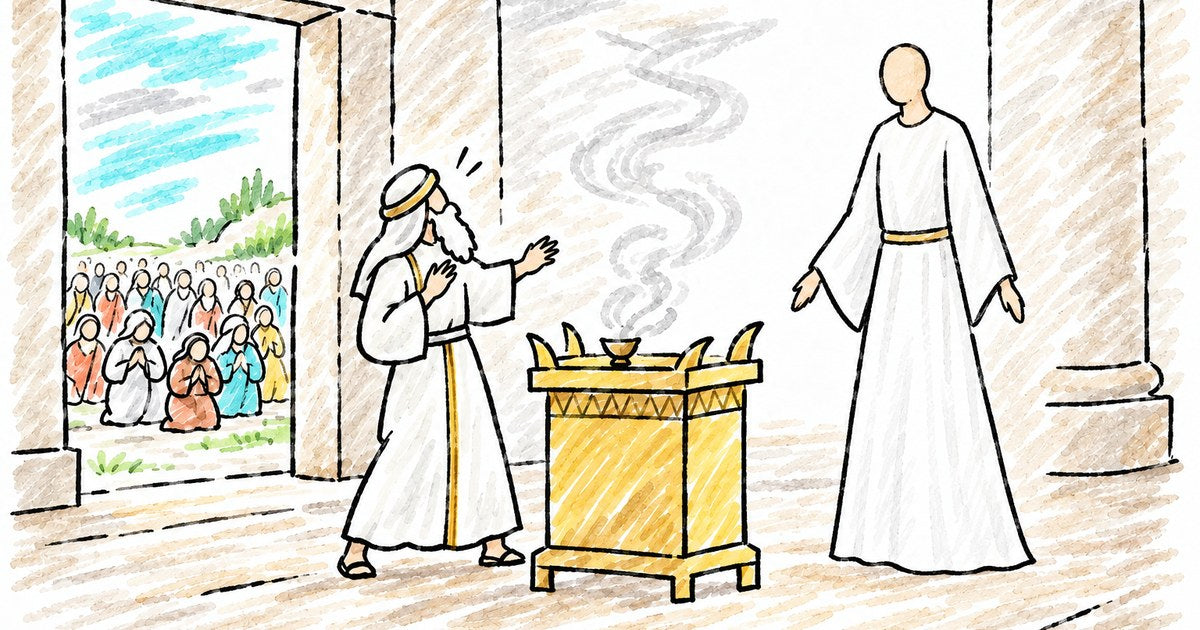
Elder Talmage: “Gabriel’s annunciation to Zacharias offers strong contrast to the delivery of his message to Mary.” One came in “the magnificent temple”; the other in a humble home in Nazareth.4
Heaven came to the holiest room in Jerusalem and to a small house in a small town.
Gabriel means “Man of God.” He was sent to Daniel, to Zacharias and to Mary, and he “is identified by latter-day revelation as Noah.”9
An ancient servant of God carried the news that the Savior was coming.
Word study · Greek
charitoō χαριτόω · “highly favoured” (Luke 1:28)
Word study · Greek
rhēma ῥῆμα · “nothing” (Luke 1:37) and “word” (Luke 1:38)
What the text does not say
Luke doesn’t give Mary’s age, and he doesn’t say whether Zacharias and Elisabeth were still praying for a child; Elder Talmage thought they “had sorrowfully given up hope of posterity.”4 Luke never says Gabriel had wings. Our drawings show him as a faceless figure of light, as with every angel in these lessons. And Luke says he “came in unto her”; he doesn’t describe what Mary was doing.1
Part 6 of 7
Both messages were about Him: the forerunner who would prepare His way, and the Son of the Highest.
Both of Gabriel’s messages were about Jesus Christ: a forerunner to “make ready a people prepared for the Lord,” and a Son who would be “called the Son of God.” One heard it and asked for proof; one heard it and said yes.
Luke 1:17, 35, 381“Long years of yearning had returned no reward—Zacharias and Elisabeth remained childless. Then came that day of days ever to be remembered.”
“Both Elisabeth and Mary looked forward with confidence that the Savior of the world would come and that a great prophet would be His forerunner. But in their deep humility they were prepared by the Spirit for their sacred part.”
“When we choose to obey the commandments cheerfully as our first priority, neither murmuring about nor measuring the things He commands, we become the handmaids of the Lord.”
“The words with which he broke his long silence were words of praise unto God in whom he had all assurance.”
Another Testament
Nephi saw “a virgin, most beautiful and fair above all other virgins.” The angel told him, “Behold, the virgin whom thou seest is the mother of the Son of God.” 1 Nephi 11:15, 18
Another Testament
An angel told King Benjamin: “he shall be called Jesus Christ, the Son of God … and his mother shall be called Mary.” Mosiah 3:8
Part 7 of 7
Gabriel’s promise
“For with God nothing shall be impossible.” Luke 1:37
Elder Maxwell noted that the angel spoke these words to “a perplexed Mary.”6 What feels impossible to you right now? Bring it to the One for whom nothing is.
Each thing you do is one more “yes.” It saves on this device, one day at a time.
0 of 6 today
Six days of trusting His word. Come again tomorrow.
A quiet moment
“Behold the handmaid of the Lord; be it unto me according to thy word.”
Read Luke 1:26–38 slowly. Picture the small room in Nazareth. Then ask Heavenly Father, “What is Thy word for me right now?” Sit quietly and listen. Luke 1:26–38
A verse to hold
Talk about it
For adults and deeper study
Longer readings, harder questions, and where to study next. Each one says what it is before you click.
A full chapter on “Gabriel’s Annunciation of John and of Jesus”: the course of Abia, the Holy Place, Zacharias’s silence and song, and Mary’s visit to Elisabeth.4
Read chapter 7 →On submitting fully to the Lord, with Mary as an example, and the reminder that “nothing shall be impossible.”6
Read the talk →Elder Monson retells Zacharias and Elisabeth’s story and John’s mission to prepare the way. President Eyring speaks of how Elisabeth and Mary “knew and believed the sacred scriptures.”5,8
Monson → Eyring →Verse-by-verse notes from a Latter-day Saint scholar: the priestly divisions, the incense, the contrast between Zacharias and Mary, and the theme of light in Luke 1–2.10
Read the commentary → BYU Studies Come, Follow Me →Both praise God for the Redeemer who is coming.
Read Luke 1 →Every quotation, gloss, and piece of background on this page is listed here: scripture first, then Church sources, then outside scholarship (labeled).
Quotations checked against the linked pages on October 7, 2026. Scripture is quoted from the King James Version as published in the Gospel Library.

A prayer heard, a question asked, a promise kept, and a young woman who said yes. With God nothing shall be impossible. Luke 1:37–38
Printable sketch notes
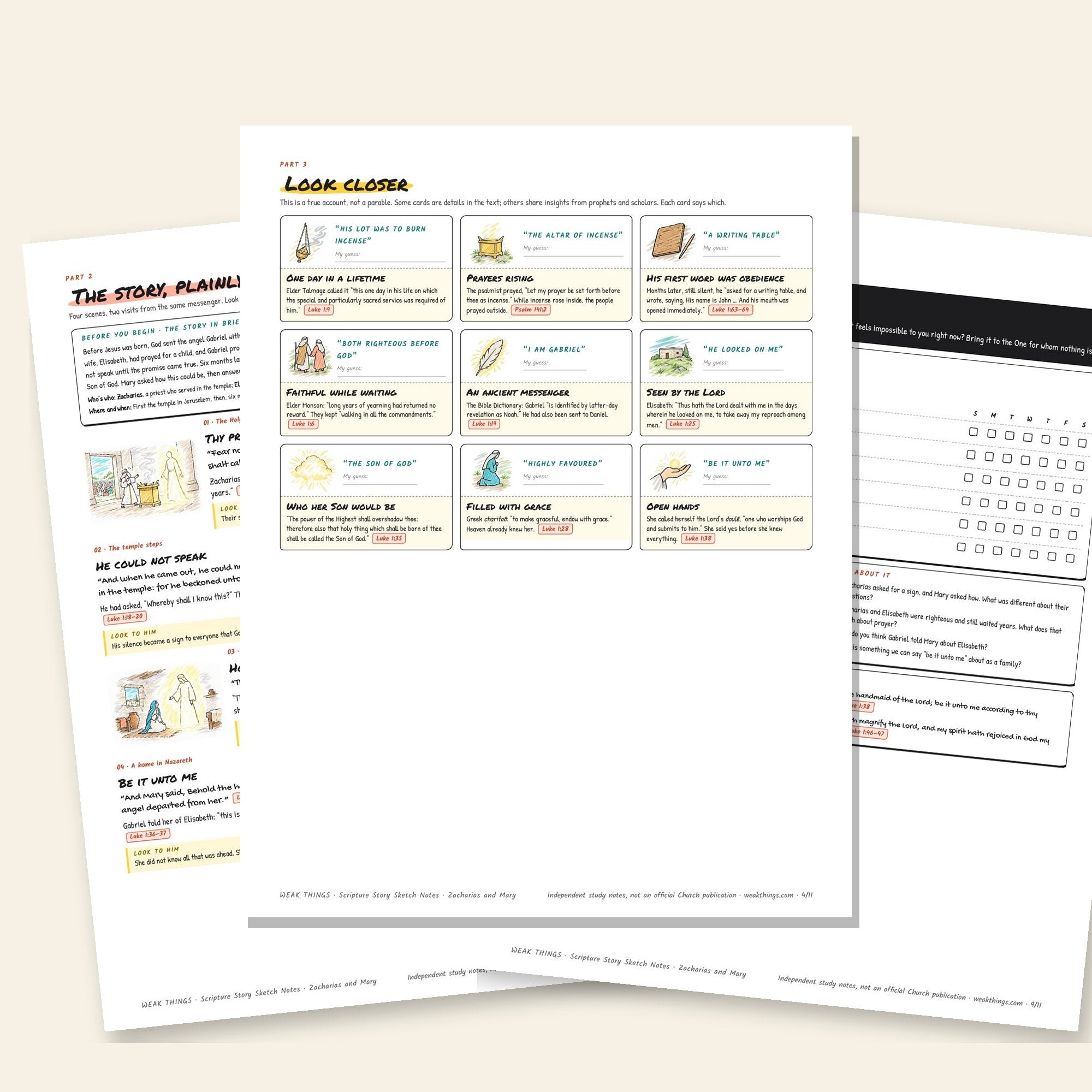
Everything on this page as a 11-page letter-size PDF: the map, scenes, cards, activity, word studies, tracker, Go deeper and sources. For home, class or a quiet Sunday.
More stories
Zacharias and Mary is part of the Scripture Story Sketch Notes for the New Testament, set alongside Come, Follow Me for December 28, 2026–January 3, 2027 (Matthew 1; Luke 1).
See every story See all 2027 weeksIndependent study notes from Weak Things, not an official publication of The Church of Jesus Christ of Latter-day Saints. Scripture quotations are from the King James Version. This is a true account, not a parable; the insights in “Look closer” are labeled by source.