Elder James E. Faust, “Five Loaves and Two Fishes” (1994)
How ordinary members with modest gifts, offered to the Savior, feed thousands, and how God has “filled our ‘baskets’ to overflowing.”6
Read the talk →Scripture Story Sketch Notes · John 6; Matthew 14:13–21; Mark 6:34–44
“I am the bread of life: he that cometh to me shall never hunger.” John 6:35
A hungry crowd, a boy with five loaves and two fish, twelve baskets left over, and the Bread of Life. Walk the hillside, look closer, and bring Him what you have.
Before you begin
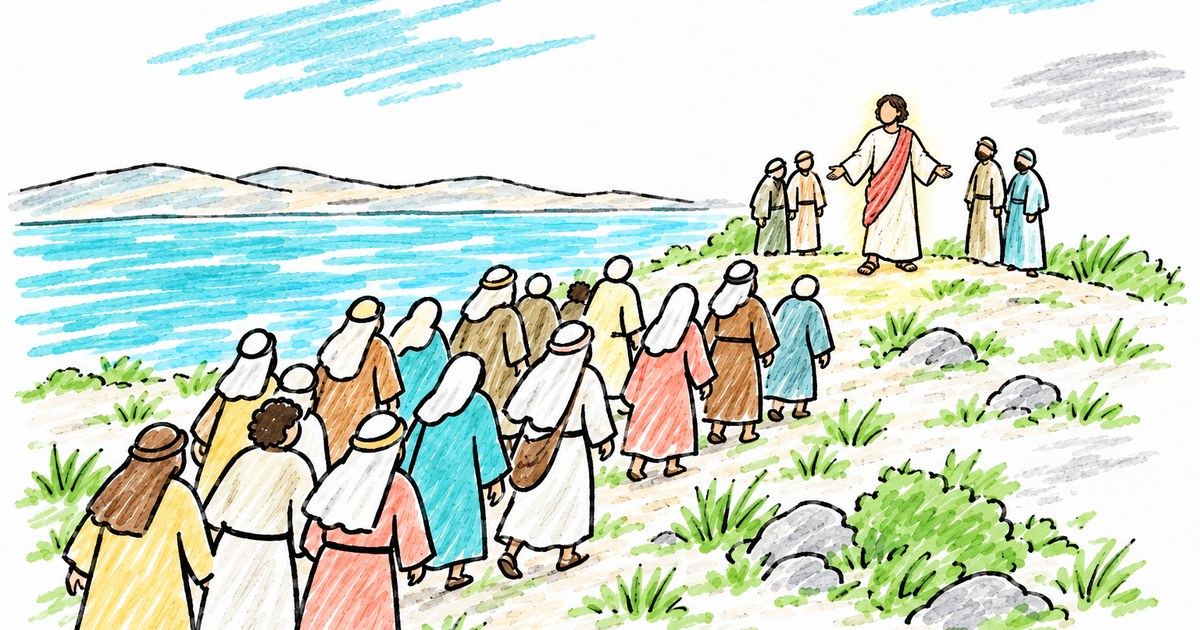
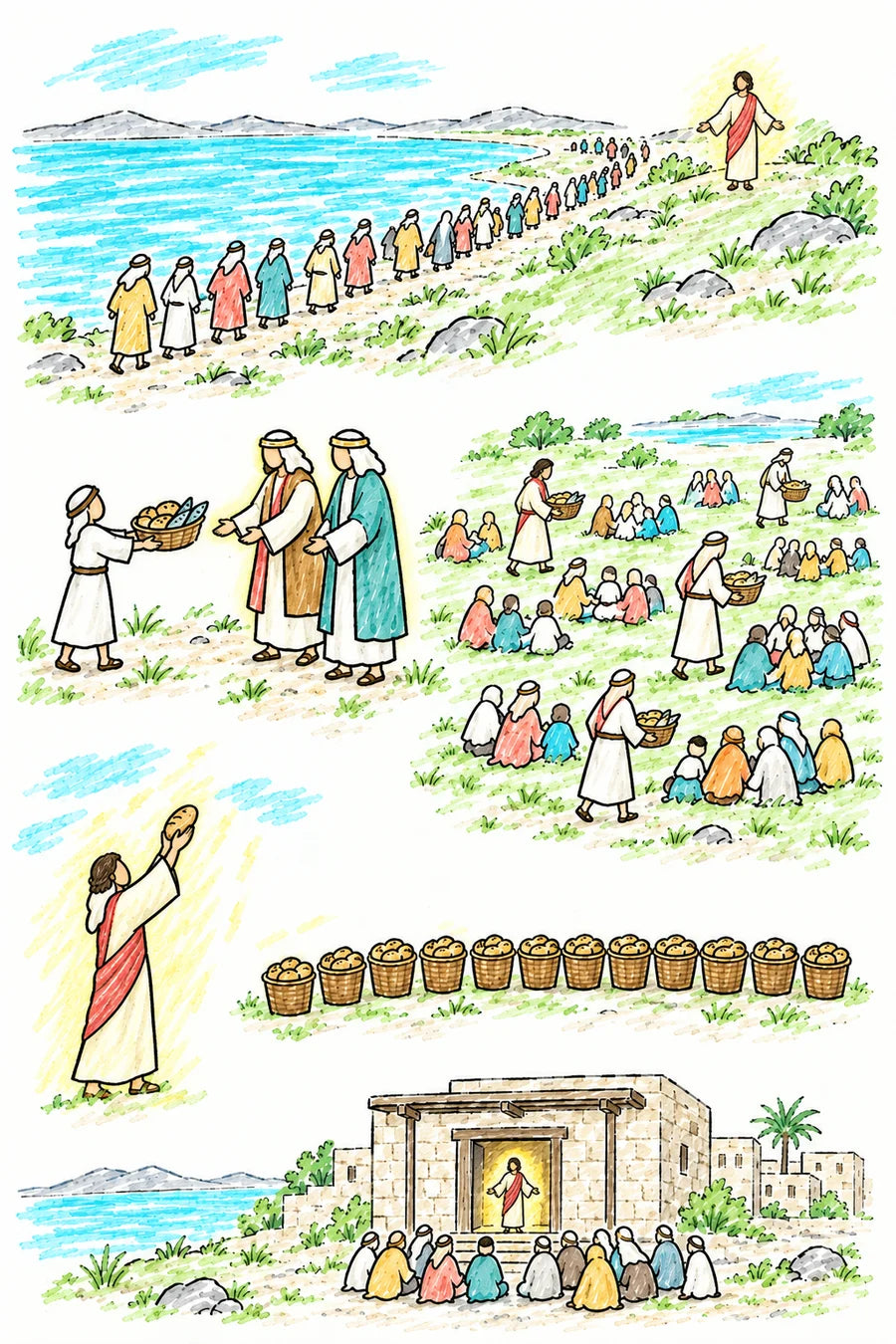
A huge crowd followed Jesus to a hillside near the Sea of Galilee, close to the Passover feast. Jesus felt compassion for them, healed the sick and taught them. When evening came, He asked Philip where they could buy bread for so many. Andrew found a boy with five barley loaves and two small fish, “but what are they among so many?”
Jesus had the people sit on the grass, gave thanks, and passed out the bread and fish through His disciples until everyone, about five thousand men plus women and children, was full. Twelve baskets of leftovers were gathered. The next day He taught, “I am the bread of life: he that cometh to me shall never hunger.” Many walked away, but Peter said, “Lord, to whom shall we go?”
A grassy hillside by the Sea of Galilee, then the synagogue in Capernaum.
He fed their bodies, then offered Himself as the bread that feeds the soul.
Read it yourself: John 6:1–14
Part 1 of 7
Eight stops from the crowd on the shore to the Bread of Life. Scroll, or tap a number on the map.
Part 2 of 7
Four scenes: compassion, a boy’s basket, thanks and plenty, and the Bread of Life. Look for the Savior in each one.
Read it plainly
Tap any dotted word for its meaning. The scripture stays exactly as written.1
Part 3 of 7
This is a true account, not a parable. Some cards are details in the text; others share insights from prophets and Church resources, and each card says which.
All nine. A crowd, coins, a boy, barley loaves, the grass, His hands, twelve baskets, manna and the bread of life. John 6:1–35
Part 4 of 7
People on that hillside may have felt they had too little, felt hungry for more, followed for the wrong reasons, or chosen to stay. Which feels most like you right now?
A next step for you
Your choice is saved only on this device.
Try it
John 6 is full of questions. Tap each card to see the answer, then answer the last one yourself.
“For he himself knew what he would do.” John 6:6
Part 5 of 7
A little background helps us see why bread meant so much. Outside sources are labeled.
Scripture Helps: “It may be significant that Jesus fed the five thousand and gave the Bread of Life sermon as the Jews were preparing for the Passover.”5
A feast about deliverance and bread.
Scripture Helps: “Through Moses, the Lord miraculously fed the people with manna from heaven.”5 The crowd remembered: “Our fathers did eat manna in the desert.”1
He is the true bread from heaven.
Elder Talmage: “The fare was simple, yet nourishing, wholesome and satisfying.”4
He fed them with ordinary bread.
“When Jesus therefore perceived that they would come and take him by force, to make him a king, he departed again into a mountain himself alone.”1
He came to be their Savior, not the king they wanted.
Word study · Greek
artos ἄρτος · “bread” (John 6:35)
Word study · Greek
klasma κλάσμα · “fragments” (John 6:12)
What the text does not say
The account doesn’t say Jesus will always multiply our food or money when we pray. The next day He warned, “Ye seek me, not because ye saw the miracles, but because ye did eat of the loaves, and were filled.”1 The miracle points to Him.
Part 6 of 7
He fed their bodies, then He offered Himself as the bread that feeds the soul.
Elder James E. Faust: “Many nameless people with gifts equal only to five loaves and two small fishes magnify their callings and serve without attention or recognition, feeding literally thousands.”
Elder James E. Faust, “Five Loaves and Two Fishes,” April 19946“Today I would like to speak of those of us who have only talents equal to five loaves and two fishes to offer the Savior to help feed the multitudes.”
“Thus God has again “fed” us and filled our “baskets” to overflowing.”
“The substance of both fish and bread increased under the Master’s touch; and the multitude feasted there in the desert, until all were satisfied.”
Gospel of Matthew
“And Jesus went forth, and saw a great multitude, and was moved with compassion toward them, and he healed their sick.” Matthew 14:14
Gospel of Mark
“They were as sheep not having a shepherd: and he began to teach them many things.” Mark 6:34
Part 7 of 7
The Savior’s words
“I am the bread of life.” John 6:35
Elder Faust spoke of offering our “five loaves and two fishes” to the Savior.6 What small offering will you bring Him this week?
One small offering a day. It saves on this device, one day at a time.
0 of 7 today
Seven days of bringing Him your loaves. Come again tomorrow.
A quiet moment
“I am the bread of life: he that cometh to me shall never hunger.”
Read John 6:5–13 slowly. Picture the boy holding out his basket. Then ask Heavenly Father what small thing He would like you to offer, and listen. John 6:5–13
A verse to hold
Talk about it
For adults and deeper study
Longer readings, harder questions, and where to study next. Each one says what it is before you click.
How ordinary members with modest gifts, offered to the Savior, feed thousands, and how God has “filled our ‘baskets’ to overflowing.”6
Read the talk →The feeding of the multitude, the gathering of fragments, the walk on the water, and the crowd searching for loaves and fishes.4
Read chapter 21 →Parallels between Jesus and Moses in John 6, the Passover setting, and the symbolism of bread.5
Read Scripture Helps →That same night, Jesus walked on the sea to His disciples. Read it as the next part of the story.2
Read Matthew 14 → Peter Walks on the Water →Every quotation, gloss, and piece of background on this page is listed here: scripture first, then Church sources, then outside scholarship (labeled).
Quotations checked against the linked pages on October 7, 2026. Scripture is quoted from the King James Version as published in the Gospel Library.

He fed their bodies, then He offered Himself as the bread that feeds the soul. Bring Him what you have. John 6:35
Printable sketch notes
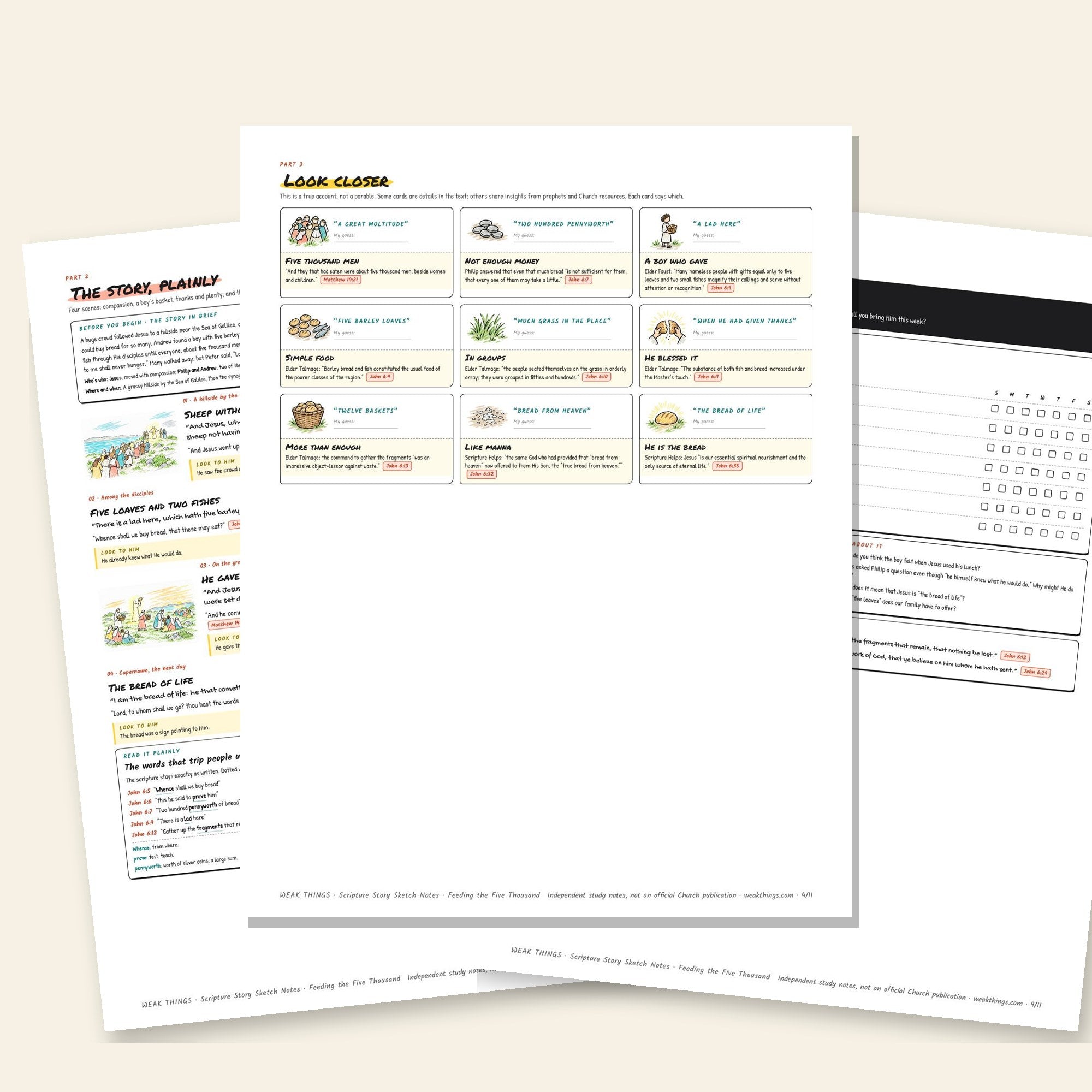
Everything on this page as a 11-page letter-size PDF: the map, scenes, cards, activity, word studies, tracker, Go deeper and sources. For home, class or a quiet Sunday.
More stories
Feeding the Five Thousand is part of the Scripture Story Sketch Notes for the New Testament, set alongside Come, Follow Me for March 29–April 4, 2027 (Matthew 14; Mark 6; John 5–6).
See every story See all 2027 weeksIndependent study notes from Weak Things, not an official publication of The Church of Jesus Christ of Latter-day Saints. Scripture quotations are from the King James Version. This is a true account, not a parable; the insights in “Look closer” are labeled by source.