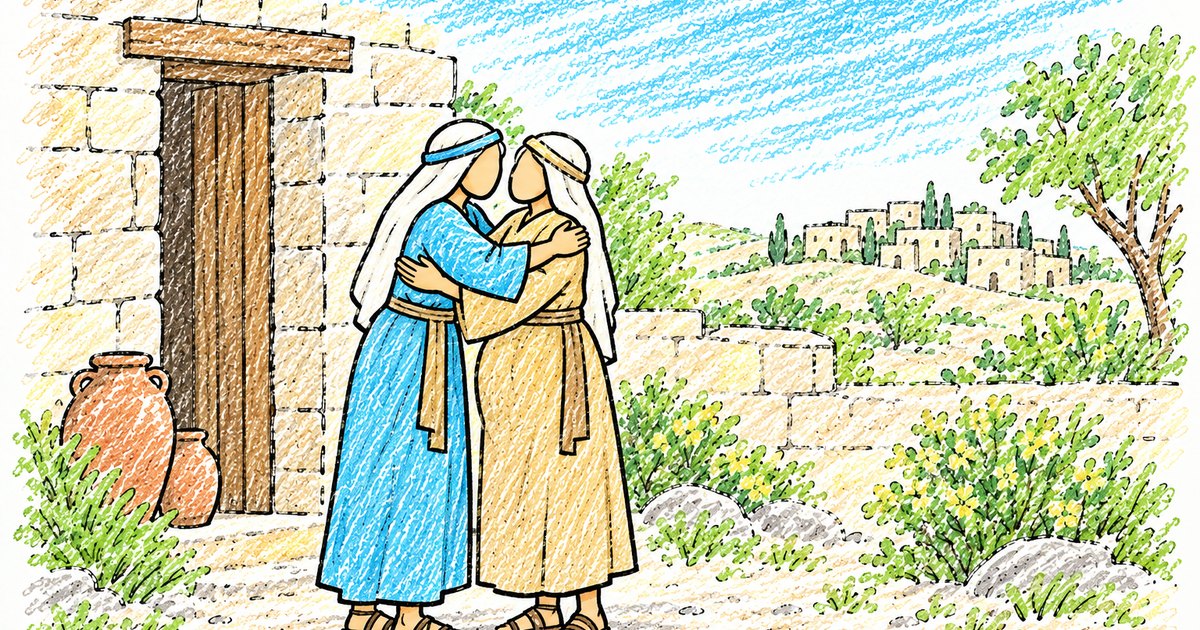
Bonnie L. Oscarson, “Sisterhood: Oh, How We Need Each Other” (2014)
Mary and Elisabeth as a model of strengthening one another across generations.6
Read the talk →Scripture Story Sketch Notes · Luke 1:39–56
“My soul doth magnify the Lord, and my spirit hath rejoiced in God my Saviour.” Luke 1:46–47
After Gabriel’s message, Mary hurried to her cousin Elisabeth. The Holy Ghost testified to Elisabeth, her unborn son leaped for joy, and Mary sang praise to God her Savior.
Before you begin
Soon after the angel Gabriel’s visit, Mary hurried south into the hill country of Judea to see her cousin Elisabeth, who was expecting a baby in her old age. When Mary called out a greeting, Elisabeth’s unborn baby leaped, and Elisabeth was filled with the Holy Ghost. She called Mary blessed and asked how “the mother of my Lord” could come to her.
Mary answered with a song of praise: “My soul doth magnify the Lord, and my spirit hath rejoiced in God my Saviour.” She sang of a God who notices the humble, lifts up the lowly, feeds the hungry and keeps His promises to Abraham’s family. Mary stayed with Elisabeth about three months, then went home.
A town in the hill country of Judea, a long journey south from Nazareth, months before Jesus was born.
Watch who Elisabeth calls “my Lord,” and who Mary calls “my Saviour.”
Read it yourself: Luke 1:39–56
Part 1 of 7
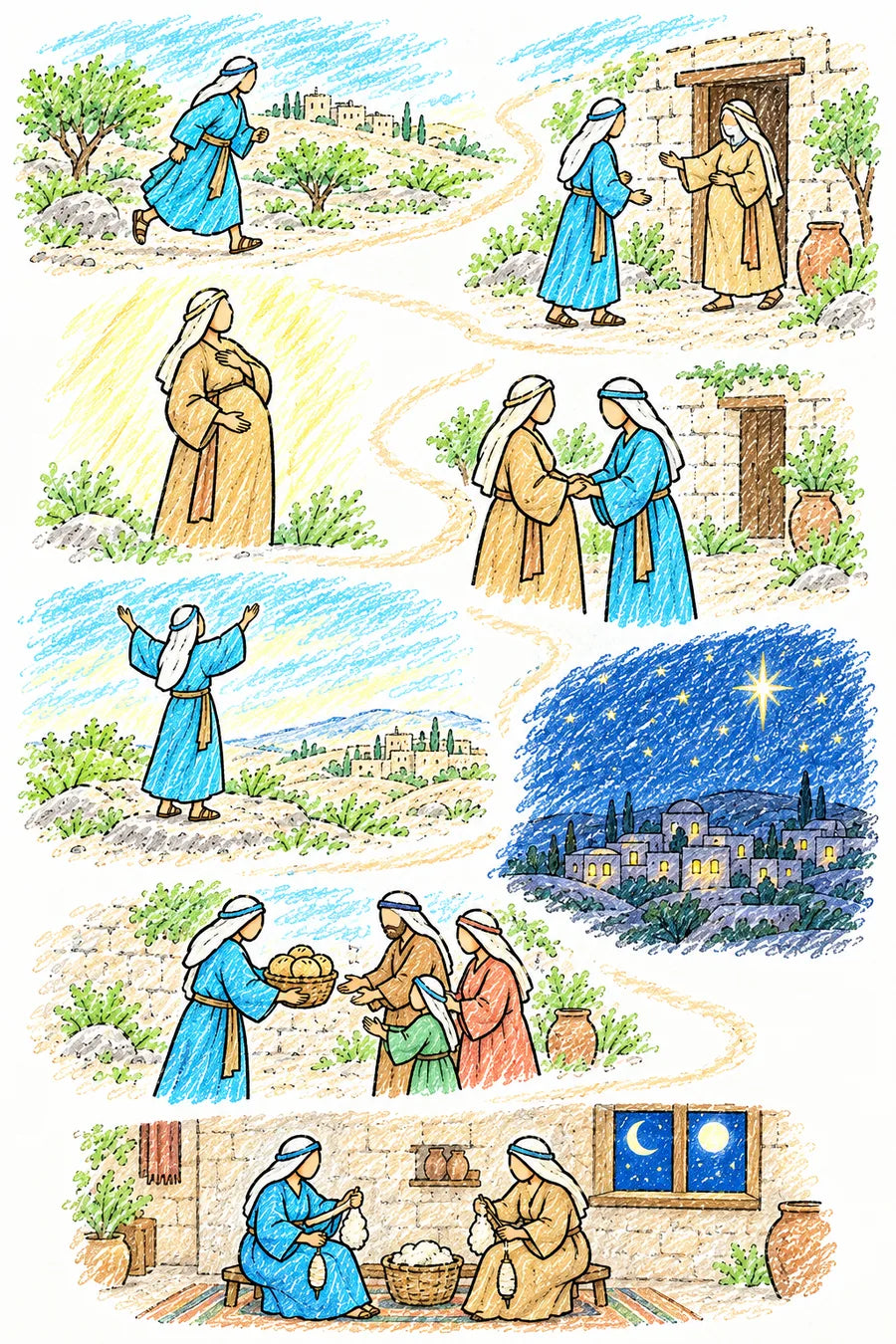
Eight stops from the road out of Nazareth to three months together. Scroll, or tap a number on the map.
Part 2 of 7
Four scenes: the road, the greeting, the song, and three months. Look for the Savior in each one.
Read it plainly
Tap any dotted word for its meaning. The scripture stays exactly as written.1
Part 3 of 7
Small details tell the story. Some cards are details in the text; others share insights from Church leaders, Church resources or outside sources. Each card says which.
All nine. The road, the door, the leap, the dove, the sun, the sandals, the arm, the bread and the tree. Luke 1:39–56
Part 4 of 7
Hurrying, feeling small, needing a friend, or full of joy. Which feels most like you right now?
A next step for you
Your choice is saved only on this device.
Try it
Mary’s song lists what God does for people. Tap a person on the left, then find what God does for them on the right.
“He that is mighty hath done to me great things.” Luke 1:49
Part 5 of 7
A little background helps Mary’s song come alive. Outside sources are labeled.
Gabriel told Mary her aged cousin was expecting a baby: “For with God nothing shall be impossible.”2
Elisabeth was living proof.
“Mary’s song closely resembles the song of Hannah,” who also “miraculously conceived” a son and gave him to the Lord.5
Mary knew her scriptures.
The song “celebrates the Lord’s mercy in once again reaching out to bless and honor His people.”5
Especially the humble.
“Because Elisabeth had faced reproach for her inability to have children, she could show empathy for Mary.”7
She understood.
Word study · Greek
megalunó μεγαλύνω · “magnify” (Luke 1:46)
Word study · Greek
skirtaó σκιρτάω · “leaped” (Luke 1:41)
What the text does not say
Mary doesn’t boast about being chosen. Her song is almost all about God: what He has done, how merciful He is, how He keeps His promises. She calls Him “God my Saviour.” Even the mother of Jesus needed Him.1
Part 6 of 7
Before He was born, He was already the center: a baby leaped, a cousin testified, a mother sang.
“It was the Lord Himself who provided Mary with someone to share her load.”
Bonnie L. Oscarson6“I can only imagine how very important the three months they spent together were to both of them.”
“She received the gift of prophecy as she bore testimony of Jesus Christ.”
“The Song of Mary associates the birth of Jesus Christ with Israel’s sacred past.”
Hannah (1 Samuel 2)
“My heart rejoiceth in the Lord … because I rejoice in thy salvation.” 1 Samuel 2:1
Alma (Book of Mormon)
Alma prophesied that the Savior “shall be born of Mary … she being a virgin, a precious and chosen vessel.” Alma 7:10
Part 7 of 7
A question to ask in prayer
Who has the Lord given me to lean on, and who needs me to be their Elisabeth? Luke 1:56
Listen for a name or a face that comes to mind. Then reach out this week.
One small way to magnify the Lord each day. It saves on this device, one day at a time.
0 of 7 today
Seven days of praise. Come again tomorrow.
A quiet moment
“My soul doth magnify the Lord.”
Read Luke 1:46–49 slowly. What would your own song of praise say? Name one great thing He has done for you. Luke 1:46–49
A verse to hold
Talk about it
For adults and deeper study
Longer readings, harder questions, and where to study next. Each one says what it is before you click.
Mary and Elisabeth as a model of strengthening one another across generations.6
Read the talk →Elisabeth’s faith, humility and gift of prophecy, and how she comforted Mary.7
Read the article →The Magnificat, Hannah’s song, and the many testimonies of Christ in Luke’s first chapters.5
Read the chapter →Read it beside Luke 1:46–55 and look for the echoes.3
1 Samuel 2 →Every quotation, gloss, and piece of background on this page is listed here: scripture first, then Church sources, then outside scholarship (labeled).
Quotations checked against the linked pages on October 11, 2026. Scripture is quoted from the King James Version as published in the Gospel Library.

He does great things through humble people. Rejoice in Him and help someone else rejoice too. Luke 1:46
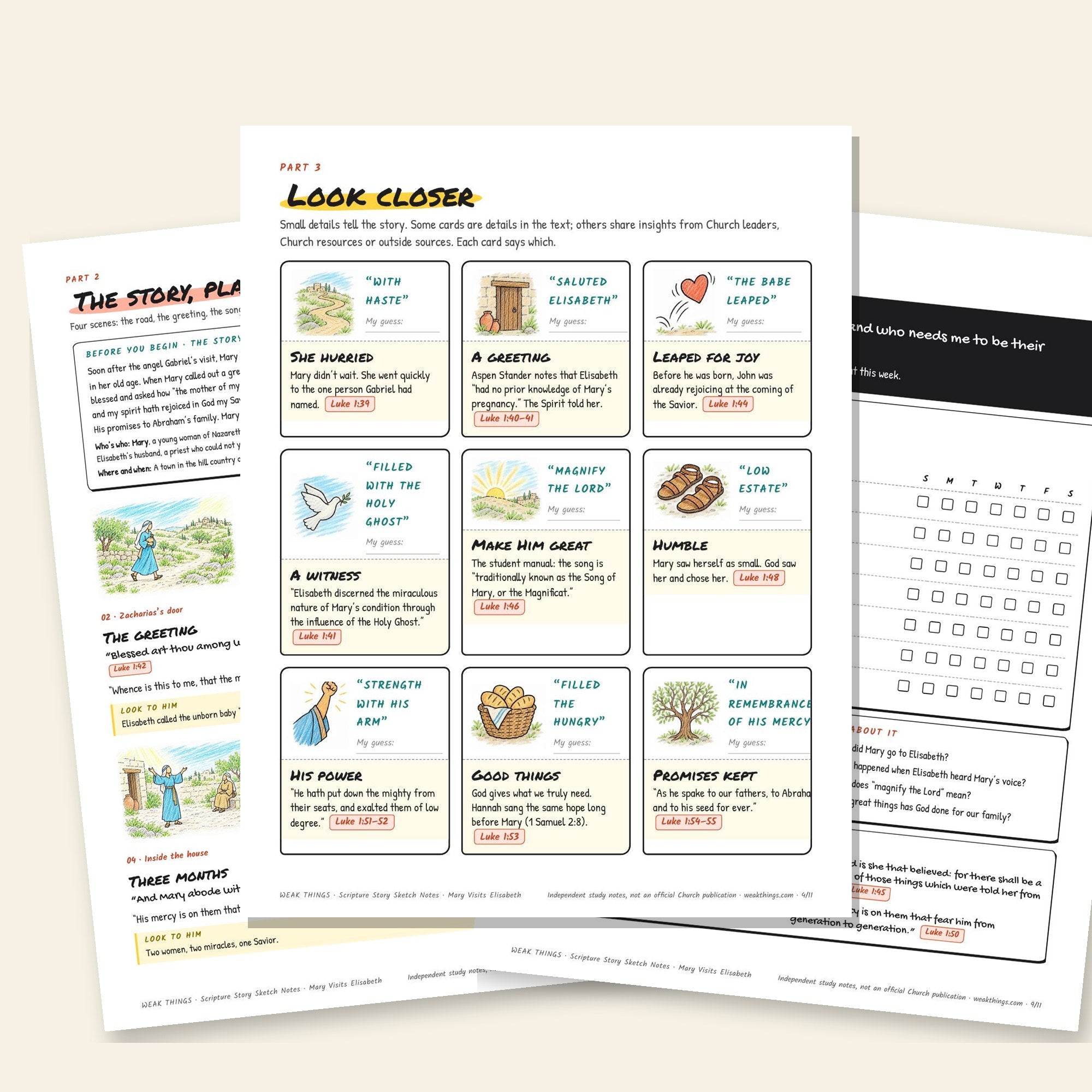
Printable sketch notes
Everything on this page as a 11-page letter-size PDF: the map, scenes, cards, activity, word studies, tracker, Go deeper and sources. For home, class or a quiet Sunday.
More stories
Mary Visits Elisabeth is part of the Scripture Story Sketch Notes for the New Testament, set alongside Come, Follow Me for December 28, 2026–January 3, 2027 (Matthew 1; Luke 1).
See every story See all 2027 weeksIndependent study notes from Weak Things, not an official publication of The Church of Jesus Christ of Latter-day Saints. Scripture quotations are from the King James Version. The words are in Luke 1:39–56; the insights in “Look closer” are labeled by source.