Doctrine and Covenants 86
The Lord’s latter-day explanation of the parable: the Apostles as sowers, the tares choking the wheat, tender blades, and gathering the wheat first.2
Read section 86 →Scripture Story Sketch Notes · Matthew 13:24–30, 36–43; Doctrine and Covenants 86
“Let both grow together until the harvest.” Matthew 13:30
Good seed, a night-time enemy, weeds that look like wheat, a patient householder and a harvest. Walk the field, see what He said it means, and find where you are.
Before you begin
Jesus told a parable about a man who planted good seed in his field. While everyone slept, an enemy came and planted tares, weeds that look like wheat while they are young. When the plants grew, the servants were surprised to see weeds and asked if they should pull them up.
The householder said no, because pulling the weeds would tear up the wheat with them. “Let both grow together until the harvest,” he said; then the wheat would be gathered into his barn. Later, Jesus explained that He is the Sower, the field is the world, the good seed are the children of the kingdom, the enemy is the devil, and the harvest is the end of the world.
A parable told beside the Sea of Galilee, then explained in a house.
He is the Sower of good seed, and His patience protects the wheat.
Read it yourself: Matthew 13:24–30
Part 1 of 7
Eight stops through the parable, from sowing to harvest. Scroll, or tap a number on the map.
Part 2 of 7
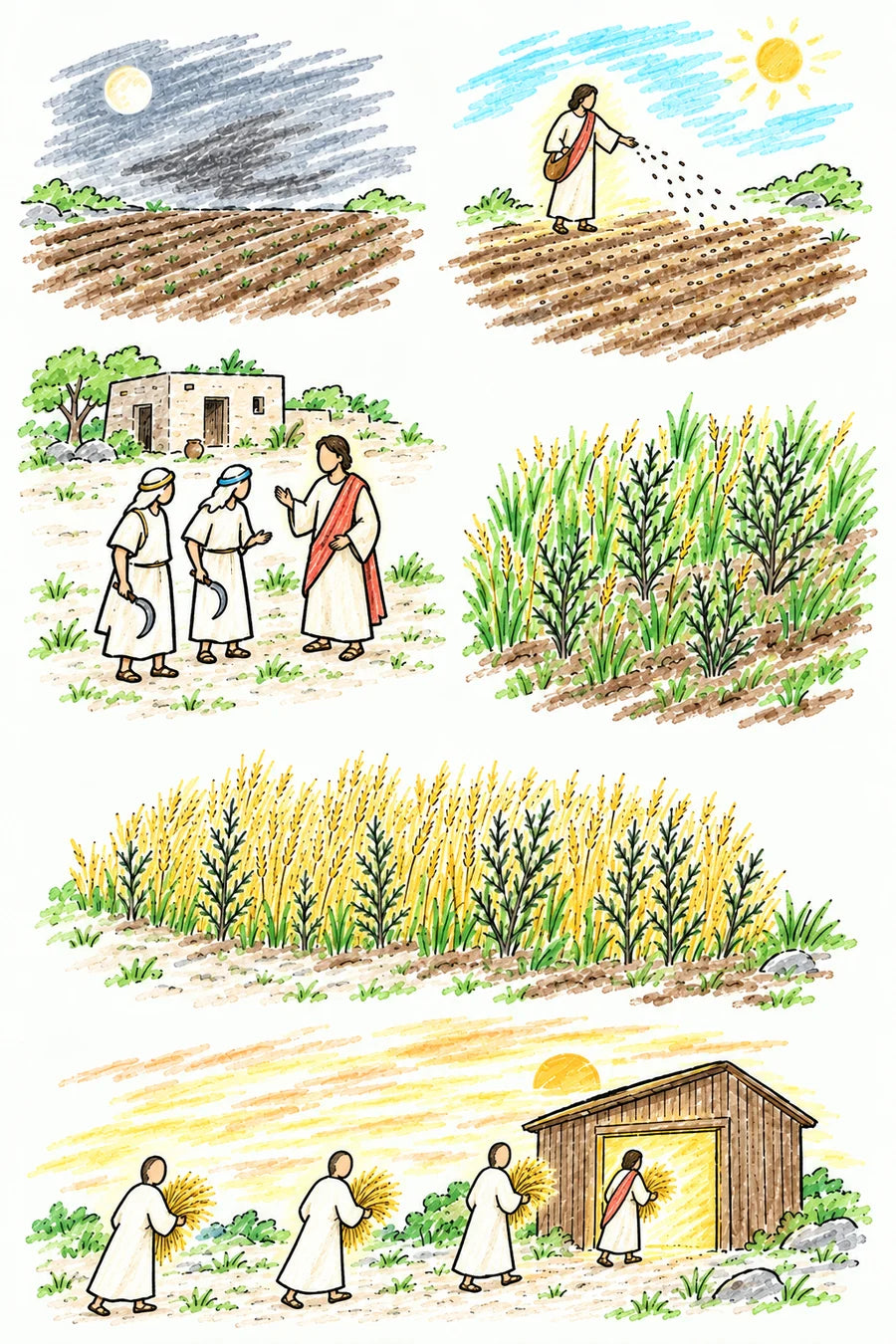
Four scenes: good seed, an enemy at night, “Let both grow together,” and the harvest. Look for the Savior in each one.
Read it plainly
Tap any dotted word for its meaning. The scripture stays exactly as written.1
Part 3 of 7
This one is a parable, and Jesus explained it Himself. Most cards give His own meaning; the rest share insights from prophets and Church resources, and each card says which.
All nine meanings. The Sower, the field, the good seed, the tares, the enemy, tangled roots, the harvest, the barn and the shining sun. Matthew 13:36–43
Part 4 of 7
People who hear this parable may be wondering why evil is here, ready to pull weeds, feeling tangled, or looking to the harvest. Which feels most like you right now?
A next step for you
Your choice is saved only on this device.
Try it
When the disciples asked, Jesus explained the parable Himself. Tap a picture on the left, then find what He said it means on the right.
“Declare unto us the parable of the tares of the field.” Matthew 13:36
Part 5 of 7
A little farming background helps the parable land. Outside sources are labeled.
Scripture Helps: “Tares are a noxious weed grass also known as bearded darnel.”4
A weed that pretends to be grain.
Scripture Helps: “once mature, wheat and tares are easy to distinguish. Thus, the only way to safely separate the wheat from the tares is to wait until harvest time.”4
Patience is the wise choice.
The Prophet Joseph Smith said of this parable: “the Church is in its infancy, and if you take this rash step, you will destroy the wheat, or the Church, with the tares.”4
He protects the young and tender.
In Doctrine and Covenants 86 the Lord says, “pluck not up the tares while the blade is yet tender (for verily your faith is weak), lest you destroy the wheat also,” and then “ye shall first gather out the wheat from among the tares.”2
His first care is the wheat.
Word study · Greek
zizanion ζιζάνιον · “tares” (Matthew 13:25)
What the text does not say
The parable doesn’t teach that evil doesn’t matter or that sin is fine. The Savior said the reapers “shall gather out of his kingdom all things that offend, and them which do iniquity.”1 It teaches that the judging and the timing are His, and that He protects the wheat.
Part 6 of 7
He is the Sower of every good seed, and He is patient enough to protect every stalk of wheat.
“He that soweth the good seed is the Son of man.”
Jesus Christ, Matthew 13:371“By the Author’s explication, the sower was Himself, the Son of Man.”
“Inspired by zeal for their Master’s profit, the servants would have forcibly rooted up the tares, but were restrained.”
“But He, knowing all things, says, Not so.”
Doctrine and Covenants
“Therefore, let the wheat and the tares grow together until the harvest is fully ripe.” Doctrine and Covenants 86:7
Doctrine and Covenants
“The angels are crying unto the Lord day and night, who are ready and waiting to be sent forth to reap down the fields.” Doctrine and Covenants 86:5
Part 7 of 7
The Savior’s words
“Let both grow together until the harvest.” Matthew 13:30
The Prophet Joseph Smith: “But He, knowing all things, says, Not so.”4 Where can you trust His timing instead of your own this week?
One step of growing a day. It saves on this device, one day at a time.
0 of 7 today
Seven days of growing toward Him. Come again tomorrow.
A quiet moment
“Then shall the righteous shine forth as the sun in the kingdom of their Father.”
Read Matthew 13:24–30 slowly, then His explanation in verses 36–43. Ask Heavenly Father what good seed He wants you to help grow, and listen. Matthew 13:36–43
A verse to hold
Talk about it
For adults and deeper study
Longer readings, harder questions, and where to study next. Each one says what it is before you click.
The Lord’s latter-day explanation of the parable: the Apostles as sowers, the tares choking the wheat, tender blades, and gathering the wheat first.2
Read section 86 →The wheat and the tares alongside the other parables by the sea, with the Savior’s own explanation and why the servants were restrained.3
Read chapter 19 →What tares are, why separation waits until harvest, and the Prophet Joseph Smith’s teachings on the parables of Matthew 13 and the gathering.4
Read Scripture Helps →The parable just before this one, about the soil of our hearts. Read them together.1
Read Matthew 13 → The Sower and the Four Soils →Every quotation, gloss, and piece of background on this page is listed here: scripture first, then Church sources, then outside scholarship (labeled).
Quotations checked against the linked pages on October 7, 2026. Scripture is quoted from the King James Version as published in the Gospel Library.

He is the Sower of every good seed, and He is patient enough to protect every stalk of wheat. He will gather His wheat home. Matthew 13:43

Printable sketch notes
Everything on this page as a 11-page letter-size PDF: the map, scenes, cards, activity, word studies, tracker, Go deeper and sources. For home, class or a quiet Sunday.
More stories
The Wheat and the Tares is part of the Scripture Story Sketch Notes for the New Testament, set alongside Come, Follow Me for March 15–21, 2027 (Matthew 13; Luke 8; 13).
See every story See all 2027 weeksIndependent study notes from Weak Things, not an official publication of The Church of Jesus Christ of Latter-day Saints. Scripture quotations are from the King James Version. This is a parable; the meanings in “What it means” come from the Savior’s own explanation and are labeled by source.