For missionaries and the families who send them

Mission
Fit.

You'll walk miles every day on your mission. That isn't the same as training. The Church sets aside 30 minutes every morning for exercise, and there's a good reason for it: a stronger body helps a missionary think clearly, handle stress, sleep well and keep serving.

“See that ye serve him with all your heart, might, mind and strength.”
Doctrine and Covenants 4:2

01 · The Missionary Standard

It's built into the schedule.

Exercise isn't something missionaries do if they find time. It's written into the sample daily schedule, right after morning prayer.

Sample daily schedule · 6:30–10:00 a.m. Missionary Standards 2.4.2
  1. 01Pray.
  2. 02Exercise (30 minutes).
  3. 03Shower, eat breakfast, and prepare for the day.
  4. 04Have personal study (60 minutes).
  5. 05Plan (30 minutes).

From Missionary Standards for Disciples of Jesus Christ, 2.4.2

4.2 · Exercise

“Exercise keeps you healthy and helps relieve stress. Make it a part of your daily routine.”

The standard asks for variety through the week: cardio, strength and flexibility. For safety, missionaries avoid heavy weights and don't use public or commercial gyms.

Missionary Standards 4.2
4.3 · Stress Management

“Missionary work is demanding, and feeling stress from time to time is normal.”

“Exercising regularly” is listed with sleep, healthy eating, family support, relaxing and spiritual strength as a way to prepare your body and mind to handle stress.

Missionary Standards 4.3

Adjusting to Missionary Life

“Regardless of the activity you choose, exercise can help increase your stamina and capacity to serve the Lord.”

The resource booklet calls regular exercise “one effective way to manage stress” and says it can leave you “energized and better able to forget the worries of the day.”

General Principles for Managing Stress

The Church even gives you the workouts.

Missionary Wellness has four workout tracks: Fitness, Running, Strength and Yoga. They're laid out week by week. Fitness workouts use timed circuits (30–40 seconds per exercise, 10 seconds rest), and Strength builds from 2–3 sets up to 4.

02 · “But I walk all day”

Walking keeps you moving. Training builds your capacity.

Tracting, biking and walking to appointments add up, and they count. But they're mostly steady, low-to-moderate effort in dress shoes with a bag on your shoulder. They don't push your heart rate into a training zone, load your legs through a full range of motion, or keep you flexible. That's why the standard asks for cardio, strength and flexibility on top of the day's work.

The 30 minutes also do something the rest of the day can't. You pick the effort, it happens before the first door knock, and it's the same every day no matter which area, companion or climate you're in.

03 · The Numbers

What the research says.

150+ min

of moderate activity each week is the WHO minimum for adults. Six mornings of 30 minutes gives you 180.

20–30%

higher risk of death for people who are not active enough, compared with those who are, per the World Health Organization.

128,119

people across 1,039 trials in a 2023 British Journal of Sports Medicine review. Physical activity gave medium reductions in depression, anxiety and distress.

14,170

participants in a 2024 BMJ network meta-analysis. Walking or jogging showed a moderate drop in depression (g = −0.62), and so did strength training and yoga.

2.2 pts

better sleep-quality score (Pittsburgh Sleep Quality Index) with regular exercise, pooled across 14 trials in a meta-analysis of sleep and exercise.

31%

of adults worldwide, about 1.8 billion people, don't get enough physical activity, according to the WHO. Missionaries can be the exception.

04 · The Body

Physiology: what 30 minutes changes.

  • A stronger heart and lungs. Regular aerobic work raises the amount of oxygen your body can use (VO₂), so a long day on hills or stairs takes less out of you.
  • Legs and back that hold up. Strength work protects knees, hips and lower back from the wear of thousands of daily steps, a heavy bag and a bike seat.
  • Steadier energy. Muscle that's used every day handles blood sugar better. That matters when meals come from members at unpredictable times.
  • Better sleep. Exercise improves sleep quality, which counts for more when your bedtime and wake time are already set.
  • Resilience overall. The WHO links regular activity to better heart, metabolic and bone health, and to better thinking and mental health.

05 · The Mind

Mood: why you feel better after.

  • Stress gets somewhere to go. Exercise works your body's stress response in a controlled way. Over time, you recover faster when stress shows up on its own.
  • Brain fuel. Exercise raises brain-derived neurotrophic factor (BDNF), a protein tied to learning and memory, per a meta-analytic review. That's useful for language study and memorizing scripture.
  • A real mood effect. In a large BMJ analysis, walking or jogging reduced depression about as much as cognitive behavioural therapy. It works alongside counseling and medication, not instead of them.
  • A win before breakfast. Starting each day with one completed, hard thing builds the confidence and discipline the rest of the day needs.

If you or your companion are struggling, exercise is one tool, not the whole answer. Talk to your mission leaders and follow Missionary Standards 4.3–4.4.

06 · The Doctrinal Foundation

Caring for your body is part of discipleship.

In the restored gospel, the body isn't a burden to put up with. It's a gift from God and part of His plan for us, and how we care for it is one way we show gratitude and consecration. You don't stop caring for it after the mission, either.

A temple

“Know ye not that your body is the temple of the Holy Ghost which is in you … therefore glorify God in your body.”
1 Corinthians 6:19–20

Run and not be weary

“[They] shall receive health in their navel and marrow to their bones … and shall run and not be weary, and shall walk and not faint.”
Doctrine and Covenants 89:18–20

The Savior's pattern

“And Jesus increased in wisdom and stature, and in favour with God and man.”
Luke 2:52

Wisdom and order

“See that all these things are done in wisdom and order; for it is not requisite that a man should run faster than he has strength.”
Mosiah 4:27

Invigorated

“Retire to thy bed early, that ye may not be weary; arise early, that your bodies and your minds may be invigorated.”
Doctrine and Covenants 88:124

“I give unto men weakness that they may be humble … then will I make weak things become strong unto them.”

Ether 12:27. Every morning workout is a small version of this promise. You show up tired and weak, you do the work, and over time the Lord makes you stronger. This page, and the WEAK THINGS brand, is built on that idea.

07 · My Favorite 30 Minutes

Step up. Step down. Repeat.

I'll be honest: my favorite workout is just plugging through a good 30-minute grind of step-ups. I don't have to put any thought into it. I just step up and down, my heart rate climbs, and it keeps me in shape. I put on a talk or some music, and by the end I've had a hard workout and some spiritual nourishment in the same half hour.

— Mike, WEAK THINGS

750 step-ups
×
16 inches
≈
1,000 feet climbed

750 step-ups take me about 37 minutes, roughly 20 a minute (80 steps a minute: up-up-down-down) on a 16-inch box. That's like walking up a 90-story building before breakfast.

Why step-ups work so well

Top glute activation

A systematic review of gluteus maximus activation ranked step-up variations in the “very high” category, above squats, deadlifts and hip thrusts. Your glutes are the biggest muscles you have, and they're what power walking and climbing.

Real cardio intensity

A study of stepping at different heights and cadences found intensity climbs with each notch: about +1 MET for every 6 cm of height and +0.6 MET for every 10 steps per minute. It recommended stepping at about 8.8 METs, roughly like stair climbing.

One leg at a time

Each rep puts your full body weight on one leg. That builds strength on each side, balance and knee and ankle control, the same things you use on stairs, curbs and hills all day.

Low impact, no jumping

You step instead of landing, so your joints stay fresh for a full day on your feet. That fits the standard's call to avoid heavy weights and train safely.

Easy to scale

Go faster, add a knee drive, carry a loaded backpack or add time. You can make it harder without new equipment, or ease off on a tired day.

Mind free to listen

The rhythm is simple enough that you don't have to think about it. That makes it a good time for a conference talk, a scripture recording or language audio.

08 · The Travel Step-Up Box

You can't move a plyo box from area to area. So I designed one you can.

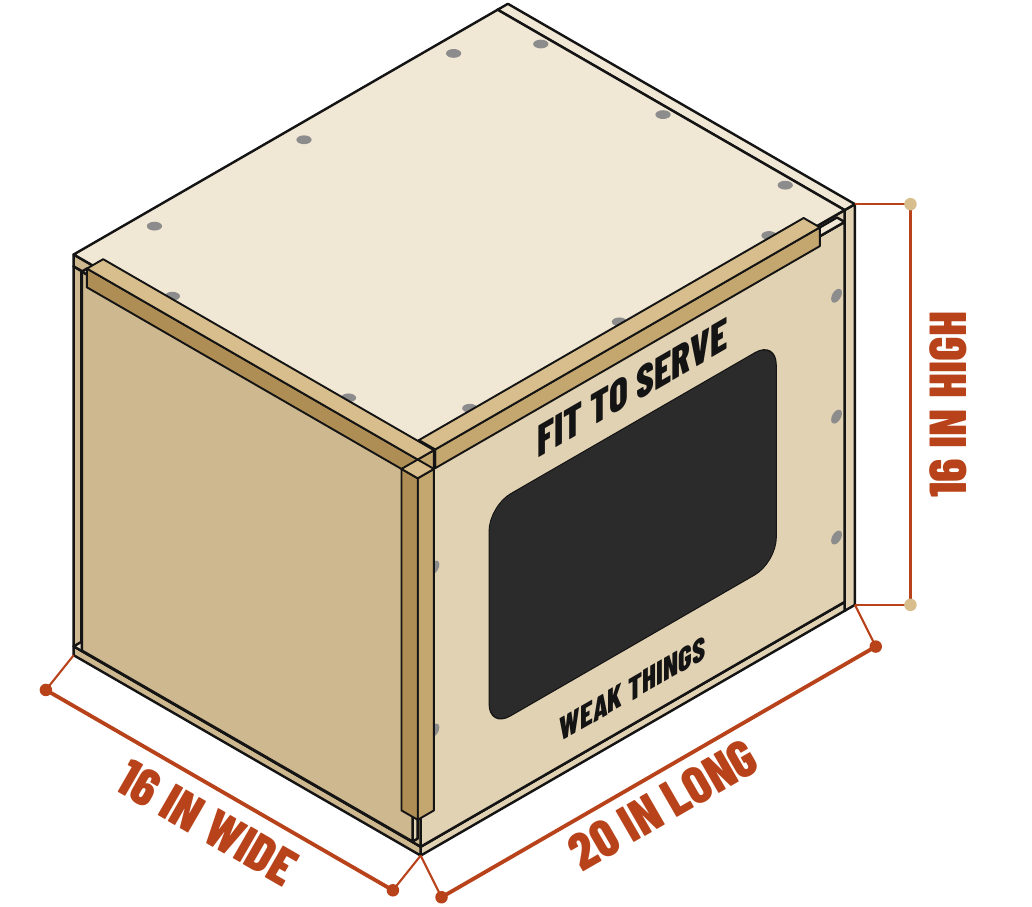
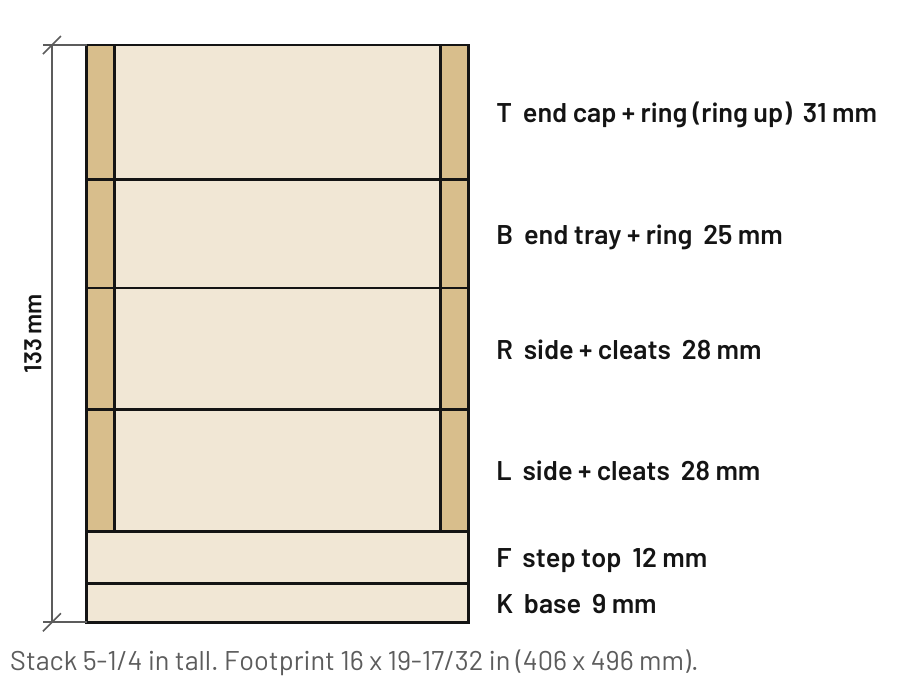
A regular plyo box is bulky and doesn't come apart. So I designed a plywood step-up box that breaks down flat, fits in a large checked suitcase and bolts back together in your new area with one small tool. You can build it before you leave, or a family member can build it and ship it to you in the mission field.

  • 16 instep height · 20 in long · 16 in wide
  • ~15 lblightweight Baltic birch build
  • 5-1/4 inflat-pack stack for a checked bag
  • 1 toola 5/32 in hex key
  • 32 boltssteel bolts into steel tee nuts, so the threads don't wear out
  • ~10 minto put it together or take it apart

The 11-page plan includes drawings, exact hole positions, a cut list, a shopping list, 12 build steps, a packing guide and two 30-minute routines. Check with your mission leaders and housing coordinator before bringing or shipping equipment, and check your airline's weight limits. It's rated for step-ups and bodyweight training only: no jumping.

Drawing of the assembled travel step-up box, 16 inches high, 20 inches long and 16 inches wide
Side view of the six panels stacked flat for packing, 5-1/4 inches tall
Six panels stack flat to 5-1/4 in.

09 · Questions

Before you pack it.

Is a step box allowed on a mission?

The standards ask missionaries to exercise daily, mix cardio, strength and flexibility, avoid heavy weights and stay out of public gyms. A bodyweight step-up box fits those guidelines. Every mission has its own rules, though, so ask your mission leaders first. Missionary Standards 4.2 tells missionaries to contact the mission office with questions.

Can my family build it and ship it to me?

Yes. The plan is written so anyone with basic tools can build it. It ships flat, and the missionary only needs the hex key to put it together.

What if I lose a bolt?

The plan uses a common hardware-store size (1/4"-20 × 1-1/4" flat head socket cap screws) and recommends carrying 4 spares. Outside the US, a metric M6 screw will not fit these tee nuts, so pack the spares.

What do I do in 30 minutes?

The plan includes two routines. One is a 20-minute circuit. The other is a 30-minute steady climb: step up and down at a pace you can hold while listening to a talk or some music.

WEAK THINGS is an independent brand and is not affiliated with or endorsed by The Church of Jesus Christ of Latter-day Saints. Quotations link to their official sources. This page is general information, not medical advice. Talk to a doctor before starting a new exercise program.